

Scientists are designing simplified biological systems, aiming to construct synthetic cells and better understand life’s mechanisms.
One of the most fundamental questions in science is how lifeless molecules can come together to form a living cell. Bert Poolman, Professor of Biochemistry at the University of Groningen, has been working to solve this problem for two decades. He aims to understand life by trying to reconstruct it; he is building simplified artificial versions of biological systems that can be used as components for a synthetic cell.

His work was detailed in two new papers published in Nature Nanotechnology and Nature Communications. In the first paper, he describes a system for energy conversion and cross-feeding of products of this reaction between synthetic cells, while he describes a system for concentrating and converting nutrients in cells in the second paper.
Synthetic Cells and Energy Conversion
Six Dutch research institutes are collaborating in the consortium BaSyc (Building a Synthetic Cell) to build the elements needed for a synthetic cell. Poolman’s group has been working on energy conversion. The real-life equivalents he aims to replicate are mitochondria, the “energy factories” of the cell. These use the molecule ADP to produce ATP, which is the standard “fuel” that cells require to function. When ATP is converted back into ADP, the energy is released and used to drive other processes.
University of Groningen, Poolman lab
Artificial Energy Factories
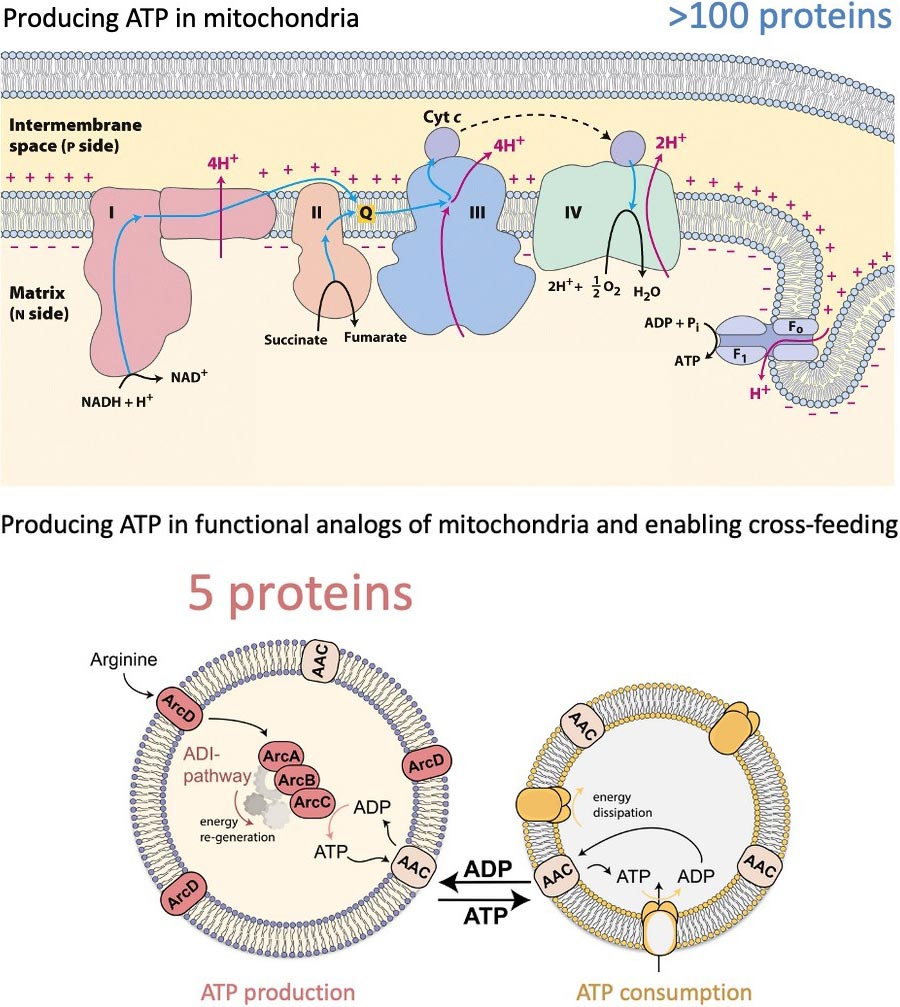
“Instead of the hundreds of components of mitochondria, our system for energy conversion uses just five,” says Poolman. “We set out to simplify it as much as possible.” This may sound odd, as evolution has done a great job of producing functional systems. “However, evolution is a one-way street, it builds on existing components and this often makes the outcome very complex,” explains Poolman. An artificial replica, on the other hand, can be designed with a specific outcome in mind.
The five components were placed inside vesicles, tiny cell-like sacs, that can absorb ADP as well as the amino acid arginine from the surrounding fluid. The arginine is “burned” (deaminated) and thus provides the energy to produce ATP, which is secreted from the vesicle. “Of course, the simplification comes at a price: we can only use arginine as the energy source, while cells use all kinds of different molecules, such as amino acids, fats, and sugars.”
Next, the Poolman group designed a second vesicle that can absorb the secreted ATP and use it to drive an energy-consuming reaction. The energy is provided by turning ATP back into ADP, which is then secreted and can be absorbed by the first vesicle, closing the loop.
Such a cycle of ATP production and use is the foundation of metabolism in every living cell and drives the “machinery” for energy-consuming reactions such as growth, cell division, protein synthesis, DNA replication, and more.
An Artificial Pumping System
The second module that Poolman created was a bit different: a vesicle in which a chemical process causes the interior to build up a negative charge and, in doing so, form an electrical potential, similar to that of an electronic circuit. The electrical potential is used to couple charge movement to the accumulation of nutrients inside the vesicle, which is carried out by transporters.
These proteins in the membrane of the vesicle work a bit like a water wheel: positively charged protons “flow” through it from outside the vesicle to the negatively charged interior. This flow drives the transporter, which in this case imports a sugar molecule, lactose. Again, this is a very common process in living cells, requiring many components that Poolman and his team mimicked with just two components.

When he submitted a paper describing this system, a reviewer asked if he couldn’t do something with the lactose that is being transported, as cells use nutrients like this to produce useful building blocks. Poolman took up the challenge and added three more enzymes to the system, which oxidized the sugar and enabled the production of the coenzyme NADH. “This helper molecule plays an essential role in the proper functioning of all cells,” explains Poolman. “And by adding NADH production, we have shown that it is feasible to expand the system.”
Towards a Fully Functional Synthetic Cell
Having a simplified synthetic equivalent of two key features of life is fascinating, but many more steps need to be integrated to form an autonomously growing and dividing synthetic cell. “The next step we want to take is adding our metabolic energy producing systems to a synthetic cell division system created by colleagues,” says Poolman.
The BaSyc program is entering its final years; funding for a new program has recently been secured. A large consortium of Dutch groups, in which Poolman is one of the leading scientists, received 40 million euros to create life from non-living modules. This EVOLF project is set to run for another ten years and aims to find out how many more lifeless modules can come together and create living cells. “Ultimately, this would give us a blueprint for life, something that is currently lacking in biology,” concludes Poolman. “This may eventually have all kinds of applications, but will also help us to better understand what life is.”
References:
“Chemiosmotic nutrient transport in synthetic cells powered by electrogenic antiport coupled to decarboxylation” by Miyer F. Patiño-Ruiz, Zaid Ramdhan Anshari, Bauke Gaastra, Dirk J. Slotboom and Bert Poolman, 12 September 2024, Nature Communications.
DOI: 10.1038/s41467-024-52085-z
“Synthetic syntrophy for adenine nucleotide cross-feeding between metabolically active nanoreactors” by Laura Heinen, Marco van den Noort, Martin S. King, Edmund R. S. Kunji and Bert Poolman, 21 October 2024, Nature Nanotechnology.
DOI: 10.1038/s41565-024-01811-1
Never miss a breakthrough: Join the SciTechDaily newsletter.
Follow us on Google and Google News.
3 Comments
NOTE 2411070135, Source 1. Analysis 1._[n]
1.
Can Life Be Manipulated? Biochemists take key steps toward synthetic life. The simplified synthetic equivalent of a cell would be like a blueprint for life. Scientists are designing simplified biological systems to construct synthetic cells and better understand the mechanisms of life.
One of the most fundamental questions in science is how inanimate molecules can come together to form living cells.
We describe the energy conversion and cross-feeding system of this reaction product between the first synthetic cells, whereas we describe a system for enriching and converting nutrients in cells.
Building the elements needed for synthetic cells. Poolman’s group has been working on energy conversion. The actual equivalent he intends to clone is the mitochondria, the cell’s “energy factory.” They use the molecular ADP to produce ATP, the standard “fuel” for cells to function. When ATP is converted back to ADP, energy is released and used to drive other processes.
2.
It shows that mitochondria produce ATP. This requires more than 100 proteins, and synthetic vesicles produce ATP with only 5 proteins.
[2]When ATP is converted back to ADP, energy is released and used to drive other processes.
_In [2]Example 1.oms4, 1 is distributed. 1 is the same as ATP of 4-point X.dd, y.uuu in a circular shape composed of 4 quarks. When these quarks are converted to triangles, they can be converted into atomic-grade ADP in a combination mode that becomes protons or neutrons. Uh-huh.
View 1.
1000
0010
0100
0010
3.
It shows that mitochondria produce ATP. This requires more than 100 proteins, and synthetic vesicles produce ATP with only 5 proteins.
an artificial energy plant
Instead of hundreds of components of mitochondria, our energy conversion system uses only five. Let’s try to simplify it as artificially as possible.
It may sound strange because evolution has played a large role in creating functional systems. However, since evolution is a one-way street and based on existing components, the results are often very complicated.[3]Artificial replicas, on the other hand, can be designed with specific outcomes in mind.
_[3]It is difficult for msbase with piles of numbers to become natural. What is more difficult is that they implement omsfull with chiral line symmetry. They were almost possible only after artificially crossing step 2. View 2.ms.vix.ain is the main character.
sample 1.vix.a’6//vixx.a(b1,g3,k3,o5,n6)
b0acfd|0000e0
000ac0|f00bde
0c0fab|000e0d
e00d0c|0b0fa0
f000e0|b0dac0
d0f000|cae0b0
0b000f|0ead0c
0deb00|ac000f
ced0ba|00f000
a0b00e|0dc0f0
0ace00|df000b
0f00d0|e0bc0a
ㅡㅡㅡㅡㅡㅡㅡㅡㅡㅡㅡㅡㅡㅡ
Source 1.
https://scitechdaily.com/can-life-be-engineered-biochemists-take-key-steps-toward-synthetic-lifeforms/
Can Life Be Manipulated? Biochemists Take Key Steps Toward Synthetic Life
Another creation denier embraces the arrogance of the creation of life. Create a molecule, any from nothing! Be sure not to use what has already been created.
Artificial cells will never work until the systems account for protein degradation. In living systems all membrane proteins degrade in days (especially electron transfer proteins like PSI and PSII) and in live systems the unfolded and damaged proteins are constantly replaced with new ones. Not to mention the hydrolysis and oxidation of the lipids themselves. The papers are cool though! BTW, they did similar work to this in the 70s with bacteriorhodopsin and ATPase in proteoliposomes.