

A study from the University of Oregon found that immersing in hot water can help lower blood pressure and strengthen the immune system.
Hot tubs and saunas are both known for easing sore muscles and providing comforting warmth, but new research suggests that hot tubs may deliver even greater health rewards.
According to a recent study from scientists at the Bowerman Sports Science Center at the University of Oregon, soaking in a hot tub may have stronger physiological effects than sitting in either a traditional dry sauna or a newer far-infrared sauna.
The researchers found that immersing the body in hot water raises core temperature more effectively, which can help lower blood pressure, boost immune activity, and enhance how the body adapts to heat stress over time. These positive effects may also continue well after the heat session ends.
“We compared the most commonly utilized modalities of passive heating as they’re used in everyday life and studied in scientific research,” said study lead author Jessica Atencio, a doctoral student in the lab of Christopher Minson. “No studies have compared the acute responses between the three.”
The results were published in the American Journal of Physiology.
Measuring the Effects
Led by Christopher Minson, the Kenneth M. and Kenda H. Singer Endowed Professor of Human Physiology and director of the Bowerman Center, the research team measured several key health indicators, including body temperature, blood pressure, heart rate, cardiac output (the amount of blood the heart pumps per minute), and immune cell activity along with blood markers linked to inflammation. Measurements were taken before, during, and after participants experienced each heating method: soaking in a hot tub, sitting in a traditional dry sauna, and using a far-infrared sauna.
The study involved 20 participants, 10 men and 10 women, between the ages of 20 and 28 who regularly engaged in physical activity. This group was selected to help the researchers clearly observe how each heat exposure affected the body in a young, healthy population.
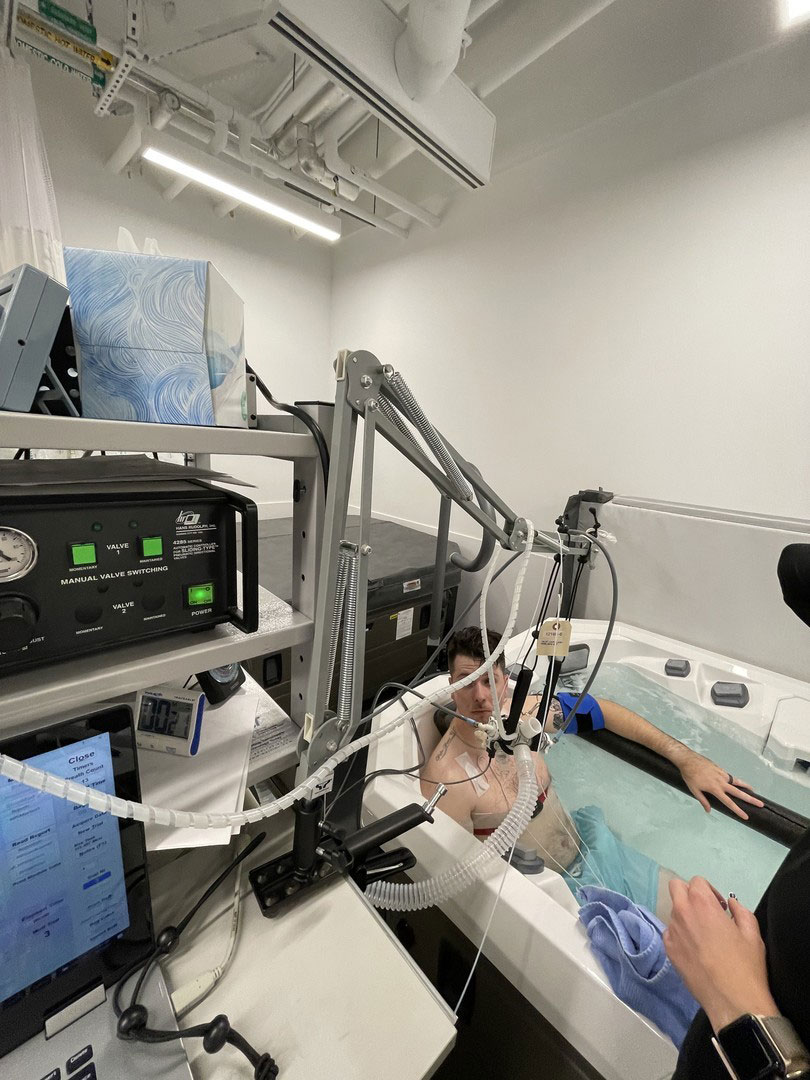
“We saw that hot water immersion was the most impactful in increasing core body temperature, which is the main stimulus for these subsequent responses,” Atencio said. “Increasing body temperature causes an increase in blood flow, and just the force of blood moving across your vessels is beneficial for your vascular health.”
While the research team took blood samples from subjects after each kind of heat therapy, only hot-water immersion produced an inflammatory response as measured by the levels of inflammatory cytokines, a kind of immune signaling molecule, and immune cell populations.
Why Hot Water Works Better
Atencio and her team were not surprised by those results.
“Hot water immersion gives you the most robust changes in core temperature because you can’t effectively dissipate heat as you can if you have contact with the air and you’re sweating to cool the body,” she said. “When you’re submerged in water, the sweat mechanisms aren’t efficient.”
Minson has studied heat therapies for more than two decades. He has focused on how heat interacts with factors such as age, exercise and illness in men and women.
“There’s no doubt in my mind that if people are willing to do some heat therapy, it’s going to align with improved health, as long as it’s done in moderation,” Minson said. “If you repeat these stresses over time, our lab and many others have shown that they are consistent with improved health.”
Regular exercise can provide benefits similar to and even better in some respects than those from heat therapy, he added, but individuals who are unable or unwilling to exercise may find that heat therapy provides an attractive option.
“It can be a very peaceful, sometimes religious, sometimes cultural, and sometimes social experience,” Minson said. “And I think those aspects contribute to the health benefits and are critically important.”
“We want people to be smart and safe about it,” he added. “We need to make sure that they are cleared by their physicians or others for heat therapy or for exercise, whether it’s mild to moderate walking or jogging, or strength training. Then they’ll be fine to do heat therapy.”
As a runner herself, Atencio knows people who like to combine heat therapy with exercise.
“We always say that exercise is the primary nonpharmacological treatment that people should be doing to promote health, but some people can’t or just won’t exercise,” she said. “Heat therapy is good supplementation.”
Reference: “Comparison of thermoregulatory, cardiovascular, and immune responses to different passive heat therapy modalities” by Jessica K. Atencio, Emma L. Reed, Karen Wiedenfeld Needham, Kathryn M. Lucernoni, Lindan N. Comrada, John R. Halliwill and Christopher T. Minson, 2025, American Journal of Physiology-Regulatory, Integrative and Comparative Physiology.
DOI: 10.1152/ajpregu.00012.2025
Never miss a breakthrough: Join the SciTechDaily newsletter.
Follow us on Google and Google News.