
According to Recent Research, Wild Fish Cannibalism Is Uncommon
Even though mosquitofish and guppies are known to be cannibalistic in captivity, it is very improbable that they would engage in cannibalism in the wild. Instead, the few instances of cannibalism in these fish are probably the result of an intense struggle for food. The results of a recent study led by researchers from the United States and the United Kingdom could not only have implications for fish lovers and researchers who use mosquitofish as models for ecological and evolutionary studies, but they may also shed light on the reasons behind and frequency of cannibalism in other animals.
Cannibalism, or preying on and devouring members of your own species, is an odd practice that often appears in human mythology and literature. But how often is it in nature, and why would animals take such drastic measures to get a meal?
In order to find out, Rüdiger Riesch, senior lecturer in evolutionary biology at the Royal Holloway University of London, and Brian Langerhans, associate professor of biology at North Carolina State University, decided to analyze data collected over a 10-year period from nearly 12,000 fish belonging to 17 different species that were caught in the wild.
“These are data accumulated from several different projects over the years,” says Langerhans, the study’s senior author. “To identify the mechanisms responsible for this sort of phenomenon in the wild, we needed really large sample sizes. So, we accumulated the data for this work while also doing other projects.”
“In captivity, mosquitofish and guppies will practice cannibalism commonly enough that there are protocols in place in research labs and aquaculture to quickly separate offspring from the larger fish,” says Riesch, the corresponding author of the work. Riesch began the project while a postdoctoral researcher in Langerhans’ lab between 2010 and 2012.
“But when you look at the diets of fish in the wild, you really don’t find much evidence of it,” Riesch says. “We wanted to find out whether and why cannibalism occurs in nature.”
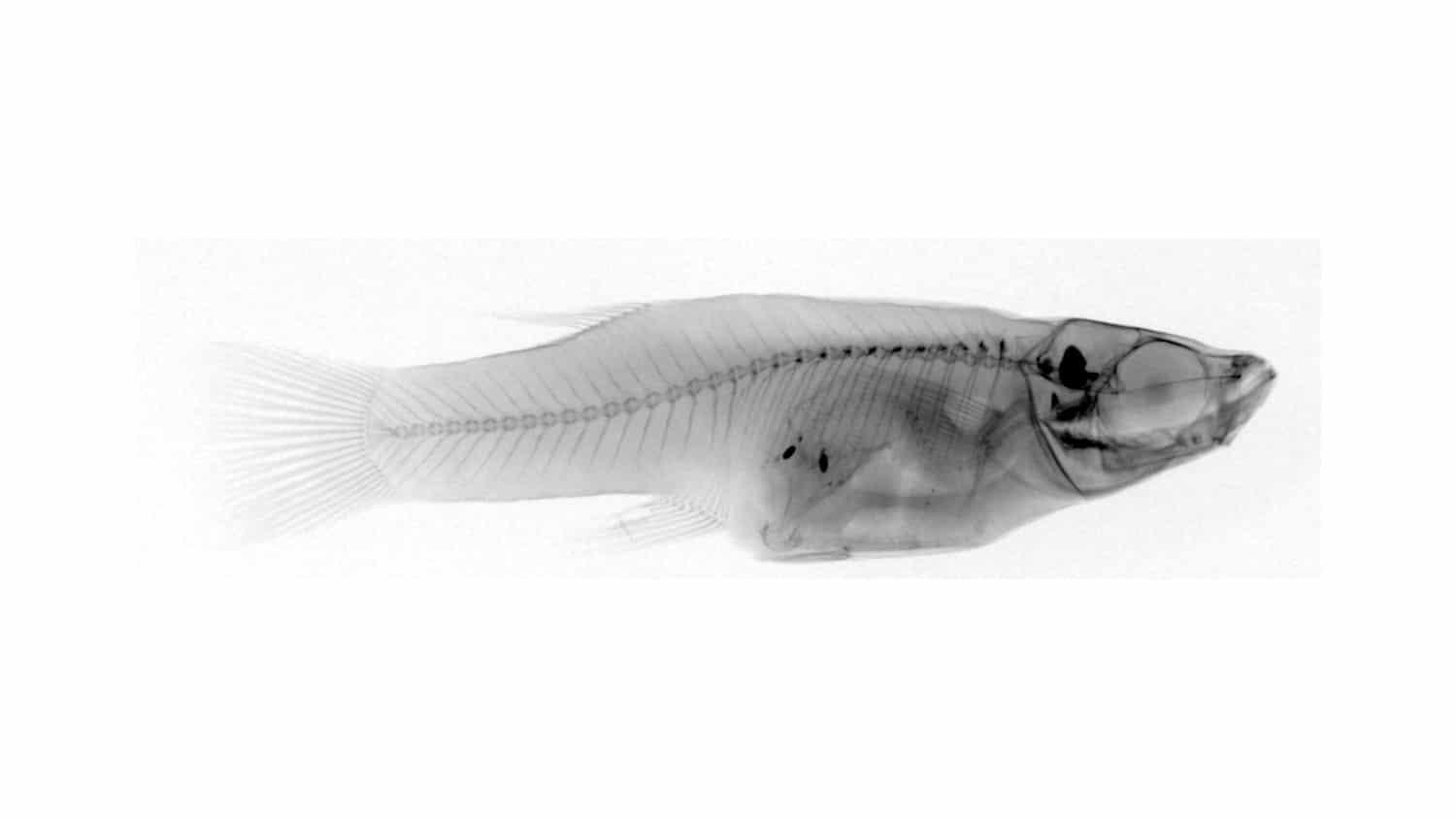
The research team examined the diets of 11,946 fish in the wild, using dissection or X-rays to determine what the fish had eaten. They found only 35 cases of cannibalism, in just three species of mosquitofish – less than 0.30% occurrence.
Key Drivers of Cannibalism: Competition and Population Density
Cannibalism was most frequent in populations with very high levels of competition for food; that is, populations lacking major predators where population densities of the fish surveyed were especially high.
To experimentally test the possible causes of cannibalism, the team studied 720 additional fish by creating “mesocosms,” large (6 feet or 1.8 meters in diameter) outdoor containers that recreated the fish’s natural environment but allowed researchers to control elements such as population density, predation risk, and resource availability. The fish within were observed for a week to determine what might influence cannibalistic behaviors. The results of these experiments also pointed to population density and resource availability as the key drivers of cannibalism.
“Resource competition seems to be the main predictor of cannibalism,” Langerhans says. “We also saw that a lack of predation has an indirect effect on cannibalism: Release from predation allows population density to skyrocket, which decreases resources. This same driving factor may be responsible for many cases of cannibalism across the animal kingdom in natural settings.”
The team was also able to rule out some potential causes for cannibalism.
“Cannibalism doesn’t happen when bigger fish more frequently encounter smaller fish,” Langerhans says. “Also, it wasn’t simply large body size that explained which individuals cannibalized – females, who are larger, cannibalized a lot more than males, but it seems more related to their greater energetic requirements for bearing live young than their actual size.”
Implications for Evolutionary Research and Fish Breeding
The work has implications not only for hobbyists or those trying to save and repopulate endangered species, but also for researchers who work in evolutionary biology and employ mosquitofish as an animal model.
“Cannibalism in these fish is an issue that biologists have to regularly contend with in lab and hatchery settings, so it was widely thought to be at least somewhat common in nature,” Langerhans says. “But we’ve shown here that it really isn’t.
“These fish are used as models for evolutionary work – quantifying how traits evolve – in labs. Now that we know cannibalism isn’t a common behavior in the wild, we know that unnatural rates of cannibalism could alter traits in the lab setting in ways that affect study results and implications, especially in studies about behavioral evolution.”
Reference: “Resource competition explains rare cannibalism in the wild in livebearing fishes” by Rüdiger Riesch, Márcio S. Araújo, Stuart Bumgarner, Caitlynn Filla, Laura Pennafort, Taylor R. Goins, Darlene Lucion, Amber M. Makowicz, Ryan A. Martin, Sara Pirroni and R. Brian Langerhans, 16 May 2022, Ecology and Evolution.
DOI: 10.1002/ece3.8872
The study was funded by the National Science Foundation.
Never miss a breakthrough: Join the SciTechDaily newsletter.
Follow us on Google and Google News.