
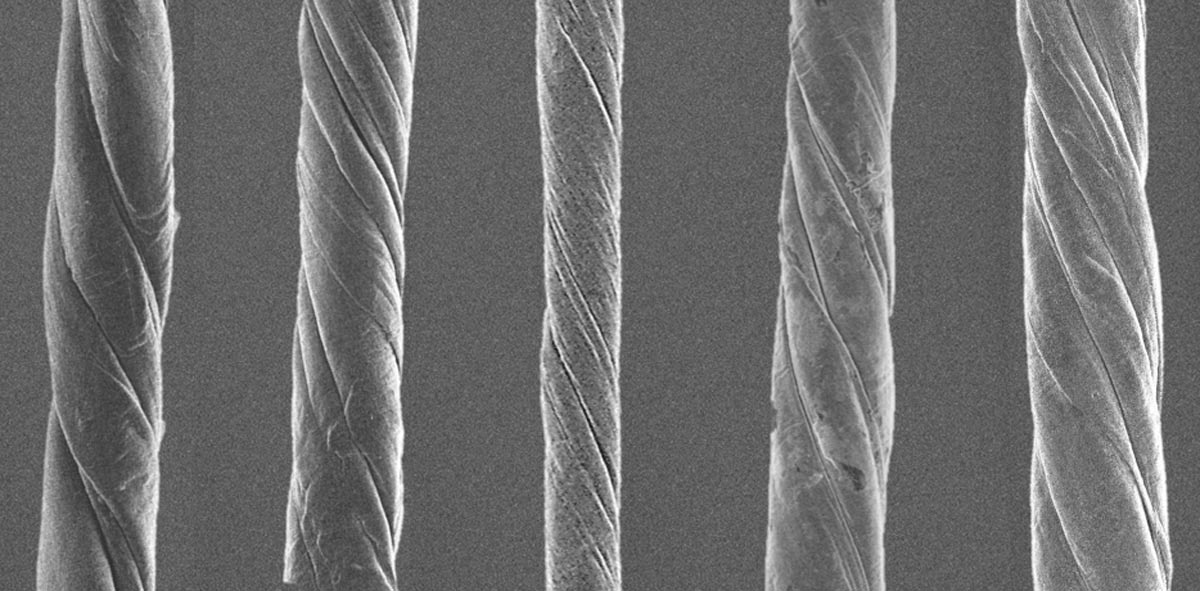
New research shows that twisted carbon nanotubes can store high densities of energy to power sensors or other technology.
Researchers have discovered that twisted carbon nanotubes can store triple the energy of lithium-ion batteries per unit mass, making them ideal for lightweight and safe energy storage applications like medical implants.
Groundbreaking Energy Storage Research
A global team of scientists, including two researchers from the Center for Advanced Sensor Technology (CAST) at the University of Maryland Baltimore County (UMBC), has demonstrated that twisted carbon nanotubes can store three times more energy per unit mass than advanced lithium-ion batteries. This breakthrough positions carbon nanotubes as a promising solution for energy storage in lightweight, compact, and safe devices like medical implants and sensors. The findings were recently published in Nature Nanotechnology.
The study was a collaborative effort among four institutions, led by Shigenori Utsumi from Suwa University of Science in Chino, Japan, Katsumi Kaneko from Shinshu University in Nagano, Japan, and Sanjeev Kumar Ujjain from CAST. Kumar Ujjain began the project at Shinshu University and continued his work after joining UMBC in 2022. Preety Ahuja, also from CAST, played a key role in the material characterization phase of the research.
Innovative Properties of Carbon Nanotubes
The researchers studied single-walled carbon nanotubes, which are like straws made from pure carbon sheets only 1 atom thick. Carbon nanotubes are lightweight, relatively easy to manufacture, and about 100 times stronger than steel. Their amazing properties have led scientists to explore their potential use in a wide range of futuristic-sounding technology, including space elevators.
To investigate carbon nanotubes’ potential for storing energy, the UMBC researchers and their colleagues manufactured carbon nanotube “ropes” from bundles of commercially available nanotubes. After pulling and twisting the tubes into a single thread, the researchers then coated them with different substances intended to increase the ropes’ strength and flexibility.
Impressive Energy Storage Capabilities
The team tested how much energy the ropes could store by twisting them up and measuring the energy that was released as the ropes unwound. They found that the best-performing ropes could store 15,000 times more energy per unit mass than steel springs, and about three times more energy than lithium-ion batteries. The stored energy remains consistent and accessible at temperatures ranging from -76 to +212 °F (-60 to +100 °C). The materials in the carbon nanotube ropes are also safer for the human body than those used in batteries.
“Humans have long stored energy in mechanical coil springs to power devices such as watches and toys,” Kumar Ujjain says. “This research shows twisted carbon nanotubes have great potential for mechanical energy storage, and we are excited to share the news with the world.” He says the CAST team is already working to incorporate twisted carbon nanotubes as an energy source for a prototype sensor they are developing.
Reference: “Giant nanomechanical energy storage capacity in twisted single-walled carbon nanotube ropes” by Shigenori Utsumi, Sanjeev Kumar Ujjain, Satoshi Takahashi, Ryo Shimodomae, Tae Yamaura, Ryosuke Okuda, Ryuichiro Kobayashi, Oga Takahashi, Satoshi Miyazono, Naoki Kato, Keiichi Aburamoto, Yuta Hosoi, Preety Ahuja, Ayumi Furuse, Yuma Kawamata, Hayato Otsuka, Kazunori Fujisawa, Takuya Hayashi, David Tománek and Katsumi Kaneko, 16 April 2024, Nature Nanotechnology.
DOI: 10.1038/s41565-024-01645-x
Never miss a breakthrough: Join the SciTechDaily newsletter.
Follow us on Google and Google News.
5 Comments
It is now possible to manufacture nanotubes made from carbon made by splitting Carbon Dioxide from the air as well as graphite and graphene, employing a Hot Electron technology owned by Global BRG Ltd
Interested in upcoming developments in solar capture, storage to power our world
How much does it cost?
Good question! The fact that they mentioned implanted medical devices might imply that the cost is quite high but would be appropriate for that sort of application.
Wow. Imagine if typical phone battery can power it constantly for for example 6h then above battery could power your phone constantly for 10 years which means no more chargers needed!