
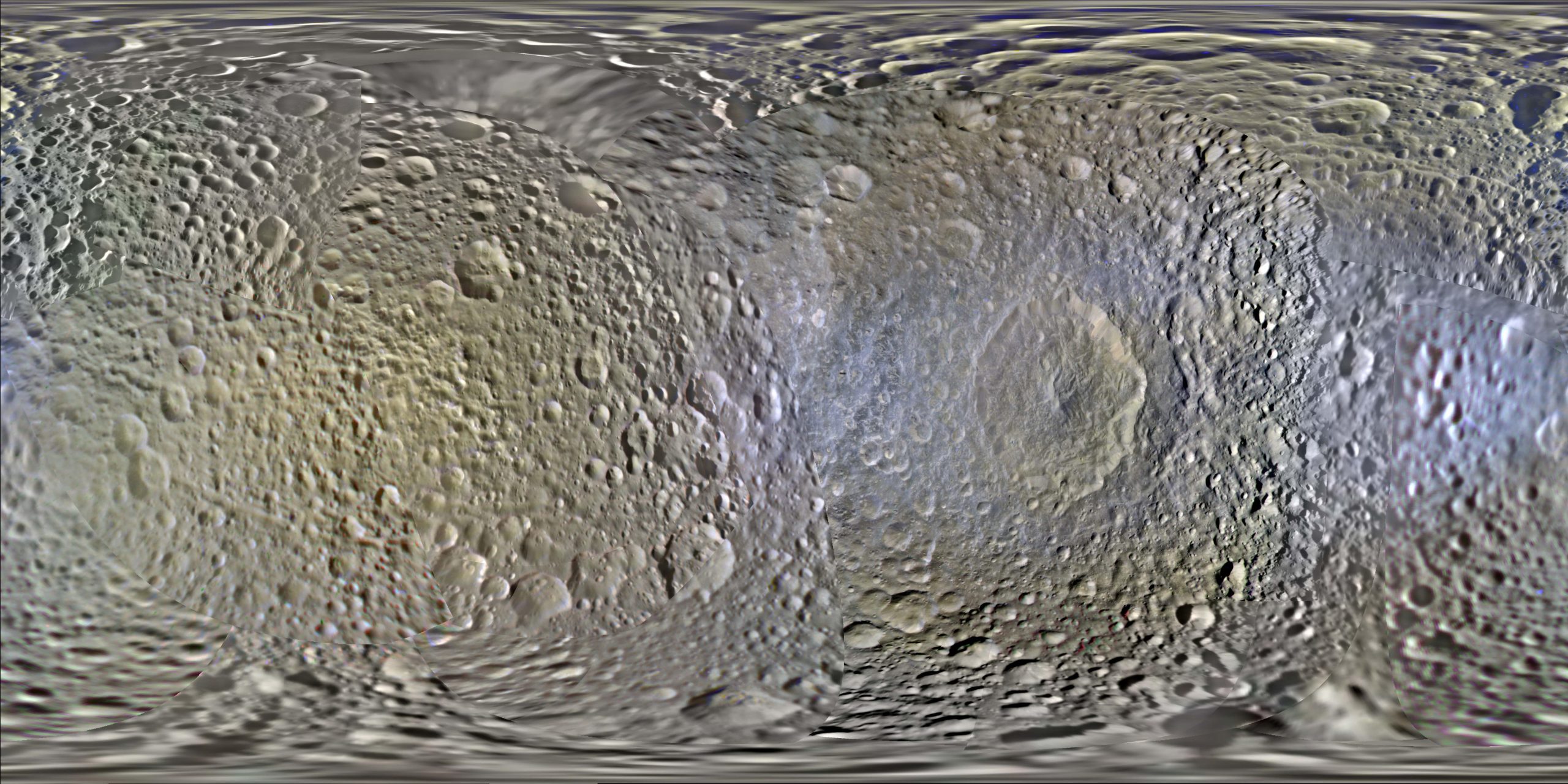
Using data collected over a ten-year period, NASA’s Cassini spacecraft has created new maps of Saturn’s six major icy moons.
Almost immediately after NASA’s twin Voyager spacecraft made their brief visits to Saturn in the early 1980s, scientists were hungry for more. The Voyagers had offered them only a brief glimpse of a family of new worlds — Saturn’s icy moons — and the researchers were eager to spend more time among those bodies.
The successor to the Voyagers at Saturn, NASA’s Cassini spacecraft, has spent the past 10 years collecting images and other data as it has toured the Ringed Planet and its family of satellites. New color maps, produced from this trove of data, show that Cassini has essentially fulfilled one of its many mission objectives: producing global maps of Saturn’s six major icy moons.
These are the large Saturnian moons, excluding haze-covered Titan, known before the start of the Space Age: Mimas, Enceladus, Tethys, Dione, Rhea, and Iapetus. Aside from a gap in the north polar region of Enceladus (to be filled in next year), and some areas of Iapetus, this objective is now more or less complete.
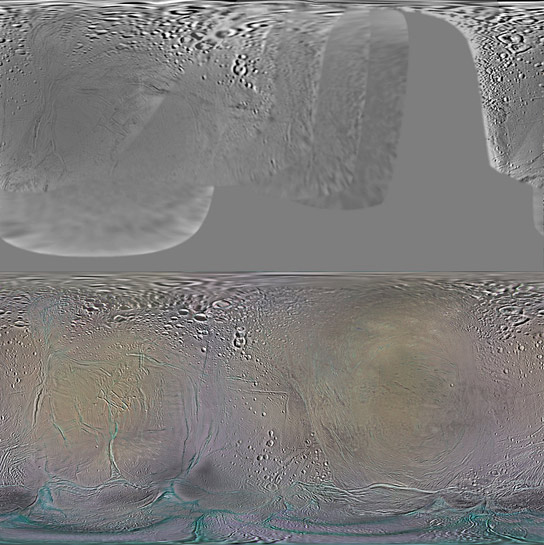
The new maps are the best global, color maps of these moons to date, and the first to show natural brightness variations and high-resolution color together. Colors in the maps represent a broader range than human vision, extending slightly into infrared and ultraviolet wavelengths. Differences in color across the moons’ surfaces that are subtle in natural-color views become much easier to study in these enhanced colors.
Cassini’s enhanced color views have yielded several important discoveries about the icy moons. The most obvious are differences in color and brightness between the two hemispheres of Tethys, Dione, and Rhea. The dark reddish colors on the moons’ trailing hemispheres are due to alteration by charged particles and radiation in Saturn’s magnetosphere. Except for Mimas and Iapetus, the blander leading hemispheres of these moons — that is, the sides that always face forward as the moons orbit Saturn — are all coated with icy dust from Saturn’s E-ring, formed from tiny particles erupting from the south pole of Enceladus.
Enceladus itself displays a variety of colorful features. Some of the gas and dust being vented into space from large fractures near the moon’s south pole returns to the surface and paints Enceladus with a fresh coating. The yellow and magenta tones in Cassini’s color map are thought to be due to differences in the thickness of these deposits. Many of the most recently formed fractures on Enceladus, those near the south pole in particular, have a stronger ultraviolet signature, which appears bluish in these maps. Their color may be due to large-grained ice exposed on the surface, not unlike blue ice seen in some places in Earth’s Arctic.
The new maps were produced by Paul Schenk, a participating scientist with the Cassini imaging team based at the Lunar and Planetary Institute in Houston.
The Cassini-Huygens mission is a cooperative project of NASA, the European Space Agency, and the Italian Space Agency. The Jet Propulsion Laboratory in Pasadena, California, manages the Cassini and Voyager missions for NASA’s Science Mission Directorate in Washington. The two Voyager spacecraft and the Cassini orbiter, along with its two onboard cameras, were designed, developed, and assembled at JPL. The Cassini imaging team consists of scientists from the United States, England, France, and Germany. The imaging team is based at the Space Science Institute in Boulder, Colorado.
You can view more images at NASA.
Never miss a breakthrough: Join the SciTechDaily newsletter.
Follow us on Google and Google News.
1 Comment
A second rate presentation with flat grey maps that have neither distance scale nor grid markers, that have nowhere near the resolution of images of Mars returned by the 1976 Viking Orbiter 🙁
http://upload.wikimedia.org/wikipedia/commons/5/56/Mars_Valles_Marineris.jpeg