
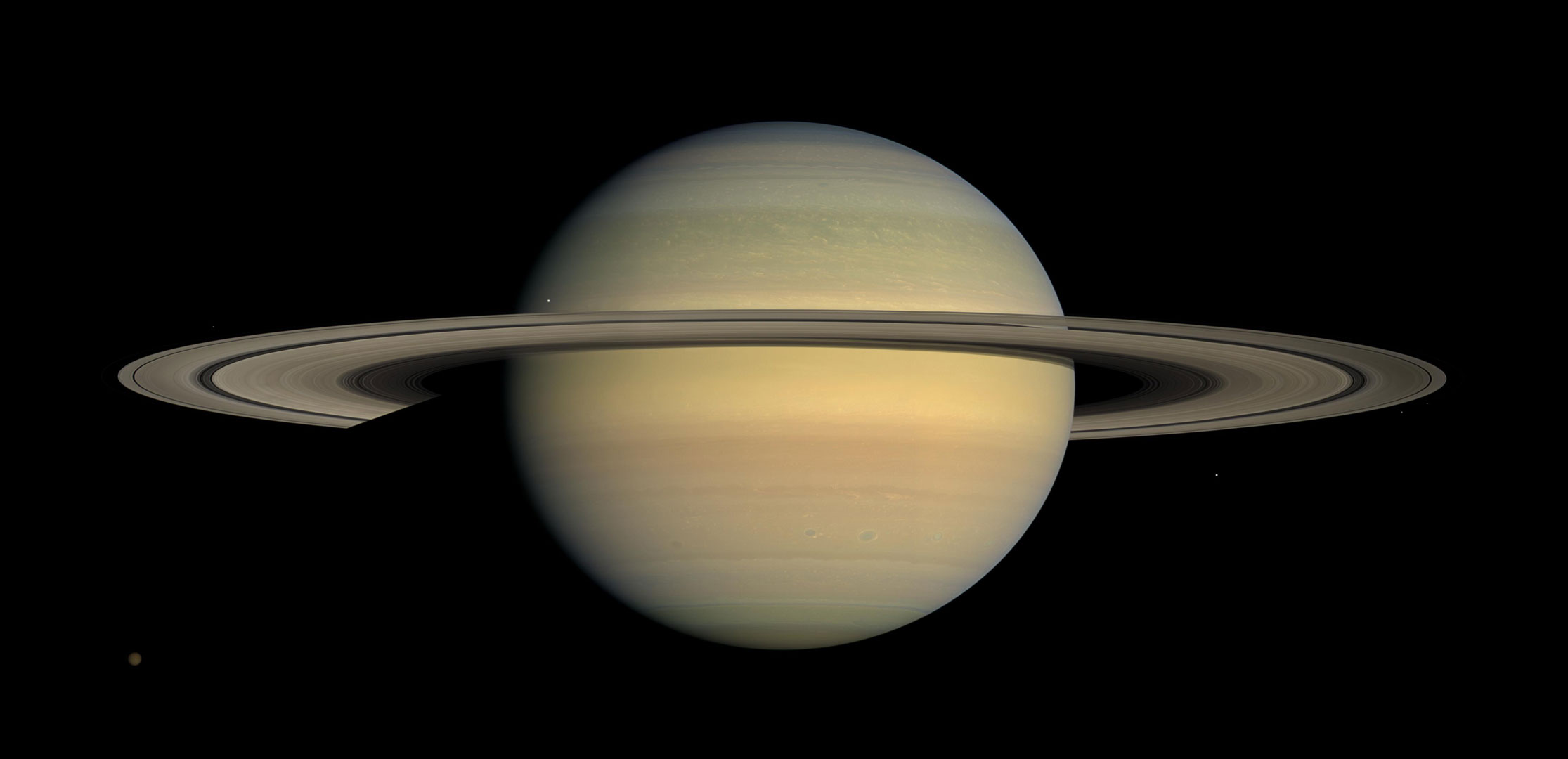
According to mission managers and orbit determination experts at NASA’s Jet Propulsion Laboratory, the Cassini Spacecraft is not experiencing unexplained deviations in its orbit around Saturn.
Several recent news stories have reported that a mysterious anomaly in Cassini’s orbit could potentially be explained by the gravitational tug of a theorized massive new planet in our solar system, lurking far beyond the orbit of Neptune. While the proposed planet’s existence may eventually be confirmed by other means, mission navigators have observed no unexplained deviations in the spacecraft’s orbit since its arrival there in 2004.
“An undiscovered planet outside the orbit of Neptune, 10 times the mass of Earth, would affect the orbit of Saturn, not Cassini,” said William Folkner, a planetary scientist at JPL. Folkner develops planetary orbit information used for NASA’s high-precision spacecraft navigation. “This could produce a signature in the measurements of Cassini while in orbit about Saturn if the planet was close enough to the sun. But we do not see any unexplained signature above the level of the measurement noise in Cassini data taken from 2004 to 2016.”
A recent paper predicts that, if data tracking Cassini’s position were available out to the year 2020, they might be used to reveal a “most probable” location for the new planet in its long orbit around the sun. However, Cassini’s mission is planned to end in late 2017, when the spacecraft — too low on fuel to continue on a longer mission — will plunge into Saturn’s atmosphere.
“Although we’d love it if Cassini could help detect a new planet in the solar system, we do not see any perturbations in our orbit that we cannot explain with our current models,” said Earl Maize, Cassini project manager at JPL.
The Cassini-Huygens mission is a cooperative project of NASA, ESA, and the Italian Space Agency. JPL, a division of the California Institute of Technology in Pasadena, manages the mission for NASA’s Science Mission Directorate in Washington.
Never miss a breakthrough: Join the SciTechDaily newsletter.
Follow us on Google and Google News.
5 Comments
I don’t understand why you would imagine that the lack of conclusive data is considered important at all, but it’s not.
Don’t mind me… I just think it was phrased a little oddly; I see now it is a refutation, not a proof of nonexistence.
would it be o.k. to all the space fans out there to say it again?CMON,IS THAT DAMN PLANET THERE OR NOT?ARE ALL THE TELESCOPES,COMPUTERS, DEEP SPACE PROBES,NOT DESIGNED TO FIND PLANETS, ASTERIODS, COMETS,PLANETIODS,OR OTHER OBJECTS WITH THE CURRENT TECHNOLOGY AVAILABLE?IT TAKES MORE PATIENCE NOT TO INSULT THE INTELLIGENCE,HOWEVER A REMINDER,GALLILEO OBSERVED JUPITER WITH HIS OWN TELESCOPE,GRANTED WE CAN ALL SEE JUPITER WITH THE NAKED EYE,WE CAN SEE THE OTHER KNOWN PLANETS WITH THE AID OF A TELESCOPE,AND YET NO ONE CAN FIND THIS MYSTERY PLANET WITH EVEN HIGHER TECH EQUIPMENT?PERHAPS IF GALLILEO AND HIS CRUDE TELESCOPE WERE HERE,WE COULD FIND IT,AND HOPEFULLY NOT GET THROWN IN THE BRIG BY THE POPE.
Nothing – not Cassini’s path, not Saturn’s orbit – be affected by a “hypothetical planet.” Only an actual planet could affect anything. Maybe if they discover a new planet, they can review their Cassini data and discover an anomaly they aren’t looking for now. Only hypothetical anomalies can be “discovered” at this point, but the anomalies would be caused by the hypothetical thinking, not a planet.
Interesting doublespeak. If a unknown were to influence the orbit of a minor moon (a satellite) it would affect/effect the larger body first?
interesting, I was taught the other, mass, influence, would vector change the least massive objects first. Even if the minor moon were by a substantial gas giant.