
Close Menu
    Facebook X (Twitter) Instagram
    SciTechDaily
    • Biology
    • Chemistry
    • Earth
    • Health
    • Physics
    • Science
    • Space
    • Technology
    Facebook X (Twitter) Pinterest YouTube RSS
    SciTechDaily
    Home»Space»Cassini Views The Light Of Day As It Illuminates Saturn
    Space

    Cassini Views The Light Of Day As It Illuminates Saturn

    By SciTechDailyJuly 11, 2017No Comments2 Mins Read
    Facebook Twitter Pinterest Telegram LinkedIn WhatsApp Email Reddit
    Share
    Facebook Twitter LinkedIn Pinterest Telegram Email Reddit
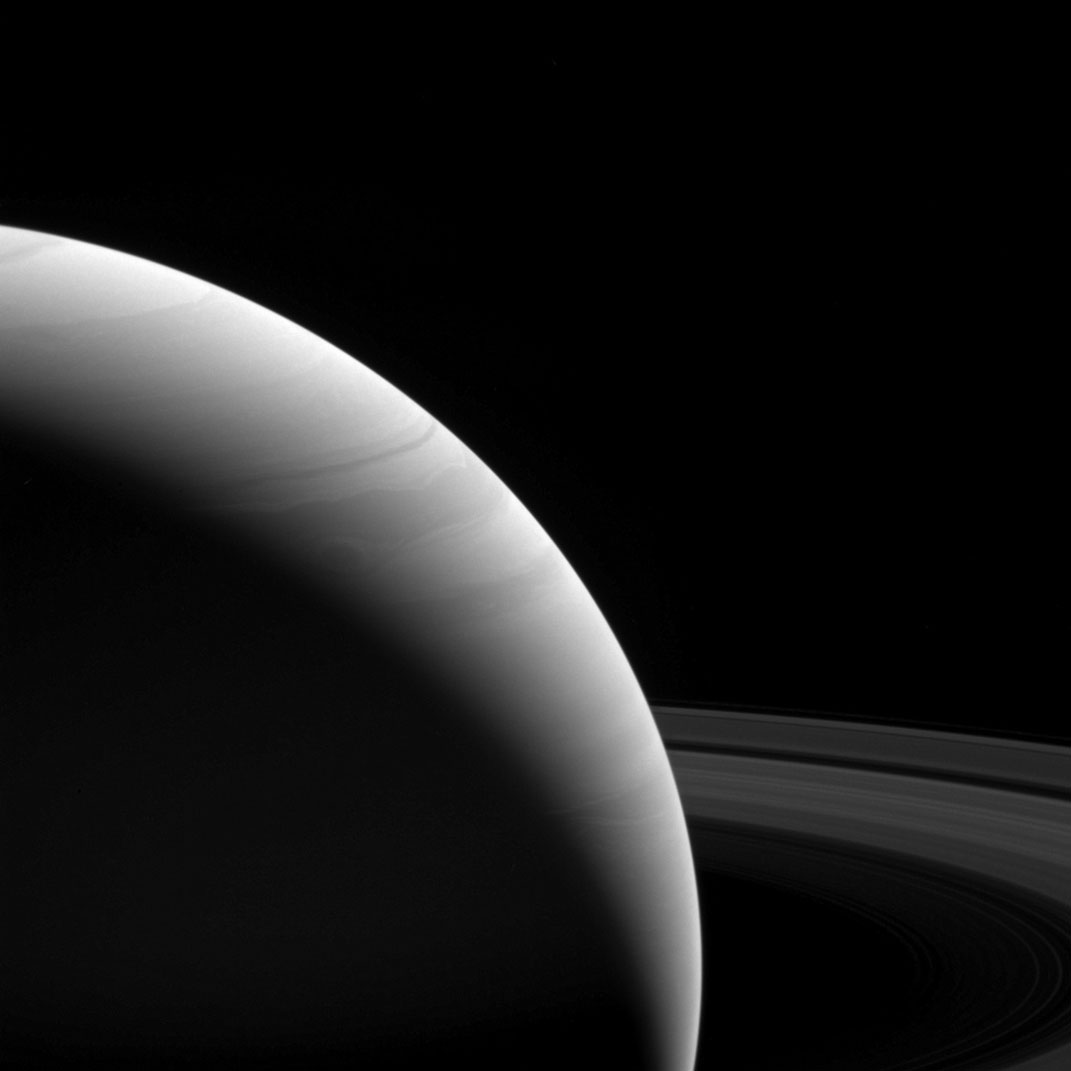
    New Cassini View of Saturn at First Light
    The dawn light casting its glow upon Saturn’s undulating cloud formations and the sweeping curves of its extensive rings. Credit: NASA/JPL-Caltech/Space Science Institute

    This newly released image shows the light of a new day as it illuminates Saturn’s wavy cloud patterns and the smooth arcs of the vast rings.

    The light has traveled around 80 minutes since it left the sun’s surface by the time it reaches Saturn. The illumination it provides is feeble; Earth gets 100 times the intensity since it’s roughly ten times closer to the sun. Yet compared to the deep blackness of space, everything at Saturn still shines bright in the sunlight, be it direct or reflected.

    This view looks toward the sunlit side of the rings from about 10 degrees above the ring plane. The image was taken with the Cassini spacecraft wide-angle camera on February 25, 2017, using a spectral filter which preferentially admits wavelengths of near-infrared light centered at 939 nanometers.

    The view was obtained at a distance of approximately 762,000 miles (1.23 million kilometers) from Saturn. Image scale is 45 miles (73 kilometers) per pixel.

    The Cassini mission is a cooperative project of NASA, ESA (the European Space Agency) and the Italian Space Agency. The Jet Propulsion Laboratory, a division of the California Institute of Technology in Pasadena, manages the mission for NASA’s Science Mission Directorate, Washington. The Cassini orbiter and its two onboard cameras were designed, developed and assembled at JPL. The imaging operations center is based at the Space Science Institute in Boulder, Colorado.

    Never miss a breakthrough: Join the SciTechDaily newsletter.
    Follow us on Google and Google News.

    Cassini-Huygens Mission Planetary Science Saturn
    Share. Facebook Twitter Pinterest LinkedIn Email Reddit

    Related Articles

    New Study Details the Changes in Saturn’s F Ring

    Cassini Reveals Possible New Moon Forming Around Saturn

    NASA Detects Ocean Inside Saturn’s Moon Enceladus

    Cassini Reveals Clues about Saturn’s Moon Titan

    Massive Saturn Storm Churns Up Water Ice from Great Depths

    Cassini Views a Spinning Vortex at Saturn’s North Pole

    Cassini Observes Meteors Colliding With Saturn’s Rings

    NASA’s Cassini Catches a Glimpse of Venus From Saturn Orbit

    Storm Spawns the Largest Tropospheric Vortex Ever Seen on Saturn

    Leave A Reply Cancel Reply

    • Facebook
    • Twitter
    • Pinterest
    • YouTube

    Don't Miss a Discovery

    Subscribe for the Latest in Science & Tech!

    Trending News

    Breakthrough Parkinson’s Drug Targets Disease at Its Genetic Roots

    Just 4 Weeks of Simple Diet Changes Reversed Signs of Aging in Older Adults

    Scientists May Have Finally Solved Why Humans Are Right-Handed

    NASA’s Hubble Accidentally Witnesses a Comet Shattering in Space

    Researchers Discover the Body’s Hidden “Off Switch” for Inflammation

    Scientists Discover Metformin Doesn’t Work the Way We Thought

    Tea or Coffee? Your Daily Choice Could Affect Osteoporosis Risk

    Vitamin C May Fight Cancer in a Surprising Way

    Follow SciTechDaily
    • Facebook
    • Twitter
    • YouTube
    • Pinterest
    • Newsletter
    • RSS
    SciTech News
    • Biology News
    • Chemistry News
    • Earth News
    • Health News
    • Physics News
    • Science News
    • Space News
    • Technology News
    Recent Posts
    • Scientists Stunned by Hybrid California Bees That Beat Deadly Mites
    • Scientists Discover Terrifying Giant Crocodile That Hunted Human Ancestors
    • Scientists Finally Think They Know Why T. rex Had Tiny Arms
    • Scientists Are Turning Ocean Trash Into Roads – and It’s Actually Working
    • This Alien Planet Has Rock Clouds That Vaporize Before Sunset
    Copyright © 1998 - 2026 SciTechDaily. All Rights Reserved.
    • Science News
    • About
    • Contact
    • Editorial Board
    • Privacy Policy
    • Terms of Use

    Type above and press Enter to search. Press Esc to cancel.