
Close Menu
    Facebook X (Twitter) Instagram
    SciTechDaily
    • Biology
    • Chemistry
    • Earth
    • Health
    • Physics
    • Science
    • Space
    • Technology
    Facebook X (Twitter) Pinterest YouTube RSS
    SciTechDaily
    Home»Space»Cassini Views “The Great Eye” of Saturn’s Moon Mimas
    Space

    Cassini Views “The Great Eye” of Saturn’s Moon Mimas

    By NASAMay 4, 2015No Comments2 Mins Read
    Facebook Twitter Pinterest Telegram LinkedIn WhatsApp Email Reddit
    Share
    Facebook Twitter LinkedIn Pinterest Telegram Email Reddit
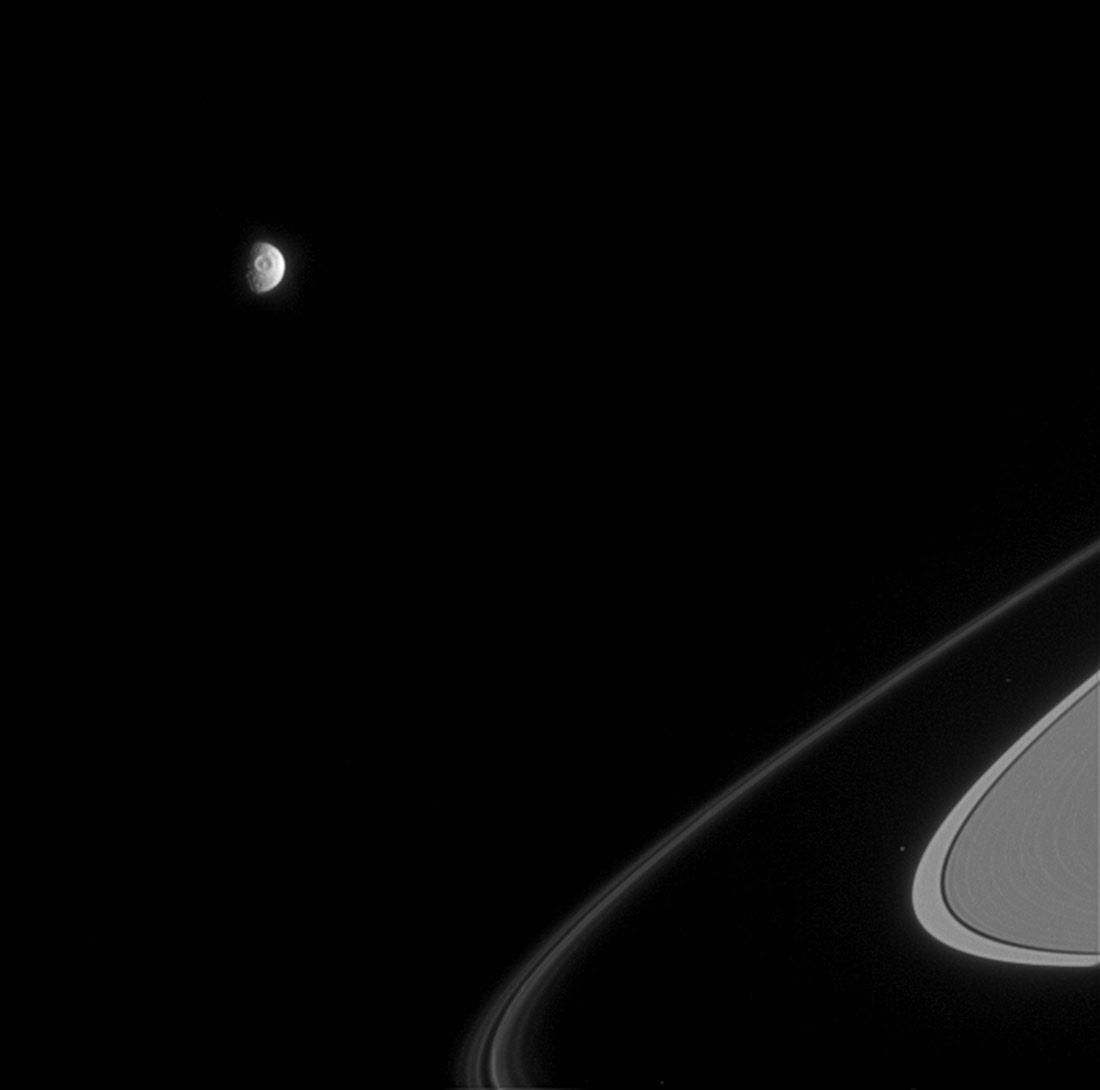
    Cassini Views Saturn's Moon Mimas
    The great eye of Saturn’s moon Mimas, a 130-kilometer-wide (80-mile) impact crater called Herschel, stares out from the battered moon. Credit: NASA/JPL/Space Science Institute; Cassini

    Taken by NASA’s Cassini spacecraft, this image reveals the 130-kilometer-wide impact crater on Saturn’s moon Mimas.

    The great eye of Saturn’s moon Mimas, a 130-kilometer-wide (80-mile) impact crater called Herschel, stares out from the battered moon. Several individual ringlets within the F ring are resolved here, and the small moon Atlas is also seen faintly outside the main rings.
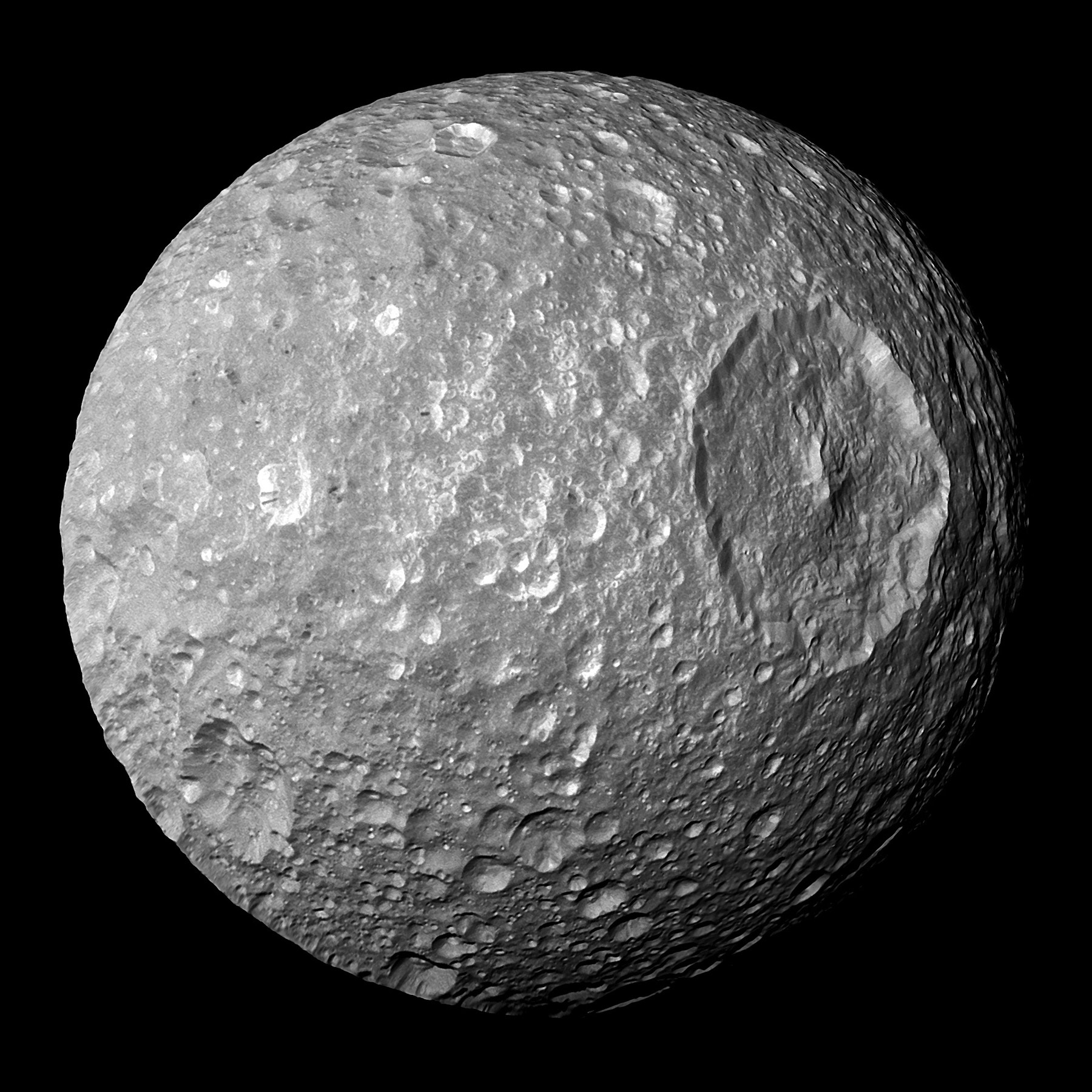
    Mimas
    Mimas with its large crater Herschel. Prominent bright-walled craters in this view include Ban just left of center near the top, and Percivale (with several dark streaks) two-thirds of the way left of Herschel. Credit: NASA/JPL/Space Science Institute; Cassini

    Mimas is 397 kilometers (247 miles across); the view shows principally the moon’s anti-Saturn hemisphere. Atlas is 32 kilometers (20 miles) across.

    The image was taken in visible light with the Cassini spacecraft narrow-angle camera on April 5, 2005, at a distance of approximately 2.1 million kilometers (1.3 million miles) from Mimas and at a Sun-Mimas-spacecraft, or phase, angle of 72 degrees. The image scale is 13 kilometers (8 miles) per pixel.

    The Cassini-Huygens mission is a cooperative project of NASA, the European Space Agency, and the Italian Space Agency. The Jet Propulsion Laboratory, a division of the California Institute of Technology in Pasadena, manages the mission for NASA’s Science Mission Directorate, Washington, D.C. The Cassini orbiter and its two onboard cameras were designed, developed, and assembled at JPL. The imaging team is based at the Space Science Institute, Boulder, Colorado.

    Never miss a breakthrough: Join the SciTechDaily newsletter.
    Follow us on Google and Google News.

    Astronomy Cassini-Huygens Mission Mimas Saturn
    Share. Facebook Twitter Pinterest LinkedIn Email Reddit

    Related Articles

    Cassini Spacecraft Views Mimas’ Gigantic Crater

    New Cassini Image Shows a Tiny Mimas, Huge Saturn Rings

    Long Divisions – New Cassini Image of Saturn and Mimas

    Dot Against the Dark – New Image of Saturn’s Moon Mimas

    Natural Color View of Saturn and Titan

    NASA’s Cassini Spots Lightning in Saturn’s Northern Hemisphere

    Cassini Changes Orbit, Saturn’s Rings Visible Again

    Cassini Data Reveals Likely Subsurface Ocean on Titan

    Heat from Within the Planet Powers Saturn’s Jet Streams

    Leave A Reply Cancel Reply

    • Facebook
    • Twitter
    • Pinterest
    • YouTube

    Don't Miss a Discovery

    Subscribe for the Latest in Science & Tech!

    Trending News

    Scientists Uncover Promising New Strategy To Stop Parkinson’s in Its Tracks

    Experts Reveal the Surprising Cancer Link Behind a Common Vitamin

    This Strange “Golden Orb” Found 2 Miles Deep Stumped Scientists for Years

    Giant “Last Titan” Dinosaur Discovered in Thailand Was Bigger Than 9 Elephants

    This “Longevity Gene” May Protect the Brain From Aging and Dementia

    Common Cleaning Chemical Could Triple Your Risk of a Dangerous Liver Disease

    Scientists Discover Bizarre 100-Million-Year-Old Insect With Giant Claws

    Scientists Discover “Good” Gut Microbes That Could Protect Against Autism and ADHD

    Follow SciTechDaily
    • Facebook
    • Twitter
    • YouTube
    • Pinterest
    • Newsletter
    • RSS
    SciTech News
    • Biology News
    • Chemistry News
    • Earth News
    • Health News
    • Physics News
    • Science News
    • Space News
    • Technology News
    Recent Posts
    • Light-Matter Particles Could Revolutionize AI Computing
    • Scientists Warn Many Insects May Not Survive a Warming World
    • Hektoria Glacier Collapse Reveals How Fast Antarctica Can Fall Apart
    • Hidden Earthquake Threat: Oregon’s Fault May Be Closer to the Surface Than Scientists Thought
    • Scientists Use Smartwatch Data To Track the Hidden Health Effects of Air Pollution
    Copyright © 1998 - 2026 SciTechDaily. All Rights Reserved.
    • Science News
    • About
    • Contact
    • Editorial Board
    • Privacy Policy
    • Terms of Use

    Type above and press Enter to search. Press Esc to cancel.