
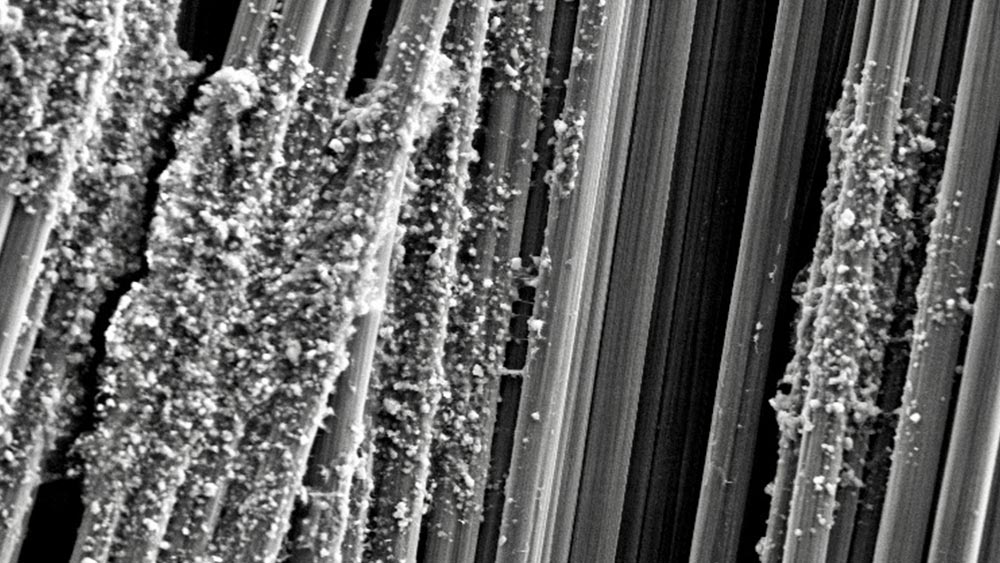
Polymers reinforced with ultra-fine strands of carbon fibers epitomize composite materials that are “light as a feather and strong as steel,” earning them versatile applications across several industries. Adding materials called carbon nanotubes can further enhance the composites’ functionality. But the chemical processes used for incorporating carbon nanotube end up spreading them unevenly on the composites, limiting the strength and other useful qualities that can be ultimately achieved.
In a new study, Texas A&M University researchers have used a natural plant product, called cellulose nanocrystals, to pin and coat carbon nanotubes uniformly onto the carbon-fiber composites. The researchers said their prescribed method is quicker than conventional methods and also allows the designing of carbon-fiber composites from the nanoscale.
The results of the study are published online in the journal American Chemical Society (ACS) Applied Nano Materials.
Composites are built in layers. For example, polymer composites are made of layers of fiber, like carbon fibers or Kevlar, and a polymer matrix. This layered structure is the source of the composites’ weakness. Any damage to the layers causes fractures, a process technically known as delamination.
To increase strength and give carbon-fiber composites other desirable qualities, such as electrical and thermal conductivity, carbon nanotubes are often added. However, the chemical processes used for incorporating the carbon nanotubes into these composites often cause the nanoparticles to clump up, reducing the overall benefit of adding these particles.
“The problem with nanoparticles is similar to what happens when you add coarse coffee powder to milk — the powder agglomerates or sticks to each other,” said Dr. Amir Asadi, assistant professor in the Department of Engineering Technology and Industrial Distribution. “To fully take advantage of the carbon nanotubes, they need to be separated from each other first, and then somehow designed to go to a particular location within the carbon-fiber composite.”
To facilitate the even distribution of carbon nanotubes, Asadi and his team turned to cellulose nanocrystals, a compound easily obtained from recycled wood pulp. These nanocrystals have segments on their molecules that attract water and other segments that get repelled by water. This unique molecular structure offers the ideal solution to construct composites at the nanoscale, said Asadi.
The hydrophobic part of the cellulose nanocrystals binds to the carbon fibers and anchors them onto the polymer matrix. On the other hand, the water-attractive portions of the nanocrystals help in dispersing the carbon fibers evenly, much like how sugar, which is hydrophilic, dissolves in water uniformly rather than clumping and settling to the bottom of a cup.
For their experiments, the researchers used a commercially available carbon-fiber cloth. To this cloth, they added an aqueous solution of cellulose nanocrystals and carbon nanotubes and then applied strong vibration to mix all of the items together. Finally, they left the material to dry and spread resin on it to gradually form the carbon nanotube coated polymer composite.
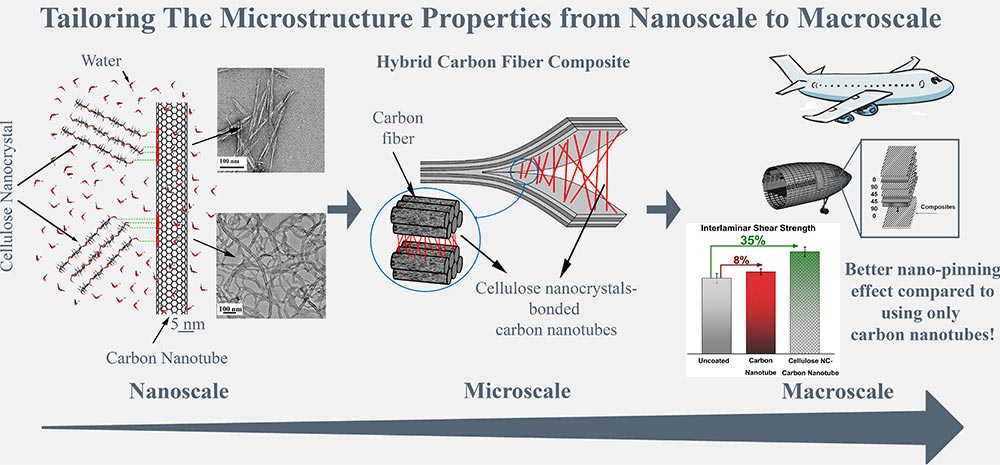
Upon examining a sample of the composite using electron microscopy, Asadi, and his team observed that the cellulose nanocrystals attached to the tips of the carbon nanotubes, orienting the nanotubes in the same direction. They also found that cellulose nanocrystals increased the composite’s resistance to bending by 33% and its inter-laminar strength by 40% based on measuring the mechanical properties of the material under extreme loading.
“In this study, we have taken the approach of designing the composites from the nanoscale using cellulose nanocrystals. This method has allowed us to have more control over the polymer composites’ properties that emerge at the macroscale,” said Asadi. “We think that our technique is a path forward in scaling up the processing of hybrid composites, which will be useful for a variety of industries, including airline and automobile manufacturing.”
Other contributors to this research include Shadi Shariatnia and Annuatha V. Kumar from the J. Mike Walker ’66 Department of Mechanical Engineering, and Ozge Kaynan from the Department of Materials Science and Engineering.
Reference: “Hybrid Cellulose Nanocrystal-Bonded Carbon Nanotubes/Carbon Fiber Polymer Composites for Structural Applications” by Shadi Shariatnia, Annuatha V. Kumar, Ozge Kaynan and Amir Asadi, 14 May 2020, Applied Nano Materials.
DOI: 10.1021/acsanm.0c00785
This research was funded by the National Science Foundation.
Never miss a breakthrough: Join the SciTechDaily newsletter.
Follow us on Google and Google News.