
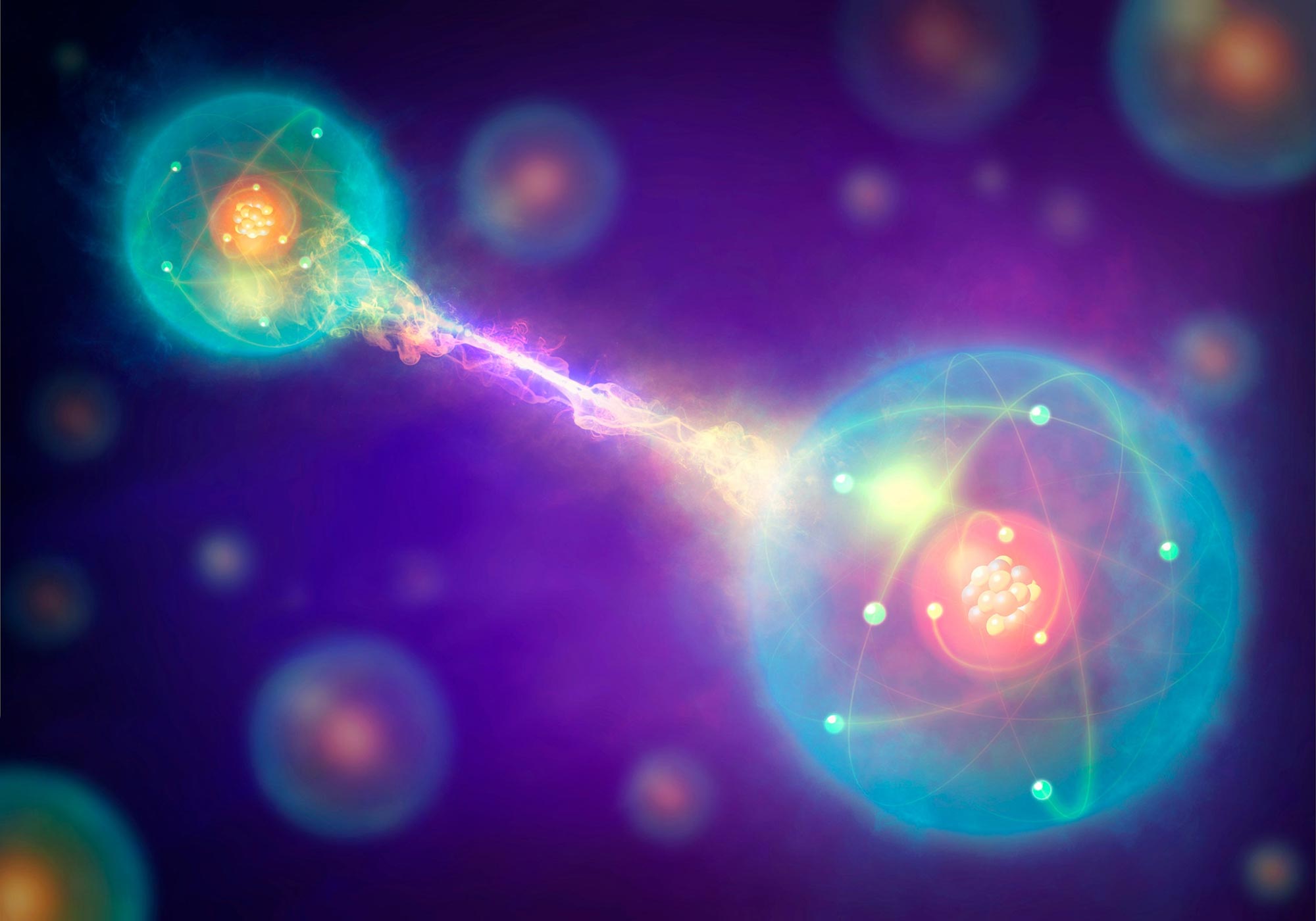
Researchers from TUM, working at CERN, have made a groundbreaking discovery that reveals how deuterons are formed.
Another long-standing question in particle physics has been answered. Scientists working with the ALICE experiment at CERN’s Large Hadron Collider (LHC), led by researchers from the Technical University of Munich (TUM), have directly observed how some of the simplest atomic nuclei and their antimatter equivalents are created in extreme particle collisions. These nuclei, known as deuterons and antideuterons, each consist of only two building blocks, making them ideal probes for studying the most fundamental forces of nature.
At the heart of every atomic nucleus is the strong interaction, the force that binds protons and neutrons together. In the new study, researchers found that the protons and neutrons needed to form deuterons are not present from the beginning of a collision. Instead, they emerge from the decay of extremely short-lived, high-energy particle states (so-called resonances) and then combine into light nuclei. The same process applies to their antimatter counterparts. The results were published in the leading journal Nature.
The experiments take place in proton collisions at the LHC at CERN, where temperatures briefly soar to more than 100,000 times hotter than the center of the Sun. Under such violent conditions, delicate objects like deuterons and antideuterons were expected to fall apart almost instantly. After all, a deuteron is made of just one proton and one neutron, held together by a relatively weak binding force.
Despite this, these light nuclei have been observed repeatedly in past experiments. The new measurements now show why: about 90 percent of the observed (anti)deuterons form through this resonance decay pathway, and they appear later, after conditions begin to cool.
Better understanding of the universe
TUM particle physicist Prof. Laura Fabbietti, a researcher in the ORIGINS Cluster of Excellence and SFB1258, emphasizes: “Our result is an important step toward a better understanding of the ‘strong interaction’ – that fundamental force that binds protons and neutrons together in the atomic nucleus. The measurements clearly show: light nuclei do not form in the hot initial stage of the collision, but later, when the conditions have become somewhat cooler and calmer.”
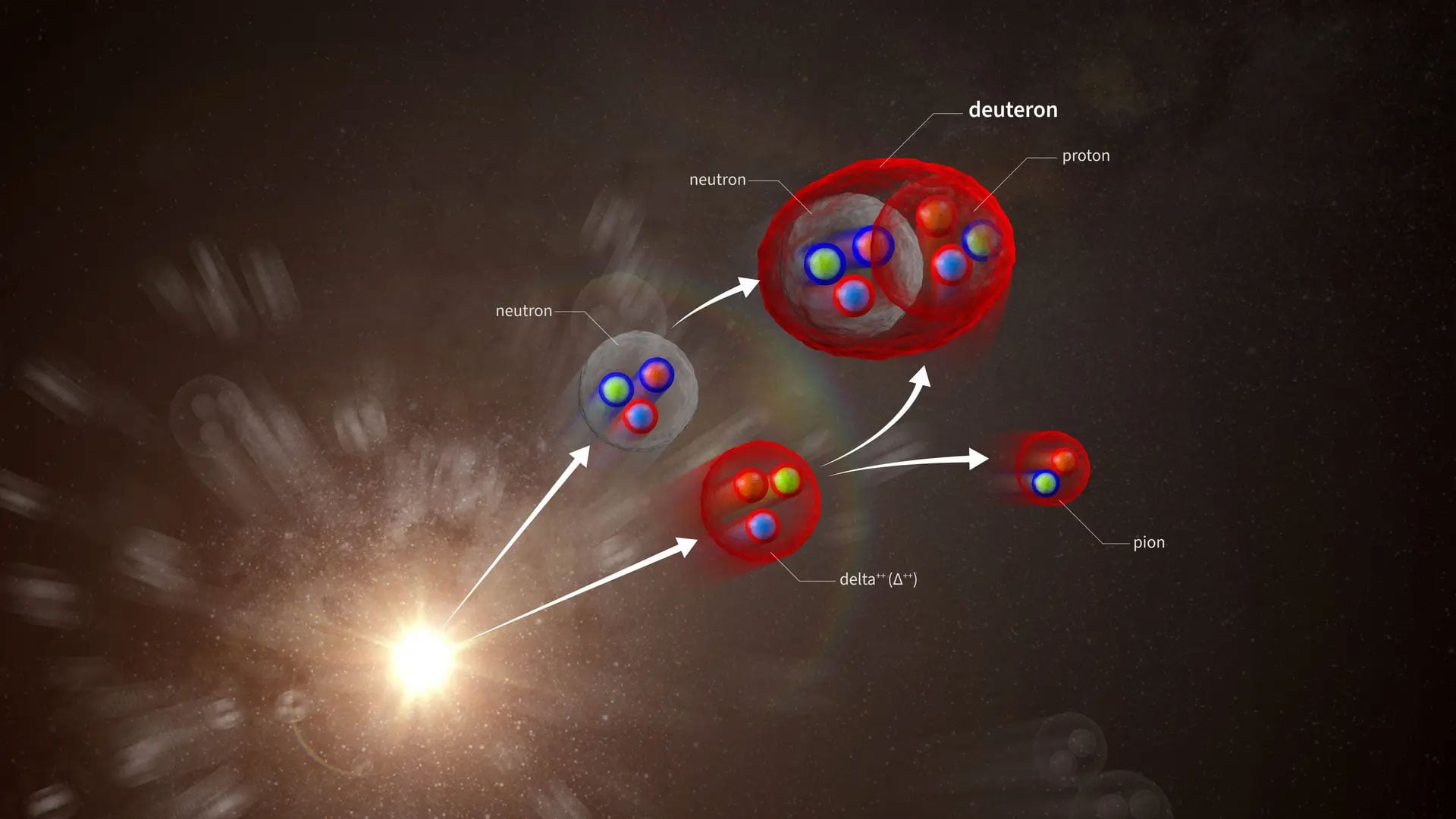
Dr. Maximilian Mahlein, a researcher at Fabbietti’s Chair for Dense and Strange Hadronic Matter at the TUM School of Natural Sciences, explains: “Our discovery is significant not only for fundamental nuclear physics research. Light atomic nuclei also form in the cosmos – for example, in interactions of cosmic rays. They could even provide clues about the still-mysterious dark matter. With our new findings, models of how these particles are formed can be improved, and cosmic data interpreted more reliably.”
Further information
CERN (Conseil Européen pour la Recherche Nucléaire) is the world’s largest research center for particle physics. It is located on the border between Switzerland and France near Geneva. Its centerpiece is the LHC, a 27-kilometer-long underground ring accelerator. In it, protons collide at nearly the speed of light. These collisions recreate conditions similar to those that existed just after the Big Bang – temperatures and energies that do not occur anywhere in everyday life. Researchers can thus investigate how matter is structured at its most fundamental level and which natural laws apply there.
Among the experiments at the LHC, ALICE (A Large Ion Collider Experiment) is specifically designed to study the properties of the so-called strong interaction – the force that holds protons and neutrons together in atomic nuclei. ALICE acts like a giant camera, capable of precisely tracking and reconstructing up to 2000 particles created in each collision. The aim is to reconstruct the conditions of the universe’s earliest fractions of a second – and thereby better understand how a soup of quarks and gluons first gave rise to stable atomic nuclei and ultimately to matter.
The ORIGINS Cluster of Excellence investigates the formation and evolution of the universe and its structures – from galaxies, stars, and planets to the very building blocks of life. ORIGINS traces the path from the smallest particles in the early universe to the emergence of biological systems. Examples include the search for conditions that could enable extraterrestrial life and a deeper understanding of dark matter. In May 2025, the second funding phase of the cluster, jointly proposed by TUM and Ludwig-Maximilians-Universität München (LMU), was approved as part of the highly competitive Excellence Strategy of the German federal and state governments.
The Collaborative Research Center “Neutrinos and Dark Matter in Astro- and Particle Physics” (SFB 1258) focuses on fundamental physics, where the weak interaction, one of the four fundamental forces of nature, is central. The third funding period of the SFB1258 started in January 2025.
Reference: “Observation of deuteron and antideuteron formation from resonance-decay nucleons” by The ALICE Collaboration, , 10 December 2025, Nature.
DOI: 10.1038/s41586-025-09775-5
Never miss a breakthrough: Join the SciTechDaily newsletter.
Follow us on Google and Google News.
6 Comments
The so-called strong nuclear force is just an imagination. Gravity is as strong as electrostatic force at that level. Nucleus is not made up of individual neutrons and protons. It is a structure made up of electron-positron pairs, with some unpaired positrons the number of which is equal to the number of electrons in the atom. The electron-positron pairs form a closed loop in which alternate bonds are electrostatic and gravitational. That is why such pairs are released during disintegration of matter. Electrons and positrons are opposite potential states of matter.
VERY GOOD! The so-called strong nuclear force is just an imagination.
When we pursue the ultimate truth of all things, the space in which our bodies and all things exist may itself be the final and deepest puzzle we need to explore. This is not only the pursuit of physics, but also the most magnificent exploration of the origin of the universe by human reason.
Based on the Topological Vortex Theory (TVT), space is an uniformly incompressible physical entity. Space-time vortices are the products of topological phase transitions of the tipping points in space, are the point defects in spacetime. Point defects do not only impact the thermodynamic properties, but are also central to kinetic processes. They create all things and shape the world through spin and self-organization.
In today’s physics, some so-called peer-reviewed journals—including Physical Review Letters, Nature, Science, and others—stubbornly insist on and promote the following:
1. Even though θ and τ particles exhibit differences in experiments, physics can claim they are the same particle. This is science.
2. Even though topological vortices and antivortices have identical structures and opposite rotational directions, physics can define their structures and directions as entirely different. This is science.
3. Even though two sets of cobalt-60 rotate in opposite directions and experiments reveal asymmetry, physics can still define them as mirror images of each other. This is science.
4. Even though vortex structures are ubiquitous—from cosmic accretion disks to particle spins—physics must insist that vortex structures do not exist and require verification. Only the particles that like God, Demonic, or Angelic are the most fundamental structures of the universe. This is science.
5. Even though everything occupies space and maintains its existence in time, physics must still debate and insist on whether space exists and whether time is a figment of the human mind. This is science.
6. Even though space, with its non-stick, incompressible, and isotropic characteristics, provides a solid foundation for the development of physics, physics must still insist that the ideal fluid properties of space do not exist. This is science.
and go on.
Is this the counterintuitive science they widely promote? Compromising with pseudo academic publications and peer review by pseudo scholars is an insult to science and public intelligence. Some so-called scholars no longer understand what shame is. The study of Topological Vortex Theory (TVT) reminds us that the most profound problems in physics often lie at the intersection of different theories. By exploring these border regions, we can not only resolve contradictions in existing theories but also discover new physical phenomena and application possibilities.
Under the topological vortex architecture, it is highly challenging for even two hydrogen atoms or two quarks to be perfectly symmetrical, let alone counter-rotating two sets of cobalt-60. Contemporary physics and so-called peer-reviewed publications (including Physical Review Letters, Science, Nature, etc.) stubbornly believe that two sets of counter rotating cobalt-60 are two mirror images of each other, constructing a more shocking pseudoscientific theoretical framework in the history of science than the “geocentric model”. This pseudo scientific framework and system have seriously hindered scientific progress and social development.
For nearly a century, physics has been manipulated by this pseudo scientific theoretical system and the interest groups behind it, wasting a lot of manpower, funds, and time. A large amount of pseudo scientific research has been conducted, and countless pseudo scientific papers have been published, causing serious negative impacts on scientific and social progress, as well as humanistic development.
Complexity does not necessarily mean that there is no logical and architectural framework to follow. Mathematics is the language and tool that reveals the motion of spacetime, rather than the motion itself. Although the physical form of spacetime vortices is extremely simple, their interaction patterns are highly complex, and we must develop more and richer mathematical languages to describe and understand them.
The development of the Topological Vortex Theory (TVT) reflects a progression from concrete physical phenomena to abstract mathematical modeling and, ultimately, to interdisciplinary unification. Its core innovation lies in forging the continuous spacetime geometry of general relativity with the discrete interactions of quantum field theory within the same topological dynamical system.
——Excerpted from https://scitechdaily.com/microscope-spacecrafts-most-precise-test-of-key-component-of-the-theory-of-general-relativity/#comment-909171.
When you go in thinking everything is particles (which is what everyone does being informed of which at the outset), the mind imagines the readily friendly particles and is locked, and trapped in the thoughts involved. Particle jail. Relax, it’s perfectly normal.
But these guys, having accelerator stats with labels, up-quarks, down, etc, at what? 173.1 GeV – thinking they can take stats from an utterly blown-apart nucleus and simply model them in smaller form because they’ll imagine them so – and call them particles – and then go with one guy’s adlib of Gluons to hold them snuggly close, even though all their accepted logic says “like charge repels” – well, a bunch of people aren’t thinking for themselves, are they? (ps: they don’t even have the accepted logic right – not really)
VERY GOOD! Which is what everyone does being informed of which at the outset, the mind imagines the readily friendly particles and is locked.
When we pursue the ultimate truth of all things, the space in which our bodies and all things exist may itself be the final and deepest puzzle we need to explore. This is not only the pursuit of physics, but also the most magnificent exploration of the origin of the universe by human reason.
Based on the Topological Vortex Theory (TVT), space is an uniformly incompressible physical entity. Space-time vortices are the products of topological phase transitions of the tipping points in space, are the point defects in spacetime. Point defects do not only impact the thermodynamic properties, but are also central to kinetic processes. They create all things and shape the world through spin and self-organization.
In today’s physics, some so-called peer-reviewed journals—including Physical Review Letters, Nature, Science, and others—stubbornly insist on and promote the following:
1. Even though θ and τ particles exhibit differences in experiments, physics can claim they are the same particle. This is science.
2. Even though topological vortices and antivortices have identical structures and opposite rotational directions, physics can define their structures and directions as entirely different. This is science.
3. Even though two sets of cobalt-60 rotate in opposite directions and experiments reveal asymmetry, physics can still define them as mirror images of each other. This is science.
4. Even though vortex structures are ubiquitous—from cosmic accretion disks to particle spins—physics must insist that vortex structures do not exist and require verification. Only the particles that like God, Demonic, or Angelic are the most fundamental structures of the universe. This is science.
5. Even though everything occupies space and maintains its existence in time, physics must still debate and insist on whether space exists and whether time is a figment of the human mind. This is science.
6. Even though space, with its non-stick, incompressible, and isotropic characteristics, provides a solid foundation for the development of physics, physics must still insist that the ideal fluid properties of space do not exist. This is science.
and go on.
Is this the counterintuitive science they widely promote? Compromising with pseudo academic publications and peer review by pseudo scholars is an insult to science and public intelligence. Some so-called scholars no longer understand what shame is. The study of Topological Vortex Theory (TVT) reminds us that the most profound problems in physics often lie at the intersection of different theories. By exploring these border regions, we can not only resolve contradictions in existing theories but also discover new physical phenomena and application possibilities.
Under the topological vortex architecture, it is highly challenging for even two hydrogen atoms or two quarks to be perfectly symmetrical, let alone counter-rotating two sets of cobalt-60. Contemporary physics and so-called peer-reviewed publications (including Physical Review Letters, Science, Nature, etc.) stubbornly believe that two sets of counter rotating cobalt-60 are two mirror images of each other, constructing a more shocking pseudoscientific theoretical framework in the history of science than the “geocentric model”. This pseudo scientific framework and system have seriously hindered scientific progress and social development.
For nearly a century, physics has been manipulated by this pseudo scientific theoretical system and the interest groups behind it, wasting a lot of manpower, funds, and time. A large amount of pseudo scientific research has been conducted, and countless pseudo scientific papers have been published, causing serious negative impacts on scientific and social progress, as well as humanistic development.
Complexity does not necessarily mean that there is no logical and architectural framework to follow. Mathematics is the language and tool that reveals the motion of spacetime, rather than the motion itself. Although the physical form of spacetime vortices is extremely simple, their interaction patterns are highly complex, and we must develop more and richer mathematical languages to describe and understand them.
The development of the Topological Vortex Theory (TVT) reflects a progression from concrete physical phenomena to abstract mathematical modeling and, ultimately, to interdisciplinary unification. Its core innovation lies in forging the continuous spacetime geometry of general relativity with the discrete interactions of quantum field theory within the same topological dynamical system.
——Excerpted from https://scitechdaily.com/microscope-spacecrafts-most-precise-test-of-key-component-of-the-theory-of-general-relativity/#comment-909171.
Topological Vortex Theory, through a set of concise yet profound mathematical formulas, provides a promising theoretical framework for unifying spacetime, gravity [1], and quantum phenomena. Its mathematical skeleton not only demonstrates the powerful role of topological methods [4, 6, 8] in fundamental physics but also opens new paths for understanding the fundamental laws of the universe. Although TVT is still under development, its core idea—that the nature of the physical world is topological—has shown unique insight and explanatory potential. With the refinement of mathematical tools and deeper physical applications, TVT is expected to make substantive contributions to solving quantum gravity [5] puzzles and exploring the origin of matter.
VERY GOOD! Which is what everyone does being informed of which at the outset, the mind imagines the readily friendly particles and is locked.
When we pursue the ultimate truth of all things, the space in which our bodies and all things exist may itself be the final and deepest puzzle we need to explore. This is not only the pursuit of physics, but also the most magnificent exploration of the origin of the universe by human reason.
Based on the Topological Vortex Theory (TVT), space is an uniformly incompressible physical entity. Space-time vortices are the products of topological phase transitions of the tipping points in space, are the point defects in spacetime. Point defects do not only impact the thermodynamic properties, but are also central to kinetic processes. They create all things and shape the world through spin and self-organization.
In today’s physics, some so-called peer-reviewed journals—including Physical Review Letters, Nature, Science, and others—stubbornly insist on and promote the following:
1. Even though θ and τ particles exhibit differences in experiments, physics can claim they are the same particle. This is science.
2. Even though topological vortices and antivortices have identical structures and opposite rotational directions, physics can define their structures and directions as entirely different. This is science.
3. Even though two sets of cobalt-60 rotate in opposite directions and experiments reveal asymmetry, physics can still define them as mirror images of each other. This is science.
4. Even though vortex structures are ubiquitous—from cosmic accretion disks to particle spins—physics must insist that vortex structures do not exist and require verification. Only the particles that like God, Demonic, or Angelic are the most fundamental structures of the universe. This is science.
5. Even though everything occupies space and maintains its existence in time, physics must still debate and insist on whether space exists and whether time is a figment of the human mind. This is science.
6. Even though space, with its non-stick, incompressible, and isotropic characteristics, provides a solid foundation for the development of physics, physics must still insist that the ideal fluid properties of space do not exist. This is science.
and go on.
Is this the counterintuitive science they widely promote? Compromising with pseudo academic publications and peer review by pseudo scholars is an insult to science and public intelligence. Some so-called scholars no longer understand what shame is. The study of Topological Vortex Theory (TVT) reminds us that the most profound problems in physics often lie at the intersection of different theories. By exploring these border regions, we can not only resolve contradictions in existing theories but also discover new physical phenomena and application possibilities.
Under the topological vortex architecture, it is highly challenging for even two hydrogen atoms or two quarks to be perfectly symmetrical, let alone counter-rotating two sets of cobalt-60. Contemporary physics and so-called peer-reviewed publications (including Physical Review Letters, Science, Nature, etc.) stubbornly believe that two sets of counter rotating cobalt-60 are two mirror images of each other, constructing a more shocking pseudoscientific theoretical framework in the history of science than the “geocentric model”. This pseudo scientific framework and system have seriously hindered scientific progress and social development.
For nearly a century, physics has been manipulated by this pseudo scientific theoretical system and the interest groups behind it, wasting a lot of manpower, funds, and time. A large amount of pseudo scientific research has been conducted, and countless pseudo scientific papers have been published, causing serious negative impacts on scientific and social progress, as well as humanistic development.
Complexity does not necessarily mean that there is no logical and architectural framework to follow. Mathematics is the language and tool that reveals the motion of spacetime, rather than the motion itself. Although the physical form of spacetime vortices is extremely simple, their interaction patterns are highly complex, and we must develop more and richer mathematical languages to describe and understand them.
The development of the Topological Vortex Theory (TVT) reflects a progression from concrete physical phenomena to abstract mathematical modeling and, ultimately, to interdisciplinary unification. Its core innovation lies in forging the continuous spacetime geometry of general relativity with the discrete interactions of quantum field theory within the same topological dynamical system.
——Excerpted from https://scitechdaily.com/microscope-spacecrafts-most-precise-test-of-key-component-of-the-theory-of-general-relativity/#comment-909171.