
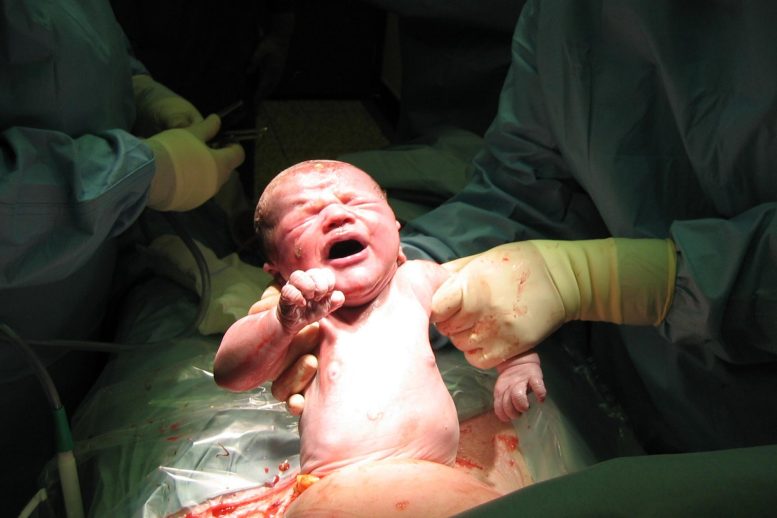
Cesarean deliveries are not associated with an increased risk of food allergy during the first year of life, according to a new study.
The research found cesarean delivery, either with or without labor, or elective or emergency, compared to vaginal birth does not impact on the likelihood of food allergy at 12 months of age. Led by the Murdoch Children’s Research Institute (MCRI), the study was published today (May 18, 2022) in the Journal of Allergy and Clinical Immunology: In Practice,
Murdoch Children’s Associate Professor Rachel Peters said the association between mode of delivery and the risk of food allergy had remained unclear prior to this study due to the lack of studies linking accurate food challenge outcomes to detailed information on the type of cesarean delivery.
The study involved 2045 infants from the HealthNuts study, with data linked to the Victorian Perinatal Data Collection to source detailed information on birth factors.
The study found of the 30 percent born by cesarean, 12.7 percent had a food allergy compared to 13.2 percent born vaginally.
“We found no meaningful differences in food allergy for infants born by cesarean delivery compared to those born by vaginal delivery,” Associate Professor Peters said. Additionally, there was no difference in the likelihood of food allergy if the cesarean was performed before or after the onset of labor, or whether it was an emergency or elective cesarean.”
Microbial Exposure and Immune System Development
Associate Professor Peters said it was thought a potential link between cesarean birth and allergy could reflect differences in early microbial exposure (bacteria from the mother’s vagina) during delivery.
“The infant immune system undergoes rapid development during the neonatal period,” she said. Mode of delivery may interfere with the normal development of the immune system. Babies born by cesarean have less exposure to the bacteria from the mother’s gut and vagina, which influences the composition of the baby’s microbiome and immune system development. However, this doesn’t appear to play a major role in the development of food allergy.”
Associate Professor Peters said the findings would assist caregivers in evaluating the risks and benefits of cesarean delivery and provide reassurance for mothers who require such interventions that there was little evidence that their baby was at an increased risk of food allergy.
Australia has the highest rates of childhood food allergy in the world, with about one in 10 infants and one in 20 children over five years of age having a food allergy.
Resolution of Peanut and Egg Allergies in Children
The findings come as new research, led by the Murdoch Children’s, also found 30 percent of peanut allergy and 90 percent of egg allergy naturally resolves by six years of age.
Associate Professor Peters said the resolution rates were great news for families and were even a little higher than what was previously thought.
The results, published in Journal of Allergy and Clinical Immunology, found infants with early-onset and severe eczema and multiple allergies were less likely to outgrow their egg and peanut allergies.
Associate Professor Peters said these infants should be targeted for early intervention trials that evaluate new treatments for food allergy such as oral immunotherapy.
“Prioritising research of these and future interventions for infants less likely to naturally outgrow their allergy would yield the most benefit for healthcare resources and research funding,” she said.
Real-Life Experiences: Coping with Food Allergies
Nicole McEvoy’s daughter Moira, 3, was diagnosed with an egg allergy at six months after having a life-threatening allergic reaction to a tiny amount of scrambled eggs.
“She stopped breathing and we thought she was choking but after undergoing several tests we learned it was anaphylaxis,” she said. We don’t have a family history of allergies so it never crossed our mind that any of our children would have food allergies.”
Nicole said the family always had to remain vigilant around food.
“It was easier to control when Moira was a baby but now that she is attending kindergarten, playdates, and birthday parties it’s always in the back of your mind that she could accidentally be given something containing egg,” she said. We have had to drill into her that she only takes food from mum and dad.”
Nicole said the latest research from the Murdoch Children’s comes as a welcome relief to her family.
“Knowing that 90 percent of egg allergy resolves by six years old age offers us a lot of hope and is hugely encouraging,” she said. It would be an enormous relief that if by the time Moira started school, the allergy had resolved and she wouldn’t have to worry about avoiding egg for the rest of her life.”
References: “Mode of Birth Is Not Associated With Food Allergy Risk in Infants” by Anne Currell, MEpi; Jennifer J. Koplin, PhD; Adrian J. Lowe, PhD; Kirsten P. Perrett, MBBS, PhD; Anne-Louise Ponsonby, MBBS, PhD; Mimi L.K. Tang, MBBS, PhD; Shyamali C. Dharmage, PhD and Rachel L. Peters, PhD, 18 May 2022, Journal of Allergy and Clinical Immunology: In Practice.
DOI: 10.1016/j.jaip.2022.03.031
“The natural history of peanut and egg allergy in children up to age 6 years in the HealthNuts population-based longitudinal study” by Rachel L. Peters, PhD; Imma Guarnieri, MBiostat; Mimi L.K. Tang, PhD; Adrian J. Lowe, PhD; Shyamali C. Dharmage, PhD; Kirsten P. Perrett, PhD; Lyle C. Gurrin, PhD and Jennifer J. Koplin, PhD, 18 May 2022, Journal of Allergy and Clinical Immunology.
DOI: 10.1016/j.jaci.2022.04.008
Researchers from the University of Melbourne, The Royal Children’s Hospital and The Florey Institute for Neuroscience and Mental Health also contributed to the findings.
Never miss a breakthrough: Join the SciTechDaily newsletter.
Follow us on Google and Google News.