
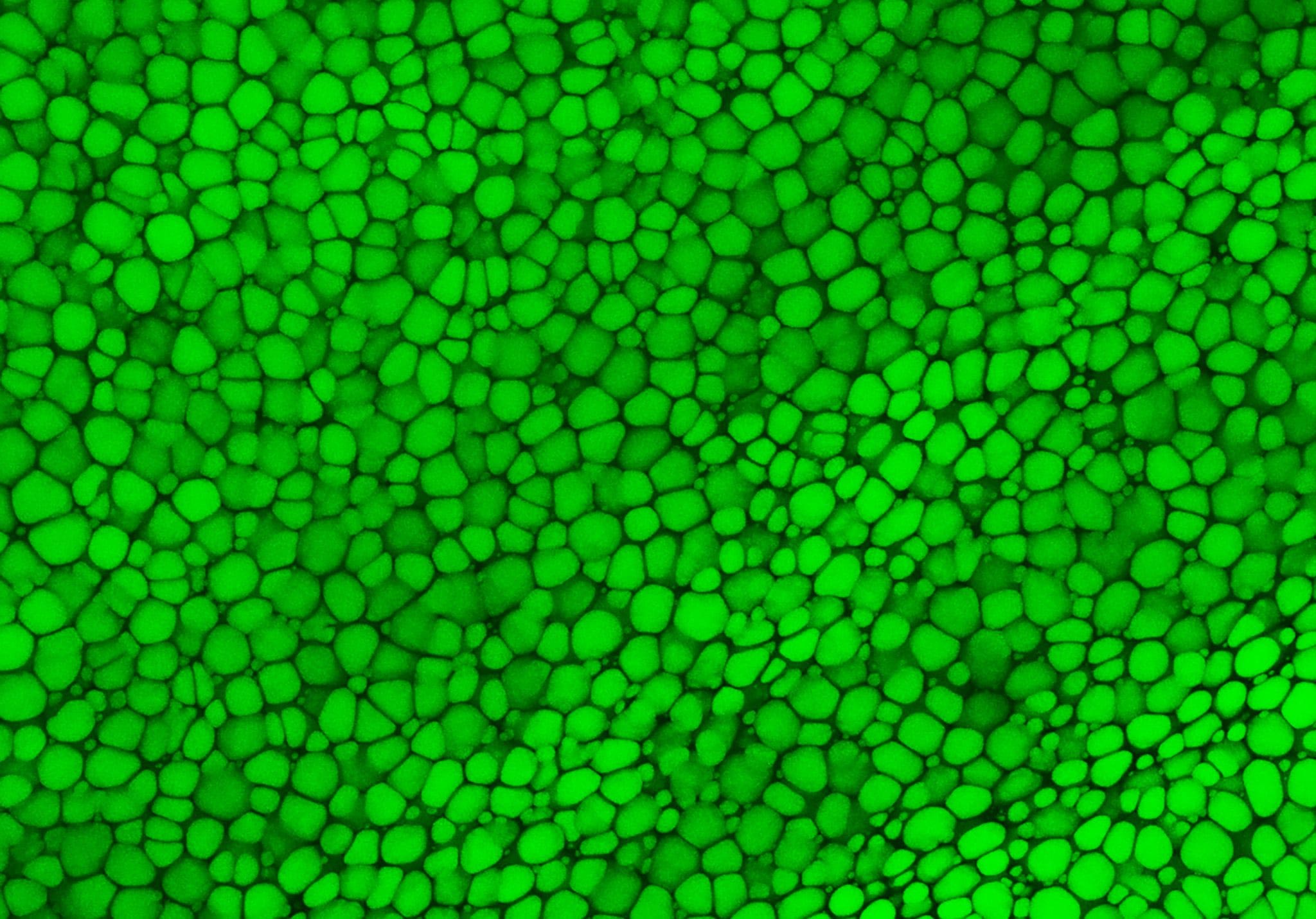
“Lipocartilage” possesses properties similar to bubble wrap—super-stable, soft, and, springy.
An international research team led by the University of California, Irvine has identified a newly discovered type of skeletal tissue with significant potential to advance regenerative medicine and tissue engineering.
Most cartilage relies on an external extracellular matrix for strength, but “lipocartilage,” which is found in the ears, nose and throat of mammals, is uniquely packed with fat-filled cells called “lipochondrocytes” that provide super-stable internal support, enabling the tissue to remain soft and springy – similar to bubbled packaging material.
Published in Science, the study explains how lipochondrocytes form and sustain their own lipid reserves, maintaining a constant size. Unlike typical fat cells (adipocytes), lipochondrocytes do not shrink or expand in response to changes in food intake.
“Lipocartilage’s resilience and stability provide a compliant, elastic quality that’s perfect for flexible body parts such as earlobes or the tip of the nose, opening exciting possibilities in regenerative medicine and tissue engineering, particularly for facial defects or injuries,” said corresponding author Maksim Plikus, UC Irvine professor of developmental and cell biology.
“Currently, cartilage reconstruction often requires harvesting tissue from the patient’s rib – a painful and invasive procedure. In the future, patient-specific lipochondrocytes could be derived from stem cells, purified, and used to manufacture living cartilage tailored to individual needs. With the help of 3D printing, these engineered tissues could be shaped to fit precisely, offering new solutions for treating birth defects, trauma, and various cartilage diseases.”
Rediscovery and Advanced Characterization
Dr. Franz Leydig first recognized lipochondrocytes in 1854, when he noted the presence of fat droplets in the cartilage of rat ears, a finding that was largely forgotten until now. With modern biochemical tools and advanced imaging methods, UC Irvine researchers comprehensively characterized lipocartilage’s molecular biology, metabolism and structural role in skeletal tissues.

They also uncovered the genetic process that suppresses the activity of enzymes that break down fats and reduce the absorption of new fat molecules, effectively locking lipochondrocytes’s lipid reserves in place. When stripped of its lipids, the lipocartilage becomes stiff and brittle, highlighting the importance of its fat-filled cells in maintaining the tissue’s combination of durability and flexibility.
Biological Significance and Future Research
In addition, the team noted that in some mammals, such as bats, lipochondrocytes assemble into intricate shapes, like parallel ridges in their oversized ears, which may enhance hearing acuity by modulating sound waves.
“The discovery of the unique lipid biology of lipocartilage challenges long-standing assumptions in biomechanics and opens doors to countless research opportunities,” said the study’s lead author, Raul Ramos, a postdoctoral researcher in the Plikus laboratory for developmental and regenerative biology.
“Future directions include gaining an understanding of how lipochondrocytes maintain their stability over time and the molecular programs that govern their form and function, as well as insights into the mechanisms of cellular aging. Our findings underscore the versatility of lipids beyond metabolism and suggest new ways to harness their properties in tissue engineering and medicine.”
Reference: “Superstable lipid vacuoles endow cartilage with its shape and biomechanics” by Raul Ramos, Kim T. Pham, Richard C. Prince, Leith B. Leiser-Miller, Maneeshi S. Prasad, Xiaojie Wang, Rachel C. Nordberg, Benjamin J. Bielajew, Jerry C. Hu, Kosuke Yamaga, Ji Won Oh, Tao Peng, Rupsa Datta, Aksana Astrowskaja, Axel A. Almet, John T. Burns, Yuchen Liu, Christian Fernando Guerrero-Juarez, Bryant Q. Tran, Yi-Lin Chu, Anh M. Nguyen, Tsai-Ching Hsi, Norman T.-L. Lim, Sandra Schoeniger, Ruiqi Liu, Yun-Ling Pai, Chella K. Vadivel, Sandy Ingleby, Andrew E. McKechnie, Frank van Breukelen, Kyle L. Hoehn, John J. RasweilerIV, Michinori Kohara, William J. Loughry, Scott H. Weldy, Raymond Cosper, Chao-Chun Yang, Sung-Jan Lin, Kimberly L. Cooper, Sharlene E. Santana, Jeffrey E. Bradley, Michael A. Kiebish, Michelle Digman, David E. James, Amy E. Merrill, Qing Nie, Thomas F. Schilling, Aliaksandr A. Astrowski, Eric O. Potma, Martín I. García-Castro, Kyriacos A. Athanasiou, Richard R. Behringer and Maksim V. Plikus, 10 January 2025, Science.
DOI: 10.1126/science.ads9960
The team included healthcare professionals and academics from the U.S., Australia, Belarus, Denmark, Germany, Japan, South Korea and Singapore, as well as staff from the Serrano Animal & Bird Hospital in Lake Forest and the Santa Ana Zoo. See the full list here.
This work was supported in part by the W.M. Keck Foundation under grant WMKF-5634988; UCI Beall Applied Innovation under Proof of Product grant IR-PR57179; LEO Foundation grants LF-AW-RAM-19-400008 and LF-OC-20-000611; Chan Zuckerberg Initiative grant AN-0000000062; Horizon Europe grant 101137006; National Institutes of Health grants U01-AR073159, R01- AR079470, R01-AR079150, R21-AR078939, P30-AR075047, R01-AR078389-01, R01-DE015038, R01-AR071457, R01-AR067821, R01GM152494, R01DE030565, TL1-TR001415, R01-DE013828, R01- DE30565, R01-HD073182, R01-AR067797, R01-DE017914 and MBRS-IMSD training grant GM055246; National Science Foundation grants DMS1951144, IOS-2421118, DMS1763272, CBET2134916, NSF-GRFP DGE-1321846 and MCB 2028424. Additional backing came from Simons Foundation grant 594598, the Yoshida Scholarship Foundation, a Howard A. Scheiderman Fellowship Award, the Ben F. Love Chair in Cancer Research at Baylor College of Medicine, the UC Riverside School of Medicine Dean’s Postdoc to Faculty Program and the Danish Cancer Society.
Never miss a breakthrough: Join the SciTechDaily newsletter.
Follow us on Google and Google News.
2 Comments
Al Gore invented skeletons!
Huh?