
Close Menu
    Facebook X (Twitter) Instagram
    SciTechDaily
    • Biology
    • Chemistry
    • Earth
    • Health
    • Physics
    • Science
    • Space
    • Technology
    Facebook X (Twitter) Pinterest YouTube RSS
    SciTechDaily
    Home»Biology»Scientists Reveal New Potential Therapeutic Targets for Mental and Neurological Disorders
    Biology

    Scientists Reveal New Potential Therapeutic Targets for Mental and Neurological Disorders

    By University of California - IrvineJanuary 31, 20231 Comment3 Mins Read
    Facebook Twitter Pinterest Telegram LinkedIn WhatsApp Email Reddit
    Share
    Facebook Twitter LinkedIn Pinterest Telegram Email Reddit
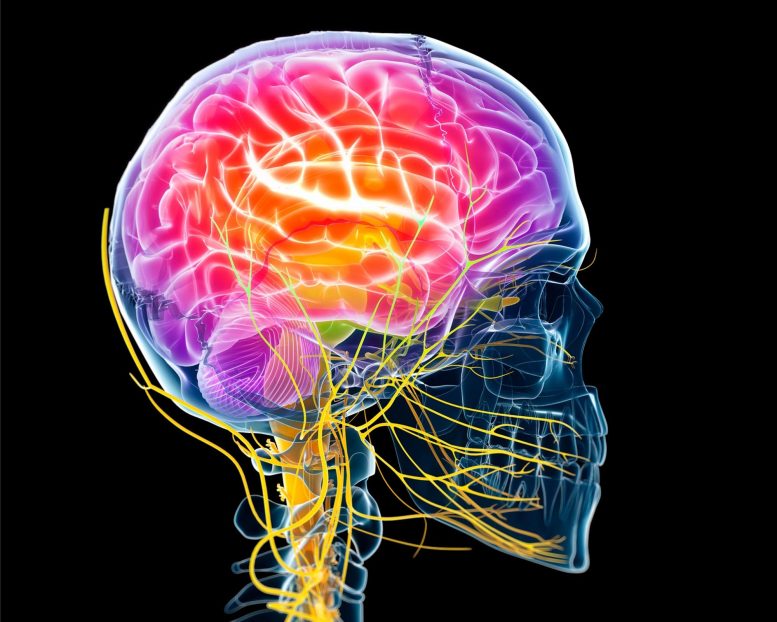
    Brain Skull Illustration
    Cilia are small, hair-like structures found on the surface of cells in the body. They are known to play important roles in various bodily functions, such as sensing the environment and moving fluids. In the brain, cilia have been found to play a crucial role in the striatum, a region that is involved in movement, motivation, and time perception. Recent research has revealed that cilia in the striatum play a key role in our ability to perceive time,

    UCI Researchers Have Discovered the Crucial Role of Cilia in the Striatum of the Brain in Time Perception

    A recent study from researchers at the University of California, Irvine found that the removal of cilia from the striatum region of the brain negatively impacted time perception and judgement, opening the possibility for new therapeutic targets for mental and neurological conditions such as schizophrenia, Parkinson’s and Huntington’s diseases, autism spectrum disorder, and Tourette syndrome.

    The striatum is responsible for processing and integrating new sensory information from the environment and coordinating the sequence of motor responses. In individuals with mental and neurological disorders, there is often a significant decline in the ability to adapt to changes in the environment and correctly estimate the timing and completion of voluntary actions.

    The study, which was recently published in the journal Molecular Neurobiology, uncovered the first evidence of the important role cilia play in timing-dependent dysfunction.

    “Our findings may revolutionize our understanding of brain functions and mental disorders in the context of the critical task performed by these previously unappreciated organelles in the brain’s ‘central clock’ function,” said Amal Alachkar, Ph.D., corresponding author, and professor of teaching in UCI’s Department of Pharmaceutical Sciences. “Our results may open new avenues for effective intervention through cilia-targeted therapies for treatment.”

    Cilia’s Role in Brain Circuitry and Executive Functions

    The striatum is part of the brain’s circuitry that performs central clock processes, essential in controlling executive functions such as motor coordination, learning, planning, and decision-making, as well as working memory and attention. Cilia protrude from the brain cell surfaces like antennae, working as a signaling hub that senses and transmits signals to generate appropriate reactions.

    To examine their physiological role, the researchers removed cilia from the striatum in mice using conditional gene manipulation technology. These rodents were not able to learn new motor tasks, showed repetitive motor behavior, and exhibited delays in decision-making. They were also deficient in rapidly recalling information about their location and orientation in space and in their ability to filter irrelevant environmental sensory information. However, the mice maintained habitual or already learned motor skills and long-term memories.

    “Successful performance of working memory, attention, decision-making, and executive function requires accurate and precise timing judgment, usually within a millisecond to a minute,” Alachkar said. “When that capacity is impaired, it means losing the ability to quickly adjust behavior in response to changes in external stimuli and failing to sustain appropriate, goal-oriented motor responses. Our ongoing work is aimed at understanding the mechanisms by which cilia regulate time perception and developing targeted therapies to improve behavioral deficits.”

    Reference: “Cilia in the Striatum Mediate Timing-Dependent Functions” by Wedad Alhassen, Sammy Alhassen, Jiaqi Chen, Roudabeh Vakil Monfared and Amal Alachkar, 2 November 2022, Molecular Neurobiology.
    DOI: 10.1007/s12035-022-03095-9

    The study was funded by the National Institutes of Health. 

    Never miss a breakthrough: Join the SciTechDaily newsletter.
    Follow us on Google and Google News.

    Autism Spectrum Disorder Brain Neuroscience Parkinson's Disease Popular Schizophrenia UC Irvine
    Share. Facebook Twitter Pinterest LinkedIn Email Reddit

    Related Articles

    Neural Surprises: Scientists Discover New Brain Mechanism

    Scientists May Have Discovered the First Sign of Autism: An Unusually Large Brain

    Synapse Surprise: Two Sisters’ Misfortune Leads to Unsettling Parkinson’s Discovery

    Cracking the Autism Code: Brain Study Reveals Four Distinct Subtypes

    Gene Mutation Linked to Autism Found to Overstimulate Brain Cells

    How Exercise Protects Against Neurodegenerative Diseases Like Alzheimer’s and Parkinson’s Disease

    New Model Helps Unravel Complex Psychiatric Disorders Such As Autism and Schizophrenia

    Natural Human Molecule Identified That Blocks Toxic Forms of Parkinson’s-Related Protein

    Researchers Uncover How the Brain Learns From Subconscious Stimuli

    1 Comment

    1. Teresa on February 1, 2023 3:55 pm

      Has anyone done a study on thiamine and confusion on the brain. Is there any neurologists that have scans of the brain that causes Kirsakoff anemia. What is the outcome for people that have this condition.

      Reply
    Leave A Reply Cancel Reply

    • Facebook
    • Twitter
    • Pinterest
    • YouTube

    Don't Miss a Discovery

    Subscribe for the Latest in Science & Tech!

    Trending News

    The Universe Is Expanding Too Fast and Scientists Can’t Explain Why

    “Like Liquid Metal”: Scientists Create Strange Shape-Shifting Material

    Early Warning Signals of Esophageal Cancer May Be Hiding in Plain Sight

    Common Blood Pressure Drug Shows Surprising Power Against Deadly Antibiotic-Resistant Superbug

    Scientists Uncover Dangerous Connection Between Serotonin and Heart Valve Disease

    Scientists Discover a “Protector” Protein That Could Help Reverse Hair Loss

    Bone-Strengthening Discovery Could Reverse Osteoporosis

    Scientists Uncover Hidden Trigger Behind Stem Cell Aging

    Follow SciTechDaily
    • Facebook
    • Twitter
    • YouTube
    • Pinterest
    • Newsletter
    • RSS
    SciTech News
    • Biology News
    • Chemistry News
    • Earth News
    • Health News
    • Physics News
    • Science News
    • Space News
    • Technology News
    Recent Posts
    • Scientists Overcome Major Quantum Bottleneck, Potentially Transforming Teleportation and Computing
    • Quantum Physics’ Strangest Problem May Hold the Key to Time Itself
    • Scientists Create “Liquid Gears” That Spin Without Touching
    • The Simple Habit That Could Help Prevent Cancer
    • Forgotten Medicinal Plant Shows Promise in Fighting Dangerous Superbugs
    Copyright © 1998 - 2026 SciTechDaily. All Rights Reserved.
    • Science News
    • About
    • Contact
    • Editorial Board
    • Privacy Policy
    • Terms of Use

    Type above and press Enter to search. Press Esc to cancel.