
Natural selection alters genes that control roundworms’ sense of smell.
- Artificial and natural selection affect the same genes in roundworms
- In both cases, genes are selected that allow worms to have a sharper sense of smell
- Worms with a heightened sense of smell can better assess surrounding resources, which plays a crucial role in survival
Evanston, Ill. — Charles Darwin was right.
In his 1859 book, “On the Origin of Species,” the famed scientist hypothesized that artificial selection (or domestication) and natural selection work in the same ways.
Now an international team, led by Northwestern University, has produced some of the first evidence that Darwin’s speculation was correct.
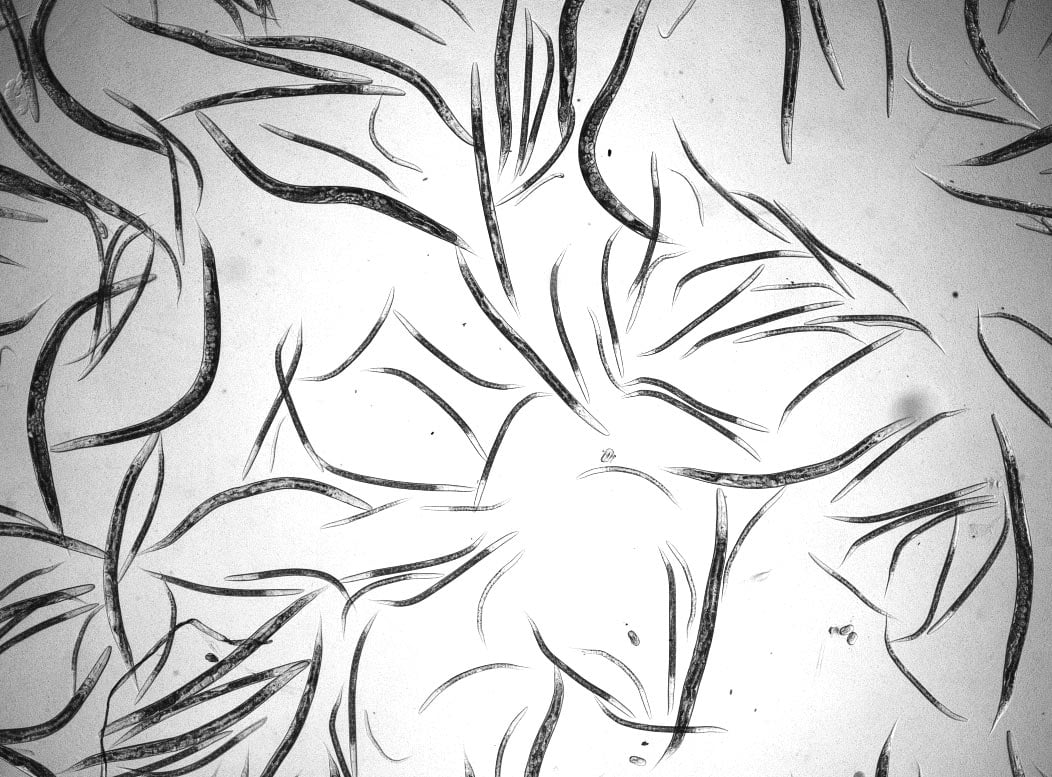
This time, the study’s subjects are not exotic birds in the Galapagos, but instead a roundworm, which relies on its sense of smell to assess the availability of food and nearby competition. In the Northwestern-led work, researchers found that natural selection acts on the same genes that control wild roundworms’ sense of smell as were previously found in domesticated worms in the lab.
“The evolution of traits is rarely connected to exact genes and processes,” said Northwestern’s Erik Andersen, who led the study. “We offer a clear example of how evolution works.”
The scientists used a combination of laboratory experiments, computational genomic analysis and field work. Their research also shows that natural selection acts on signal-sensing receptors rather than the downstream parts of the genetic process.
The study was published on September 23, 2019, in the journal Nature Ecology & Evolution. Andersen is an associate professor of molecular biosciences in Northwestern’s Weinberg College of Arts and Sciences.
A keystone model organism, C. elegans is a one-millimeter-long roundworm that lives in decaying organic matter — particularly rotten fruits — and feeds on bacteria. These roundworms are typically found in gardens and compost piles.
For C. elegans, having a keen sense of smell can be the difference between life or death. If they smell enough food in their environment, then they will stay, grow and reproduce. If they sense a shortage of food and/or too much competition from other worms, then they will undertake a long and potentially fatal journey in search of a more favorable environment. This process, called “dauer,” delays growth and reproduction.
In other words, dauer decreases reproductive success in the short term in order to ensure survival in the long run.
“At some point in their lives, these worms must make a gamble,” Andersen said. “In the time it takes for a worm to come out of dauer and start growing again, the worm that stayed behind has already been multiplying. If the food runs out, then the dauer worm made the right decision and wins. If the food doesn’t run out, then the dauer worm loses.”
Andersen and his collaborators found that evolution plays a significant role in a worm’s decision to stay or enter dauer. Some roundworms have one genetic receptor to process scents; other roundworms have two. The roundworms with two receptors have a heightened sense of smell, which allows them to better assess the availability of resources in their environment and make a better gamble.
“If worms can smell large numbers of worms around them, that gives them an advantage,” Andersen said. “This was discovered in a previous study of artificial selection in worms. Now we also found that result in natural populations. We can see specific evidence in these two genes that artificial and natural selection act similarly.”
###
The study, “Selection and gene flow shape niche-associated variation in pheromone response,” was supported by a National Science Foundation CAREER Award. Daehan Lee, a postdoctoral researcher in Andersen’s laboratory, was the paper’s first author.
Reference: “Selection and gene flow shape niche-associated variation in pheromone response” by Daehan Lee, Stefan Zdraljevic, Daniel E. Cook, Lise Frézal, Jung-Chen Hsu, Mark G. Sterken, Joost A. G. Riksen, John Wang, Jan E. Kammenga, Christian Braendle, Marie-Anne Félix, Frank C. Schroeder and Erik C. Andersen, 23 September 2019, Nature Ecology & Evolution.
DOI: 10.1038/s41559-019-0982-3
Never miss a breakthrough: Join the SciTechDaily newsletter.
Follow us on Google and Google News.
6 Comments
“…has produced some of the first evidence that Darwin’s speculation was correct.”
This is irresponsible in how inaccurate it is…
Should perhaps say “New work by team at Northwestern provides additional evidence of natural selection, in further contribution to the massive, irrefutable body of evidence already in the record.”
They’re still worms.
The fact that these worms are in any proximity to garbage argues for spontaneous generation. How else? Do they carpet the earth in profligate expectation that somewhere their progeny will find a dead mouse within a radius of what, one meter? Mindless,uninformed speculation from the lazy back row of the Internet.
What we are looking for is the addition of code within an established genome. Do some worms have 2 receptors because of new created genetic code? Or was the code already present? Do worms with only one receptor lack code because of less “evolution” or because they lost information? I saw nothing addressing these questions. It’s just more of the same. “We see differences that coincide with differences.” Show us an increase in genetic code. Show an example of mutation writing new and beneficial code. Because that is what Darwin ultimately proposed. That complexity in code happens all by itself. As a writer of code, I find the hypothesis insulting, asinine, and completely unfounded and unobserved.
This is a selection out of existing genes, not the creation of new ones. It’s the opposite of so called Darwinism evolution. Again Darwin’s theory falls flat.
This is change due to selection of existing genes, not the production of new genetic material, something that has never been observed and for which there is no known process. The article is a classic example of a belief system triumphing over known scientific evidence.