
Close Menu
    Facebook X (Twitter) Instagram
    SciTechDaily
    • Biology
    • Chemistry
    • Earth
    • Health
    • Physics
    • Science
    • Space
    • Technology
    Facebook X (Twitter) Pinterest YouTube RSS
    SciTechDaily
    Home»Science»Chemical Traces From Intense Starbursts Shed Light on Cosmic History
    Science

    Chemical Traces From Intense Starbursts Shed Light on Cosmic History

    By Catriona Kelly, University Of EdinburghJune 4, 2018No Comments3 Mins Read
    Facebook Twitter Pinterest Telegram LinkedIn WhatsApp Email Reddit
    Share
    Facebook Twitter LinkedIn Pinterest Telegram Email Reddit
    Chemical Traces Cast Light on Cosmic History
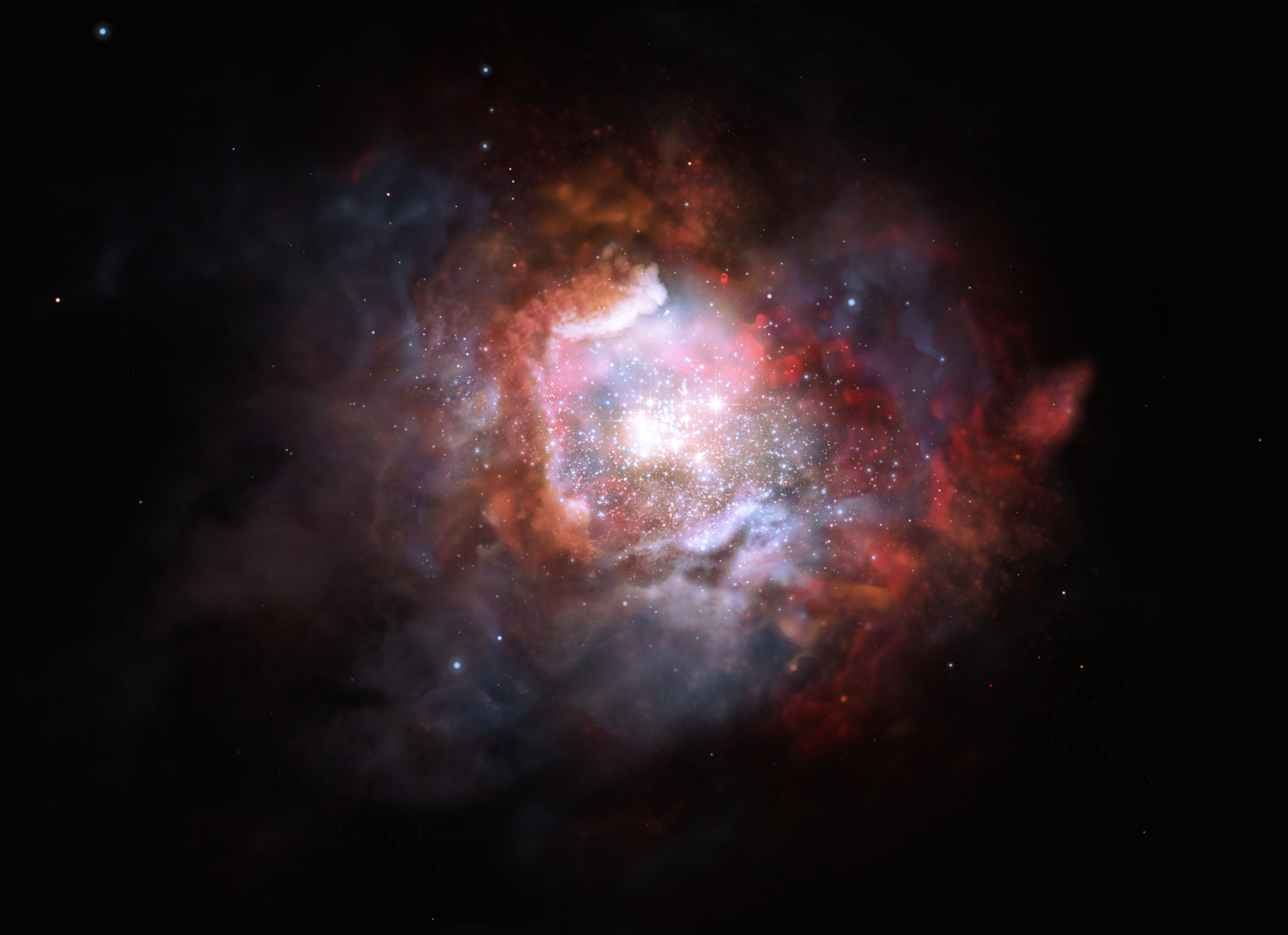
    Fresh insight into intense star formation, or starburst, events such as the one shown in this artist’s impression are challenging scientists’ understanding of the Universe. Credit: ESO/M.Kornmesser

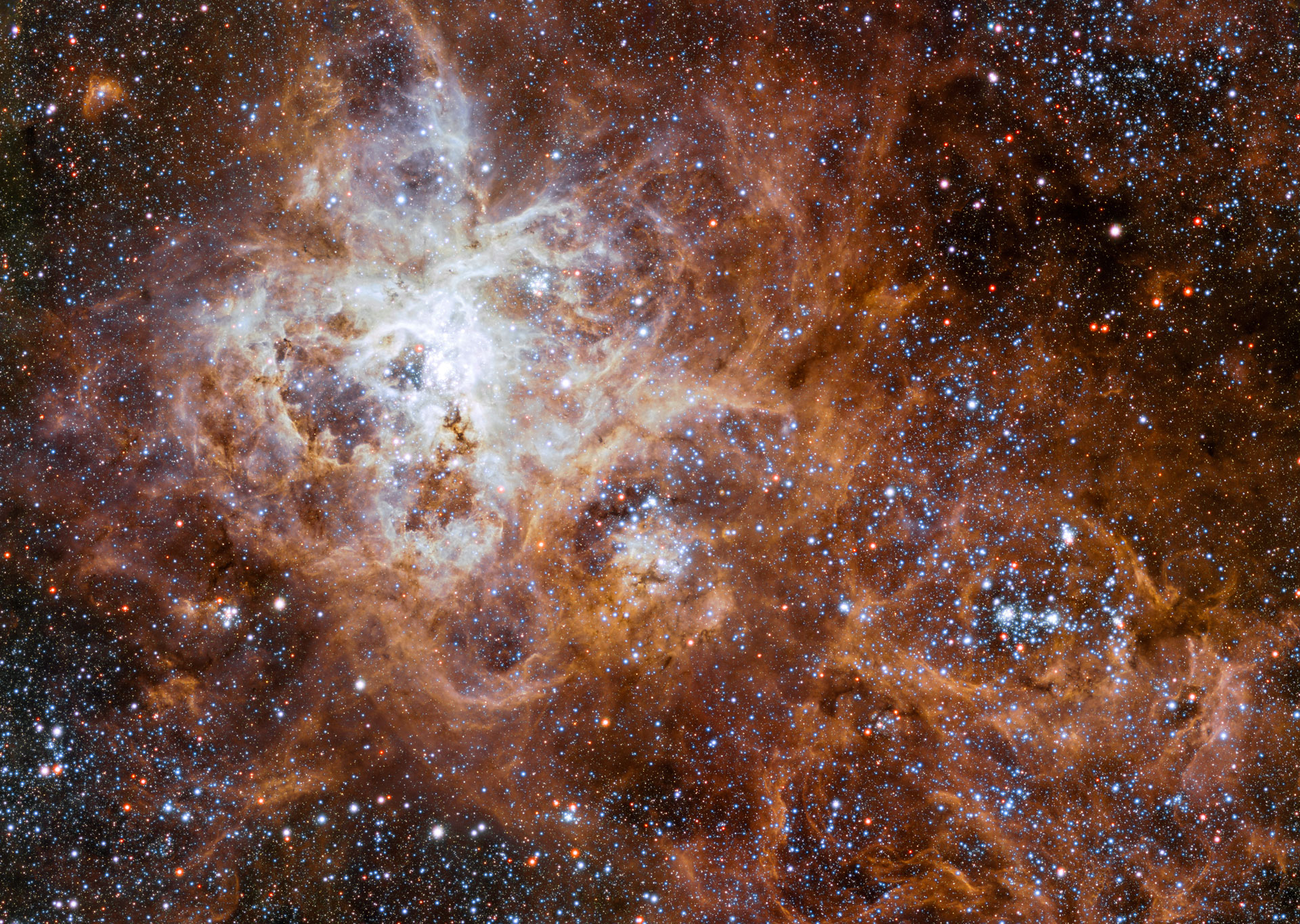
    Fresh insight into how stars are formed is challenging scientists’ understanding of the Universe.

    A study of intense starbursts – events in distant galaxies in which stars are generated hundreds or thousands of times faster than in our Milky Way – is changing researchers’ ideas about cosmic history. The findings will help scientists understand how galaxies in the early Universe evolve into those we see today.

    Instead of observing the optical light from starbursts, which is obscured by enormous quantities of dust, scientists instead observed radio waves, measuring the relative abundances of different types of carbon monoxide gas.

    They were able to differentiate between the gas expelled from massive stars, which shine very brilliantly for a short time, and that expelled from less massive stars, like our own Sun, which can shine steadily for billions of years.
    Tarantula Nebula
    Fresh insight into intense star formation events- – such as this gigantic star-forming region in the Large Magellanic Cloud galaxy — are challenging scientists’ understanding of the Universe. Credit: ESO

    Applying this novel technique for the first time, astronomers found that stars born inside galaxies undergoing a powerful starburst tend to be massive. In this regard, these are very different from those born inside galaxies that build up their stars over billions of years.

    Scientists verified their findings using powerful computer models based on the evolution of our Milky Way galaxy and by observing starburst galaxies in the early Universe, which formed within a few billion years of the Big Bang. Such young galaxies are unlikely to have undergone previous episodes of star formation, which might otherwise have confused the results.

    Researchers collected their data using the powerful ALMA telescope in the high Atacama Desert in Chile.

    The five-year study, published in Nature, was carried out by astronomers at the University of Edinburgh and the European Southern Observatory (ESO), working alongside experts in Italy and Greece. It was supported by the European Research Council.

    The ALMA telescope is operated by a partnership of the ESO, the US National Science Foundation, and the National Institutes of Natural Sciences of Japan, in cooperation with the Republic of Chile.

    Dr. Zhi-Yu Zhang, of the University of Edinburgh’s School of Physics and Astronomy, who led the study, said: “Traditional telescopes are of limited use when studying dusty starburst galaxies. We reached our results using a powerful new radio telescope, hunting for traces of chemical elements from past events. For astronomers, these are like fossils. The results challenge classical ideas about the formation of stars in galaxies across cosmic time.”

    Professor Rob Ivison, of the University of Edinburgh’s School of Physics and Astronomy and ESO, said: “Our findings lead us to question our understanding of cosmic history. Astronomers building models of the Universe must now go back to the drawing board, with yet more sophistication required.”

    Reference: “Stellar populations dominated by massive stars in dusty starburst galaxies across cosmic time” by Zhi-Yu Zhang, D. Romano, R. J. Ivison, Padelis P. Papadopoulos and F. Matteucci, 4 June 2018, Nature.
    DOI: 10.1038/s41586-018-0196-x

    Never miss a breakthrough: Join the SciTechDaily newsletter.
    Follow us on Google and Google News.

    Astronomy Cosmology Starbursts University of Edinburgh
    Share. Facebook Twitter Pinterest LinkedIn Email Reddit

    Related Articles

    Starburst Galaxies Contain Much Higher Proportions of Massive Stars

    Hubble Image of the Week – Starbursts in Virgo (NGC 4536)

    Hubble Image of the Week: Starburst Galaxy Messier 94

    New Model May Rule Out the Presence of Dark Matter

    Lyman-Alpha Blobs are Some of the Largest Individual Objects in the Observable Universe

    Large Globular Star Clusters Survive Collisions, Smaller Clusters Do Not

    Links Between Core Collapse Supernovae and Star Formation Established

    The Bolshoi Simulation: Boxing the Universe

    Baryon Oscillation Spectroscopic Survey Measures the Universe’s Expansion and Dark Energy

    Leave A Reply Cancel Reply

    • Facebook
    • Twitter
    • Pinterest
    • YouTube

    Don't Miss a Discovery

    Subscribe for the Latest in Science & Tech!

    Trending News

    Scientists Discover Bizarre 100-Million-Year-Old Insect With Giant Claws

    Scientists Discover “Good” Gut Microbes That Could Protect Against Autism and ADHD

    Scientists Reveal That Eating Almonds Every Day Could Transform Your Gut, Metabolism, and Appetite

    Scientists May Have Solved Two of Fusion Energy’s Biggest Problems at Once

    Scientists Discover Hidden “Switch” That Burns Fat and Could Treat Bone Disease

    After 50 Years of Mystery, Researchers Identify New Human Blood Group

    Beyond Pain Relief: Scientists Discover a Protein That Could Stop Osteoarthritis in Its Tracks

    Scientists Discover Why Alcohol Prevents the Liver From Healing, Even After You Quit

    Follow SciTechDaily
    • Facebook
    • Twitter
    • YouTube
    • Pinterest
    • Newsletter
    • RSS
    SciTech News
    • Biology News
    • Chemistry News
    • Earth News
    • Health News
    • Physics News
    • Science News
    • Space News
    • Technology News
    Recent Posts
    • NASA’s Roman Space Telescope Nears Launch for Epic Hunt Across the Universe
    • Ancient Mega-Floods Once Ripped Across Mars and Left This Giant Scar
    • Scientists Just Used Sunlight To Pull Off a Quantum Physics Feat Once Thought Impossible
    • Scientists Discover “Immature” Brain Cells That May Defy Alzheimer’s
    • Children of Centenarians Share One Surprising Habit That May Boost Longevity
    Copyright © 1998 - 2026 SciTechDaily. All Rights Reserved.
    • Science News
    • About
    • Contact
    • Editorial Board
    • Privacy Policy
    • Terms of Use

    Type above and press Enter to search. Press Esc to cancel.