
Close Menu
    Facebook X (Twitter) Instagram
    SciTechDaily
    • Biology
    • Chemistry
    • Earth
    • Health
    • Physics
    • Science
    • Space
    • Technology
    Facebook X (Twitter) Pinterest YouTube RSS
    SciTechDaily
    Home»Space»Chemistry Might Influence Habitable Zones Around Extrasolar Systems
    Space

    Chemistry Might Influence Habitable Zones Around Extrasolar Systems

    By SciTechDailyFebruary 2, 2012No Comments3 Mins Read
    Facebook Twitter Pinterest Telegram LinkedIn WhatsApp Email Reddit
    Share
    Facebook Twitter LinkedIn Pinterest Telegram Email Reddit
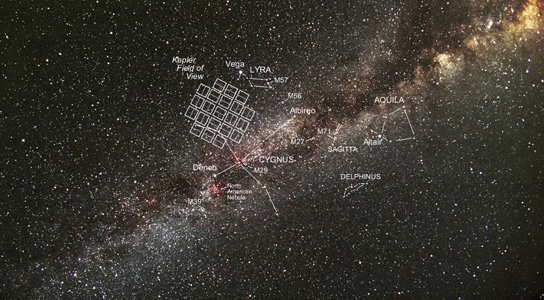
    kepler-field-of-view
    Researchers created computer models to explore how variations in eight elements—carbon, oxygen, sodium, aluminum, silicon, magnesium, calcium, and titanium—could influence the behavior of F, G, and K-type stars, the ones most similar to our Sun.

    Trace elements in extrasolar systems might influence the evolution of habitable zones around their stars, where carbon-based life as we know it might dwell. Most stars are made up of hydrogen and helium gas, but there still remain traces of heavier elements, like metals, that are inherited from the remnants of older stars or forged by stellar fusion.

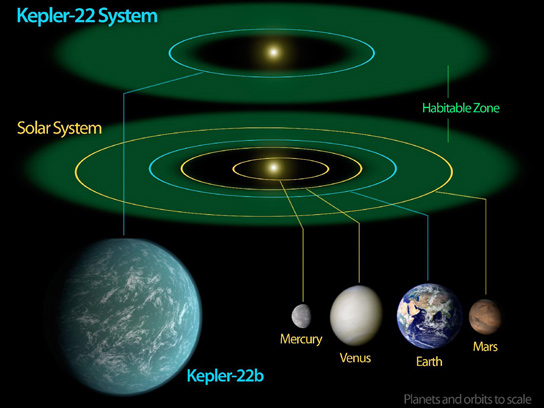
    Scientists are able to detect what elements a particular star possesses by looking at the light it emits, which comes in a variety of different wavelengths. The habitable zone of a star is defined by whether liquid can survive on its surface, since all life as we know it exists where there is water. If the exoplanet is too far from its star, then the water becomes frozen. If it’s too close, it might boil away.
    habitable-zones-kepler

    Patrick Young, a theoretical astrophysicist and astrobiologist at Arizona State University, and his colleagues generated computer models for how the variation in eight elements, carbon, oxygen, sodium, aluminum, silicon, magnesium, calcium, and titanium, might affect the behavior of F, G, and K-type stars, which are the most similar to Sol.

    A higher opacity of stable objects traps the energy of fusion more efficiently and results in a larger radius, cooler star, states Young. More efficient use of energy means that the stellar furnace can proceed slower, resulting in a star with a longer lifetime.

    spacer-volcano

    The scientists found that the presence of calcium, sodium, magnesium, aluminum and silicon had small but significant effects on a star’s evolution. Higher levels of these resulted in cooler, redder stars. Oxygen also played a key role to alter a star’s lifetime and its habitable zone.

    Oxygen-depleted stars had a lifetime of 3.5 billion years, while oxygen-rich stars had one of 8.5 billion years. Earth will remain habitable for another billion years, for about 5.5 billion years in total. After that, the sun will become too hot. It took complex cellular life 3.9 billion years to evolve, so low-oxygen stars aren’t suitable candidates for finding extrasolar life.

    Kepler has detected worlds in the habitable zone around their stars. Certain key minerals, such as magnesium silicate, silicon dioxide, magnesium orthosilicate, and magnesium oxide in planets, which are a good for life to arise, come from an appropriate carbon-oxygen and magnesium-silicon ratio in their parent stars.

    Never miss a breakthrough: Join the SciTechDaily newsletter.
    Follow us on Google and Google News.

    Astrobiology Astrophysics Exoplanet Habitable Kepler Space Telescope
    Share. Facebook Twitter Pinterest LinkedIn Email Reddit

    Related Articles

    Scientists Say This Hellish “Day-Night” Planet May Support Life

    Kepler-76b: A Hot Jupiter With Superrotation

    Two New Extrasolar Planets KOI-200b and KOI-889b Detected

    Astronomers Use “Characterization by Proxy” to Learn the Nature of Kepler-61

    Water Planets in the Habitable Zone: A Closer Look at Kepler 62e and 62f

    Scientists Detected Exoplanetary System With Regularly Aligned Orbits Similar to Our Solar System

    Astronomers Obtain Precise Measurements of the Two Kepler-16 Stars

    Tidal Heating Suggests Less Habitable Planets

    NASA’s Kepler Mission Discovers 11 New Extrasolar Systems with 26 Exoplanets

    Leave A Reply Cancel Reply

    • Facebook
    • Twitter
    • Pinterest
    • YouTube

    Don't Miss a Discovery

    Subscribe for the Latest in Science & Tech!

    Trending News

    New Study Reveals Why Ozempic Works Better for Some People Than Others

    Climate Change Is Altering a Key Greenhouse Gas in a Way Scientists Didn’t Expect

    New Study Suggests Gravitational Waves May Have Created Dark Matter

    Scientists Discover Why the Brain Gets Stuck in Schizophrenia

    Scientists Engineer “Tumor-Eating” Bacteria That Devour Cancer From Within

    Even “Failed” Diets May Deliver Long-Term Health Gains, Study Finds

    NIH Scientists Discover Powerful New Opioid That Relieves Pain Without Dangerous Side Effects

    Collapsing Plasma May Hold the Key to Cosmic Magnetism

    Follow SciTechDaily
    • Facebook
    • Twitter
    • YouTube
    • Pinterest
    • Newsletter
    • RSS
    SciTech News
    • Biology News
    • Chemistry News
    • Earth News
    • Health News
    • Physics News
    • Science News
    • Space News
    • Technology News
    Recent Posts
    • Why Some People Reach 100: New Study Reveals Key Biological Differences
    • This Is How Ovarian Cancer Spreads Before Doctors Can Detect
    • Scientists Discover Hidden Virus Linked to Colorectal Cancer
    • Hidden Danger: Widely Used Pesticides Linked to 150% Higher Cancer Risk
    • The Mystery of the Notes: Why No One Knows How This 120-Year-Old Song Should Sound
    Copyright © 1998 - 2026 SciTechDaily. All Rights Reserved.
    • Science News
    • About
    • Contact
    • Editorial Board
    • Privacy Policy
    • Terms of Use

    Type above and press Enter to search. Press Esc to cancel.