
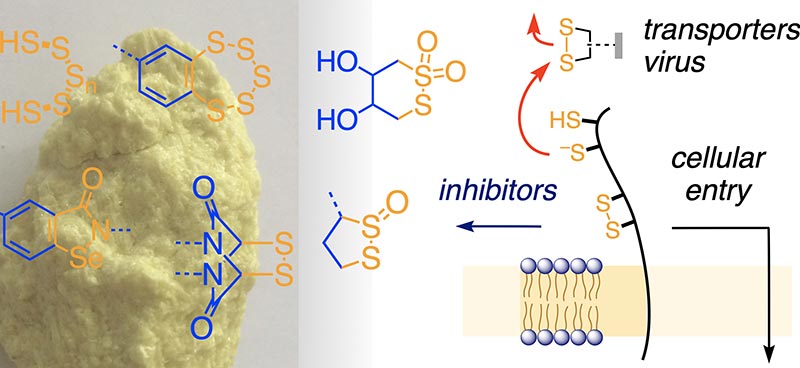
Some viruses can get inside cells via a mechanism that involves sulfur organic molecules. Chemists at UNIGE have discovered effective inhibitors and blocked the uptake of SARS-CoV-2.
The cell membrane is impermeable to viruses: to get inside and infect a cell, they use a range of strategies to exploit the cellular and biochemical properties of the membranes. The thiol-mediated uptake of organic molecules similar to alcohols, where oxygen is replaced by a sulfur atom, is one of the entry mechanisms, with its use by Human Immunodeficiency Virus (HIV) demonstrated a few years ago. No effective inhibitor is currently available because of the robustness of the chemical reactions and bonds at work. A research group from the University of Geneva (UNIGE) has identified inhibitors that are up to 5,000 times more effective than the one most often used today. Preliminary tests – published and available free of charge in Chemical Science, the flagship journal of the Royal Society of Chemistry – demonstrate the blocking of the cellular entry of viruses expressing the SARS-CoV-2 proteins. The study paves the way for research into new antivirals.
Since 2011, the laboratory led by Professor Stefan Matile in UNIGE’s Department of Organic Chemistry, member of the two National Centre of Competence in Research (NCCR) Chemical Biology and Molecular Systems Engineering, has been investigating the way thiols react with other structures containing sulfur: sulfides, molecules where sulfur is combined with another chemical element. “These are very special chemical reactions because they can change state dynamically,” begins Professor Matile. In fact, covalent bonds, based on sharing electrons between two atoms, freely oscillate between sulfur atoms, depending on conditions.
Passing the cell membrane
Sulfur compounds are present in nature, particularly on the membrane of eukaryotic cells and on the envelope of viruses, bacteria, and toxins. Studies suggest that they play a role in one of the mechanisms – known as thiol-mediated uptake – that enables the very difficult passage from outside to inside the cell. This key step involves the dynamic bond between thiols and sulfides. “Everything that approaches the cell can connect to these dynamic sulfur bonds,” continues Professor Matile. “They cause the substrate to enter the cell either by fusion or endocytosis, or by direct translocation through the plasma membrane into the cytosol.” Studies a few years ago showed that the entry of HIV and diphtheria toxin use a mechanism involving thiols.
“This chemistry is well known, but no one believes it was involved in cellular uptake,” says the professor, who explains that this skepticism on the part of the scientific community is probably due to the lack of inhibitor available to test it. “The involvement of membrane thiols in cellular uptake is usually tested by inhibition using Ellman’s reagent. Unfortunately, this test isn’t always reliable, partly because of the relatively low reactivity of Ellman’s reagent faced with the high reactivity of thiols and sulfides.”
The quest for an inhibitor
While Stefan Matile’s laboratory was working on writing a bibliographic review on the subject during the first Swiss lockdown in the spring of 2020, it began looking for a potential inhibitor, thinking that it could prove useful as an antiviral against SARS-CoV-2. Professor Matile’s coworkers reviewed potential inhibitors and carried out in vitro cellular uptake tests of sulfur molecules marked with fluorescent probes to assess their presence inside cells using fluorescence microscopy.
Molecules up to 5,000 times more effective than Ellman’s reagent were identified. With these excellent inhibitors in hand, the laboratory threw itself into viral tests with the help of Neurix, a Geneva-based start-up. They modified laboratory viruses, called lentivectors, expressing the proteins of the SARS-CoV-2 viral envelope pandemic safely and harmlessly. One of the inhibitors was found to be effective at blocking the virus’s entry into cells in vitro. “These results are at a very early stage and it would be entirely speculative to say we’ve discovered an antiviral drug against coronavirus. At the same time, this research shows that thiol-mediated uptake could be an interesting line of enquiry for developing future antivirals,” concludes Professor Matile.
Reference: “Inhibitors of thiol-mediated uptake” by Yangyang Cheng, Anh-Tuan Pham, Takehiro Kato, Bumhee Lim, Dimitri Moreau, Javier López-Andarias, Lili Zong, Naomi Sakai and Stefan Matile, 18 November 2020, Chemical Science.
DOI: 10.1039/D0SC05447J
Never miss a breakthrough: Join the SciTechDaily newsletter.
Follow us on Google and Google News.