
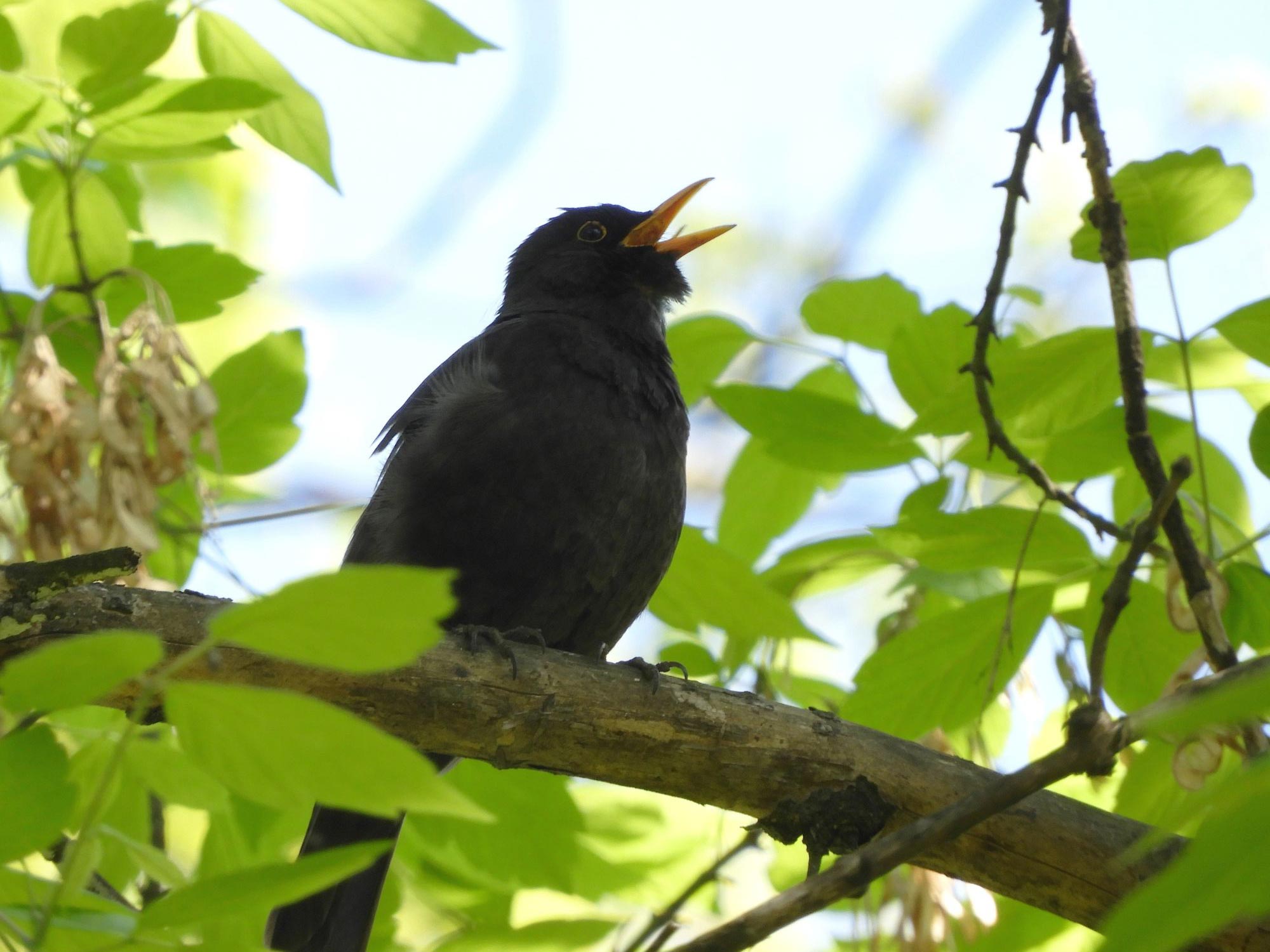
Chinese Blackbirds can mimic electric moped alarms, though their imitations are simplified. A new study shows this mimicry is more common than expected and may involve copying both the source and other birds, prompting further research into urban sound influence on birdsong.
Many songbirds are capable of mimicking a wide range of sounds, including those made by other bird species, amphibians, and even insects, particularly during the breeding season. This vocal mimicry is thought to play a role in courtship displays. In captivity, birds such as parrots are well known for imitating human-made sounds, including human speech.
However, according to Changjian Fu, an ornithologist and PhD candidate at the Lab of Animal Behavior and Conservation at Nanjing University in China, reports of wild birds mimicking human-made sounds remain anecdotal. To date, no scientific study has conducted a systematic or quantitative investigation of this phenomenon.
To that end, Fu and his colleagues described in a study published in the KeAi journal Avian Research how human-made sounds and those imitated by birds differ through quantitative investigations.
“We started by looking for a mimic living next to human communities. Under this scenario, urban birds provide us with an ideal object,” shares Fu. “We noticed that some Chinese Blackbirds (Turdus mandarinus) living in our campus can produce some sounds like alarms of electric mopeds incorporated in their songs sometimes. This is interesting because this kind of alarm is challenging sounds to produce.”
Investigating the Mimicry of Electric Mopeds
Consequently, the researchers decided to quantitatively investigate the electric moped sound mimicry in Chinese Blackbirds to understand the acoustic differences between the mimicry and sounds of real electric mopeds.
“We knew that male Chinese Blackbirds produce very large song repertoires, including various song types, mimicry, and their species-specific songs,” says Fu. “Nonetheless, It was a very challenging endeavor because Chinese Blackbirds can imitate a lot of sounds from other birds, and their species-specific songs are also various.”

During the study, which involves six months of field work and recording of over 40 electric moped sounds and 26 male Chinese Blackbirds’ song repertoires – including a total of 3,041 songs – the team discovered that the males (50%) could imitate the alarms of electric mopeds, and 84 songs contained the mimetic alarms (2.8%).
Simplified Imitation
“Mimicking human-made sounds in Chinese Blackbirds is more common than we think. However, we found obvious differences between these imitations and the real sounds,” adds Fu.
The team also discovered that, although the mimicry sounded vivid, quantitative analysis revealed obvious differences between the two sounds. Mimetic alarms possessed lower frequencies and fewer notes than the real alarms.
“As human-made sounds are difficult to produce, Chinese Blackbirds copy a simplified version of these sounds,” explains Fu. “We also found that the mimetic sounds from different sites also differed in acoustic structures. Chinese Blackbirds seem to imitate the sounds not only from electric mopeds directly, but also from other conspecific neighbors, which is known as ‘secondary mimicry.’”
Human-sound mimicry in songbirds may be universal, and its development is a complex process. The authors note that further studies should include how many human-made sounds are imitated, the mimicry accuracy, and the correlation between urbanization progress and the proportion of human-made sounds in mimetic repertoires of songbirds.
Reference: “Chinese Blackbirds (Turdus mandarinus) mimic electric moped sounds with lower consistency and frequencies” by Changjian Fu, Vishal Kumar Prasad, Xiaochun Wang and Zhongqiu Li, 21 February 2025, Avian Research.
DOI: 10.1016/j.avrs.2025.100231
The study was funded by the National Key Research and Development Program of China and the Western Light-Key Laboratory Cooperative Research Cross-Team Project of Chinese Academy of Sciences.
Never miss a breakthrough: Join the SciTechDaily newsletter.
Follow us on Google and Google News.