
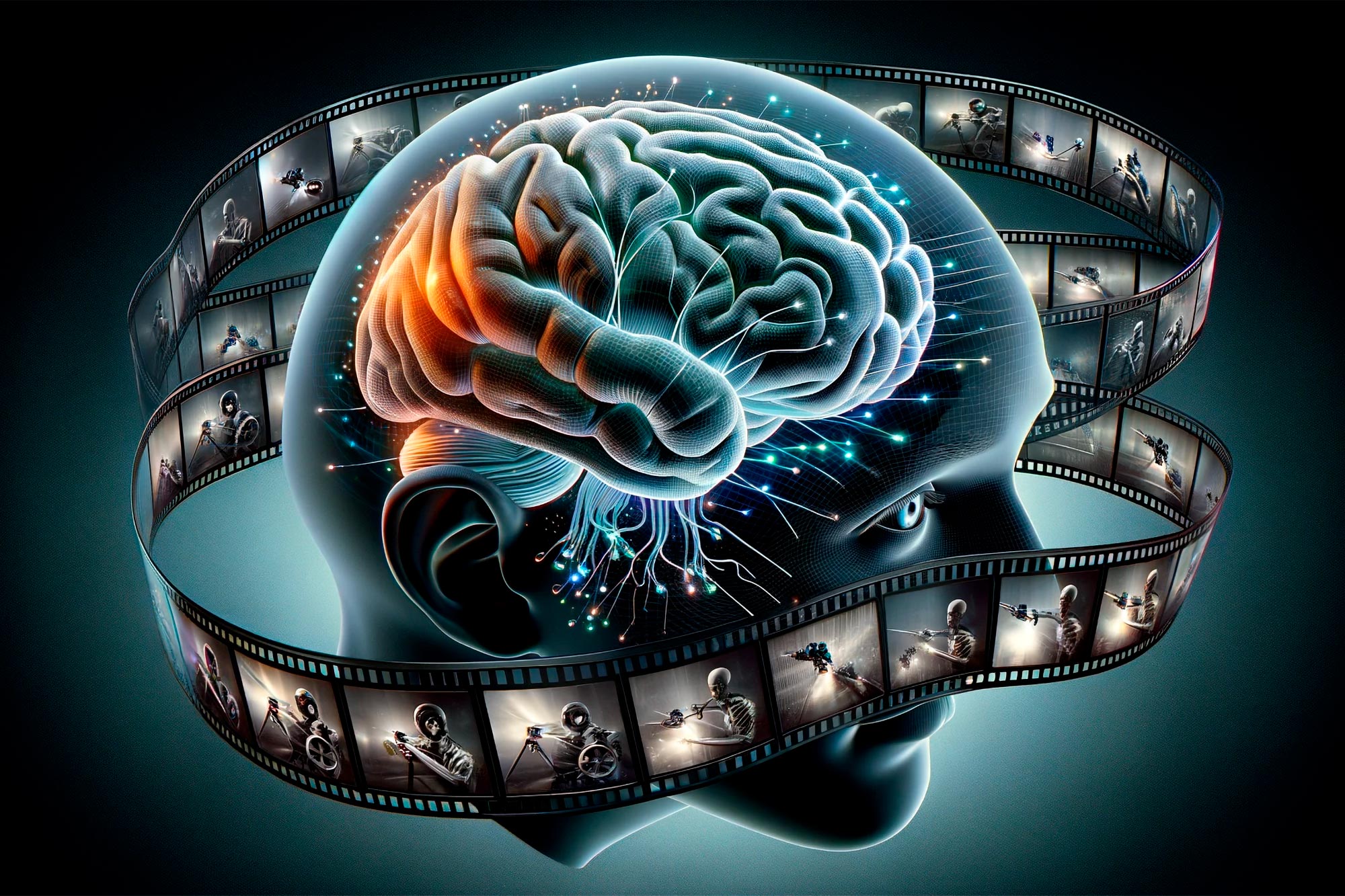
New research on the continuity illusion uncovers how the brain perceives smooth motion, emphasizing the superior colliculus’s importance and suggesting new approaches for neuroscience research and clinical practice.
A study by a team at the Champalimaud Foundation (CF) has cast a new light on the superior colliculus (SC), a deep-seated brain structure often overshadowed by its more prominent cortical neighbor. Their discovery uncovers how the SC may play a pivotal role in how animals see the world in motion, and sheds light on the “continuity illusion,” an essential perceptual process integral to many of our daily activities, from driving vehicles to watching movies.
Understanding the Continuity Illusion
Imagine watching a film. The moving images you see are actually a series of static frames shown rapidly. This is the continuity illusion at work, where our brain perceives a sequence of quick flashes as continuous, smooth motion. It’s a phenomenon not just vital to our enjoyment of films but also a fundamental aspect of how all mammals, from humans to rats, perceive the dynamic world around them. This study from the CF’s Shemesh Lab, published today (February 12) in Nature Communications, delves into how this illusion is encoded in the brain.
The Science of Perception
The speed at which flashes must occur for our brain to see them as constant rather than flickering is known as the Flicker Fusion Frequency (FFF) threshold. This threshold varies among animals; for instance, birds, which need to see fast movements, have a higher threshold than humans, which means they can still perceive light as flickering, rather than continuous, even when it’s blinking very rapidly. The FFF threshold is also important in nature, such as in predator-prey interactions, and can be affected by certain diseases like liver disorders or eye conditions like cataracts.
Interestingly, different methods of measuring this threshold, like observing animal behavior or recording electrical activity in the eyes or the cortex (the brain’s outer layer that processes what we see), can give different results. This suggests that other parts of the brain also play a role in how we perceive flickering light.
In this study, researchers combined functional MRI (fMRI) brain scans, behavioral experiments, and electrical recordings of brain activity to understand how this process works. Their findings indicate that the SC is vital in the transition from seeing individual flashes to smooth motion, and that it may be a key component in the creation of the continuity illusion.
A Three-Pronged Attack
“This project was really a ground-up endeavor, and began as a conversation between two PhD students at CF,” notes Noam Shemesh, senior author of the study. “Rita Gil, a student in my lab, was exploring the rat brain’s responses to different light frequencies with MRI. Her discussions with Mafalda Valente, in the lab of Alfonso Renart, led to the development of a behavioral task in which rats were trained to distinguish between flashes and continuous light.
Using the MRI and behavioral data, they also recorded the brain’s electrical activity during light stimulation. This approach enabled them to measure and compare FFF thresholds using three distinct methods: MRI, behavioral experiments, and electrophysiology. This multimodal approach is quite rare, and is really what sets this study apart. We’re also grateful to Alfonso Renart for the interesting discussions that contributed to this research.”
Bridging Behavioral and Biological Data
For the fMRI experiments, rats were shown visual stimuli at frequencies ranging from low to high. To minimize movement and ensure stable brain imaging, the animals were lightly sedated.
“fMRI is a non-invasive technique that tracks changes in blood flow, which are indicative of neural activity in the brain,” explains Gil. “One of the advantages of fMRI is its ability to map brain activity throughout the entire visual pathway, simultaneously capturing activity from multiple regions.”
The goal was to observe how the brain shifts from perceiving individual flashes of light (static vision) to a continuous flow of light (dynamic vision), and to pinpoint the brain regions involved.
“When we looked at the SC,” says Gil, “we found markedly different responses based on the frequency of visual stimuli. As the frequency of the visual stimulus increased, moving towards continuous light perception, there was a shift in the SC’s response from positive to negative fMRI signal regimes.”
Positive signals reflect increased neural activity, while negative signals potentially signify the opposite. Based on these observations, a hypothesis began to form: might the transition from static to dynamic vision in the continuity illusion involve the suppression of activity in the SC?
To answer this question, they next turned to behavioral experiments. Rats were trained in a specially designed box, where they learned to go to one side port if they perceived the light as flickering, and to the other if they perceived it as continuous. Correct choices were rewarded with water to reinforce the learning. By varying the light frequencies displayed, the team recorded at which point the rats perceived the flickering light as continuous.
When they compared the behavioral data with the fMRI data, they made a surprising discovery: the change from positive to negative fMRI signals in the SC at certain frequencies matched the frequencies at which rats behaviourally perceived the shift from flickering to continuous light.
Given that the SC showed the strongest correlation between behavior and fMRI data compared to other brain areas, the researchers targeted it for electrophysiological recordings, directly measuring the electrical activity of its neurons. They used light sedation to maintain consistency with the fMRI conditions. Their aim was to better understand the specific neural mechanisms involved when rats perceive flickering versus continuous light. Did the positive and negative signals detected in fMRI correspond to neural activity and suppression, respectively, as they had hypothesized?
At low light frequencies where rats discerned individual flashes, the researchers observed increased neural activity corresponding to each flash. At higher frequencies perceived as continuous light, the neural responses to these individual flashes diminished, and instead, there were more pronounced responses at both the start and the end of the light stimulation. Notably, there was a marked suppression of neural activity in between these initial (onset) and final (offset) peaks.
Valente notes, “Our measurements of electrical activity in the SC aligned well with our fMRI data, which exhibited onset and offset peaks surrounding the negative signals at higher frequencies. These electrophysiological recordings support the notion that the positive and negative signals recorded in fMRI do indeed represent neural activity and suppression, respectively. It seems that this suppression happens when animals enter a state of dynamic vision mode, potentially serving as a key contributor to flicker fusion and the continuity illusion.”
Reflecting on the study, Valente shares, “What really surprised us was how closely the fMRI signals in the SC matched the behavioural data, even more than those in the cortex, which is typically seen as the main visual processing area in mammals. Equally striking was to find the same patterns in the SC even after we had intentionally disabled the cortex, suggesting that these signals originate in the SC itself and are not just a result of activity from the cortex.”
Gil continues, “This points to the SC’s role as a novelty detector. For instance, at lower light frequencies, each flash seems to be processed as a new event by the SC. But as the frequency increases beyond a certain point, the SC appears to decide the stimulus is no longer new or noteworthy, leading to reduced activity. This could account for the pattern of increased activity at the start and end of high-frequency stimulation, with periods of suppression in between.”
Implications and Future Directions
“Our findings provide a roadmap for how neuroscience experiments could be conducted in the future,” concludes Shemesh. “By initially using fMRI to present stimuli, researchers can efficiently pinpoint which brain regions to focus on for more detailed electrophysiological studies. This approach not only saves time and resources but also capitalizes on fMRI’s strength in reflecting the population activity of brain regions. While it doesn’t offer the granular detail of single-cell activity, fMRI’s ability to show the bigger picture – whether there’s more brain activation or suppression – makes it a valuable first step in guiding subsequent experiments.”
The authors believe that their findings hold relevance for clinical applications. In cases of individuals with visual impairments, optic nerve diseases, or conditions like autism and stroke, this study offers new avenues for both assessment and potential treatment of visual dysfunctions. By determining and comparing FFF thresholds in these individuals against those in healthy populations, and observing how these thresholds evolve, it may be possible to gauge the adaptability of specific brain regions. This could lead to an understanding of which areas of the brain remain amenable to treatment, paving the way for the development of targeted therapeutic interventions.
Looking ahead, the researchers aim to identify which specific cell types in the SC are responsible for the activities they observed. Their broader objective is to deepen our comprehension of the roles of various brain regions within the visual pathway, combining experimental techniques such as targeted lesions or visual deprivation along with MRI studies.
These strategies promise to provide a deeper insight into the adaptability and function of visual regions, refining our current model of how each area contributes to visual perception. So, the next time you’re watching a movie, experiencing the illusion of fluid motion from the rapid succession of frames, spare a thought for the intricate processes at play in your brain, and for the ongoing research efforts to unravel them.
Reference: “Rat superior colliculus encodes the transition between static and dynamic vision modes” by Rita Gil, Mafalda Valente and Noam Shemesh, 12 February 2024, Nature Communications.
DOI: 10.1038/s41467-024-44934-8
Never miss a breakthrough: Join the SciTechDaily newsletter.
Follow us on Google and Google News.
2 Comments
If there are those of us who can discern the timely manifest of a premonition then a flickering light offers no challenge….1113
What is the effect of flickering light on people’s lives and what is the achievement of your research for people