
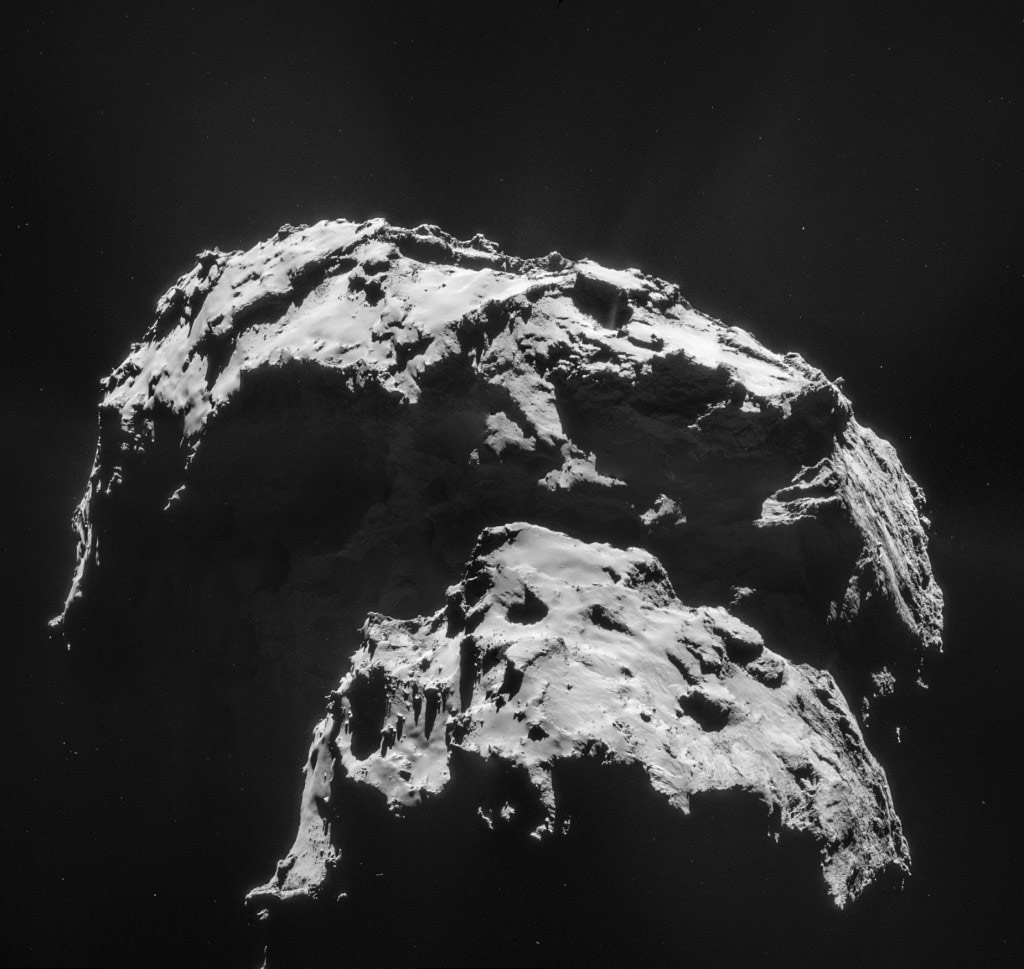
New research from NASA’s Jet Propulsion Laboratory used a cryostat instrument, nicknamed “Himalaya,” to study the icy conditions under which comets form.
Astronomers tinkering with ice and organics in the lab may have discovered why comets are encased in a hard, outer crust.
Using an icebox-like instrument nicknamed Himalaya, the researchers show that fluffy ice on the surface of a comet would crystallize and harden as the comet heads toward the sun and warms up. As the water-ice crystals form, becoming denser and more ordered, other molecules containing carbon would be expelled to the comet’s surface. The result is a crunchy comet crust sprinkled with organic dust.
“A comet is like deep-fried ice cream,” said Murthy Gudipati of NASA’s Jet Propulsion Laboratory in Pasadena, California, corresponding author of a recent study appearing in The Journal of Physical Chemistry. “The crust is made of crystalline ice, while the interior is colder and more porous. The organics are like a final layer of chocolate on top.”
The lead author of the study is Antti Lignell, a postdoctoral scholar at the California Institute of Technology in Pasadena, who formerly worked with Gudipati at JPL.
Researchers already knew that comets have soft interiors and seemingly hard crusts. NASA’s Deep Impact and the European Space Agency’s Rosetta spacecraft both inspected comets up close, finding evidence of soft, porous interiors. Last November, Rosetta’s Philae probe bounced to a landing on the surface of 67P/Churyumov-Gerasimenko, confirming that comets have a hard surface. The black, soot-like coats of comets, made up of organic molecules and dust, had also been seen before by the Deep Impact mission.
But the exact composition of comet crust — and how it forms — remains unclear.
In the new study, researchers turned to labs on Earth to put together a model of crystallizing comet crust. The experiments began with amorphous, or porous, ice — the proposed composition of the chilliest of comets and icy moons. In this state, water vapor molecules are flash-frozen at extremely cold temperatures of around 30 Kelvin (minus 243 degrees Celsius, or minus 405 degrees Fahrenheit), sort of like Han Solo in the Star Wars movie “The Empire Strikes Back.” Disorderly states are preserved: Water molecules are haphazardly mixed with other molecules, such as the organics, and remain frozen in that state. Amorphous ice is like cotton candy, explains Gudipati: light and fluffy and filled with pockets of space.
On Earth, all ice is in the crystalline form. It’s not cold enough to form amorphous ice on our planet. Even a handful of loose snow is in the crystalline form, but contains much smaller ice crystals than those in snowflakes.
Gudipati and Lignell used their Himalaya cryostat instrument to slowly warm their amorphous ice mixtures from 30 Kelvin to 150 Kelvin (minus 123 degrees Celsius, or minus 190 degrees Fahrenheit), mimicking conditions a comet would experience as it journeys toward the sun. The ice had been infused with a type of organics, called polycyclic aromatic hydrocarbons, or PAHs, which are seen everywhere in deep space.
The results came as a surprise.
“The PAHs stuck together and were expelled from the ice host as it crystallized. This may be the first observation of molecules clustering together due to a phase transition of ice, and this certainly has many important consequences for the chemistry and physics of ice,” said Lignell.
With PAHs kicked out of the ice mixtures, the water molecules had room to link up and form the more tightly packed structures of crystalline ice.
“What we saw in the lab — a crystalline comet crust with organics on top — matches what has been suggested from observations in space,” said Gudipati. Deep fried ice cream is really the perfect analogy, because the interior of the comets should still be very cold and contain the more porous, amorphous ice.”
The composition of comets is important to understand how they might have delivered water and organics to our nascent, bubbling-hot Earth. New results from the Rosetta mission show that asteroids may have been the primary carriers of life’s ingredients; however, the debate is ongoing and comets may have played a role. For Gudipati, comets are capsules containing clues not only to our planet’s history but to the birth of our entire solar system.
He said, “It’s beautiful to think about how far we have come in our understanding of comets. Future missions designed to bring cold samples of comets back to Earth could allow us to fully unravel their secrets.”
Rosetta is a European Space Agency mission with contributions from its member states and NASA. JPL, a division of the California Institute of Technology in Pasadena, manages the U.S. contribution to the Rosetta mission for NASA’s Science Mission Directorate in Washington.
Caltech manages JPL for NASA.
Reference: “Mixing of the Immiscible: Hydrocarbons in Water-Ice near the Ice Crystallization Temperature” by Antti Lignell and Murthy S. Gudipati, 10 October 2014, The Journal of Physical Chemistry A.
DOI: 10.1021/jp509513s
Never miss a breakthrough: Join the SciTechDaily newsletter.
Follow us on Google and Google News.