
Close Menu
    Facebook X (Twitter) Instagram
    SciTechDaily
    • Biology
    • Chemistry
    • Earth
    • Health
    • Physics
    • Science
    • Space
    • Technology
    Facebook X (Twitter) Pinterest YouTube RSS
    SciTechDaily
    Home»Space»Columbia Scientists Reveal Magnetic Secrets Behind Ultra-Energetic Cosmic Rays
    Space

    Columbia Scientists Reveal Magnetic Secrets Behind Ultra-Energetic Cosmic Rays

    By Columbia UniversityJanuary 7, 2025No Comments3 Mins Read
    Facebook Twitter Pinterest Telegram LinkedIn WhatsApp Email Reddit
    Share
    Facebook Twitter LinkedIn Pinterest Telegram Email Reddit
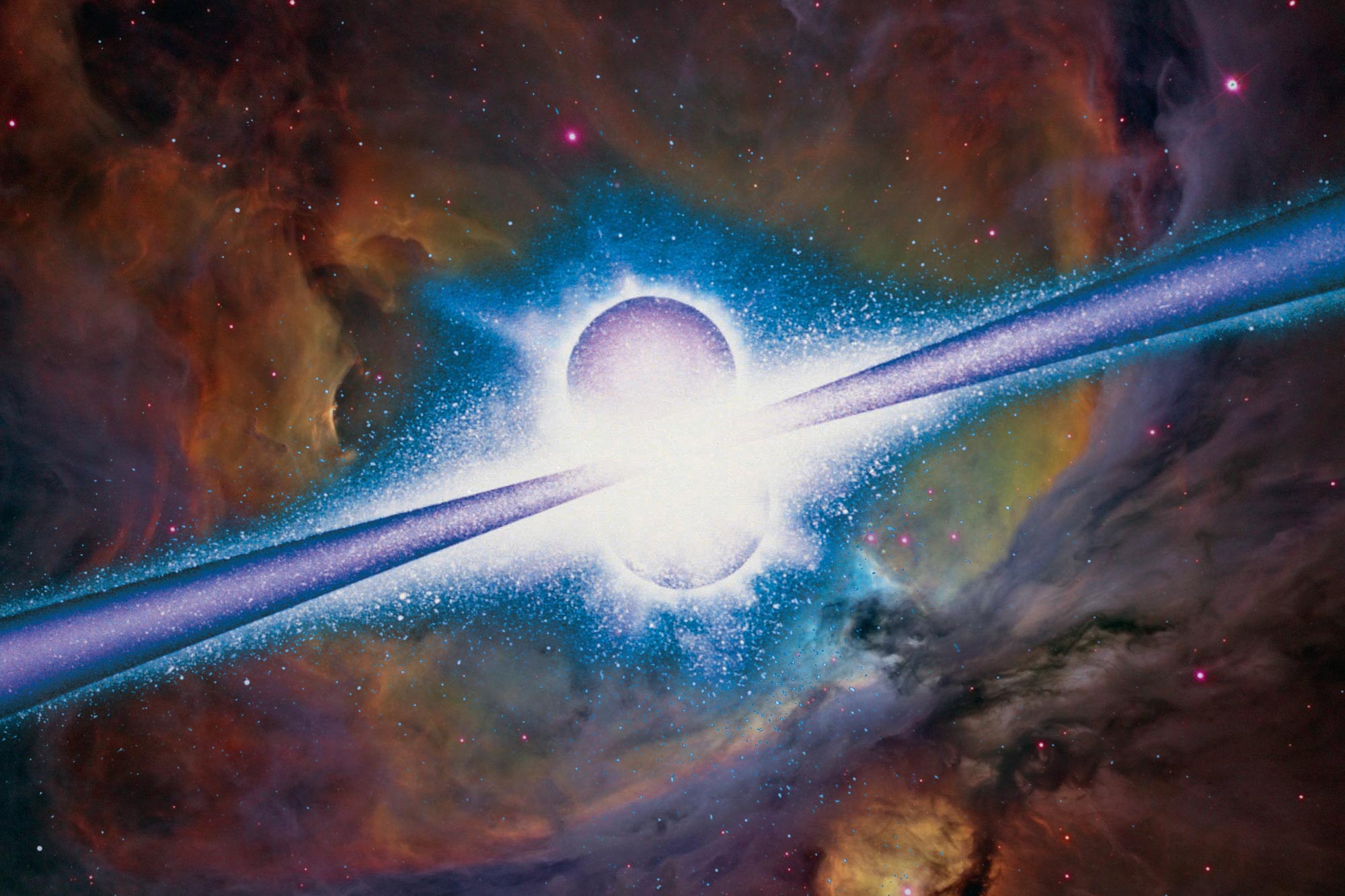
    Gamma Ray Burst Artist's Illustration
    Ultra-high energy cosmic rays likely gain their immense energy from tangled magnetic fields in extreme astrophysical environments, rather than shock waves from star explosions. This breakthrough highlights the role of magnetic turbulence in accelerating particles to extraordinary levels.

    Ultra-high energy cosmic rays are energized by magnetic turbulence, not shock acceleration, according to new research. Tangled magnetic fields in extreme astrophysical environments propel particles to incredible energies, advancing our understanding of these cosmic phenomena.

    Ultra-high-energy cosmic rays, originating from some of the most extreme astrophysical environments—such as the turbulent regions near black holes and neutron stars—carry significantly more energy than the energetic particles emitted by our Sun. These cosmic particles possess approximately 10 million times the energy of those accelerated in the most powerful particle collider on Earth, the human-made Large Hadron Collider.

    But where does all that energy come from? For years, scientists theorized that it came from shocks that occur in extreme astrophysical environments—when, for example, a star explodes before forming a black hole, causing a huge explosion that kicks up particles.

    New Insights Into Cosmic Ray Energy

    That theory was plausible, but, according to new research published in The Astrophysical Journal Letters, the observations are better explained by a different mechanism. The source of the cosmic rays’ energy, the researchers found, is more likely magnetic turbulence. The paper’s authors found that magnetic fields in these environments tangle and turn, rapidly accelerating particles and sharply increasing their energy up to an abrupt cutoff.

    “These findings help solve enduring questions that are of great interest to both astrophysicists and particle physicists about how these cosmic rays get their energy,” said Luca Comisso, associate research scientist in the Columbia Astrophysics Lab, and one of the paper’s authors.

    The paper complements research published last year by Comisso and collaborators on the sun’s energetic particles, which they also found emerge from magnetic fields in the sun’s corona. In that paper, Comisso and his colleagues discovered ways to better predict where those energetic particles would emerge.

    A Ten-Order-of-Magnitude Difference

    Ultra-high energy cosmic rays are orders of magnitude more powerful than the sun’s energetic particles: They can reach up to 1020 electron volts, whereas particles from the Sun can reach up to 1010 electron volts, a 10-order-of-magnitude difference. (To give an idea of this vast difference in scale, consider the difference in weight between a grain of rice with a mass of about 0.05 grams and a 500-ton Airbus A380, the world’s largest passenger aircraft.) “It’s interesting that these two extremely different environments share something in common: their magnetic fields are highly tangled and this tangled nature is crucial for energizing particles,” Comisso said.

    “Remarkably, the data on ultra-high energy cosmic rays clearly prefers the predictions of magnetic turbulence over those of shock acceleration. This is a real breakthrough for the field,” said Glennys R. Farrar, an author on the paper and professor of physics at New York University.

    Reference: “Ultra-High-Energy Cosmic Rays Accelerated by Magnetically Dominated Turbulence” by Luca Comisso, Glennys R. Farrar and Marco S. Muzio, 4 December 2024, The Astrophysical Journal Letters.
    DOI: 10.3847/2041-8213/ad955f

    The research was supported by the National Science Foundation.

    Never miss a breakthrough: Join the SciTechDaily newsletter.
    Follow us on Google and Google News.

    Astronomy Astrophysics Black Hole Columbia University Neutron Star
    Share. Facebook Twitter Pinterest LinkedIn Email Reddit

    Related Articles

    Astronomers May Use Pulsars To Detect Merging Supermassive Black Holes

    Super-Bright Extragalactic Stellar Explosion – “The Cow” – Is Likely a Dying Star Giving Birth to a Black Hole or Neutron Star

    Neutron Star Collisions Are a “Goldmine” of Heavy Elements – Chief Cosmic Source for Gold, Platinum

    Stellar Collision Triggers Supernova Explosion – “This Is the First Time We’ve Actually Seen Such an Event”

    Ripples in Space-Time Detected – Caused by the Death Spiral of a Neutron Star and a Black Hole

    The Odd Couple: Groundbreaking New Discovery From Gravitational Whispers

    Gravitational-Wave Observatories Detect Rare Mergers of Black Holes With Neutron Stars for the First Time

    The Final Dance of Mixed Neutron Star-Black Hole Pairs: A New Type of Cataclysmic Event in the Cosmos

    A New Type of Cataclysmic Event in the Cosmos: Astrophysicists Detect First Black Hole-Neutron Star Mergers

    Leave A Reply Cancel Reply

    • Facebook
    • Twitter
    • Pinterest
    • YouTube

    Don't Miss a Discovery

    Subscribe for the Latest in Science & Tech!

    Trending News

    Why Popular Diabetes Drugs Like Ozempic Don’t Work for Everyone: The “Genetic Glitch”

    Scientists Stunned After Finding Plant Thought Extinct for 60 Years

    Scientists Discover Tiny New Spider That Hunts Prey 6x Its Size

    Natural Component From Licorice Shows Promise for Treating Inflammatory Bowel Disease

    Scientists Warn: Popular Sweetener Linked to Dangerous Metabolic Effects

    Monster Storms on Jupiter Unleash Lightning Beyond Anything on Earth

    Scientists Create “Liquid Gears” That Spin Without Touching

    The Simple Habit That Could Help Prevent Cancer

    Follow SciTechDaily
    • Facebook
    • Twitter
    • YouTube
    • Pinterest
    • Newsletter
    • RSS
    SciTech News
    • Biology News
    • Chemistry News
    • Earth News
    • Health News
    • Physics News
    • Science News
    • Space News
    • Technology News
    Recent Posts
    • Ancient Bacteria Turned a DNA System Into a Cell Skeleton
    • Researchers Finally Solve 50-Year-Old Blood Group Mystery
    • Scientists Discover “Molecular Switch” That Fuels Alzheimer’s Brain Inflammation
    • Hidden Ocean Currents Revealed in Stunning Detail by AI
    • Trees Emit Tiny Lightning Flashes During Storms and Scientists Finally Prove It
    Copyright © 1998 - 2026 SciTechDaily. All Rights Reserved.
    • Science News
    • About
    • Contact
    • Editorial Board
    • Privacy Policy
    • Terms of Use

    Type above and press Enter to search. Press Esc to cancel.