

Scientists discovered that ciprofloxacin blocks ACE through a novel mechanism, opening new paths for safer blood pressure treatments.
Scientists from the UK and South Africa have made a surprising discovery that could lead to better treatments for high blood pressure and heart disease. They’ve uncovered a surprising new role for ciprofloxacin, a widely-used antibiotic.
Led by Professor Ravi Acharya from the University of Bath and Professor Ed Sturrock from the University of Cape Town, the research team found that ciprofloxacin can block an enzyme known as ACE, or Angiotensin-Converting Enzyme. This enzyme plays a key role in controlling blood pressure.
What makes this discovery especially promising is how ciprofloxacin blocks ACE. It works differently from existing ACE inhibitor medications, offering a fresh approach that could help design new drugs with fewer side effects.
High blood pressure affects about one in three adults in the UK. Currently, around 12 million people rely on ACE inhibitors to manage it. This new finding could open the door to safer, more effective therapies.
ACE increases blood pressure by converting an inactive molecule called angiotensin I into angiotensin II, which narrows (or constricts) blood vessels. ACE inhibitor medications block this process, thereby reducing blood pressure.
The Complexity of ACE and Its Side Effects
However, ACE is also involved in other chemical reactions that affect a range of physiological functions, including kidney function, reproduction, and the immune response.
As a result of this “promiscuity”, current medications that block ACE affect multiple bodily processes, causing unwanted side effects such as coughing or swelling of the throat and tongue.
The ACE enzyme has two parts, termed the N-domain and C-domain. The two parts harbor a pocket, or active site. Current inhibitors bind to this site, filling the pocket and stopping the enzyme from working.
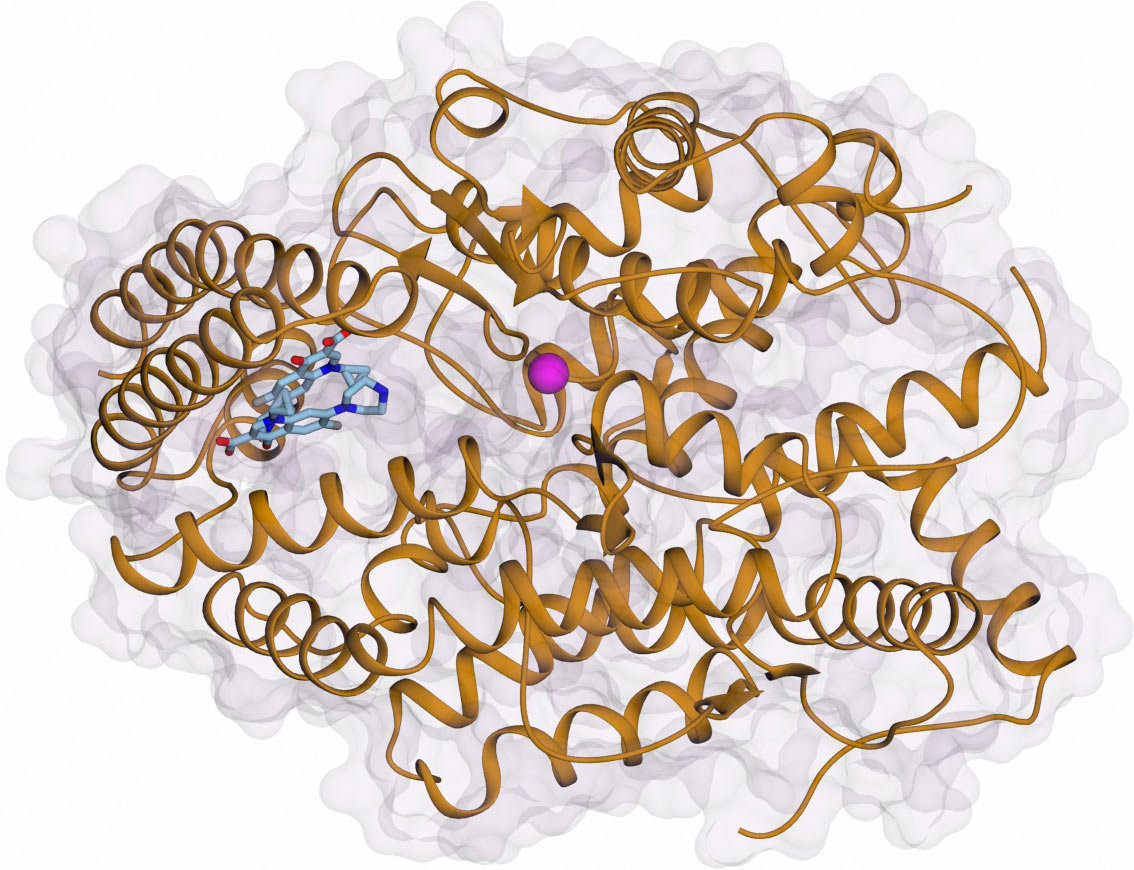
In their study, published in ACS Bio & Med Chem Au, the authors show that ciprofloxacin binds selectively to a different “allosteric” site in the C-domain, which blocks angiotensin I from binding but does not inhibit the enzyme’s other functions.
While ciprofloxacin binds too weakly to be effective as a treatment itself, the team suggests it could be used as a template for a new family of drugs based on the same chemical structure, with the aim of developing better, more targeted ACE inhibitors that could have fewer side effects.
Future Drug Development and Collaboration
Professor Ravi Acharya, from the University of Bath’s Department of Life Sciences, said: “This groundbreaking research not only advances our understanding of ACE regulation but also highlights the potential for creating next-generation inhibitors that are safer and more efficient in managing hypertension and cardiovascular disorders.
“Our study brings a fresh twist by identifying the antibiotic ciprofloxacin as an allosteric inhibitor of ACE – instead of latching onto the active site like traditional inhibitors, ciprofloxacin cleverly binds to an exosite within the C-domain, away from the catalytic pocket.”
Funded by the UKRI-BBSRC (Biotechnology and Biological Sciences Research Council), the research brought together a team of biochemists from Acharya’s and Sturrock’s groups who have been collaborating for 30 years.
Dr Vinasha Ramasamy and Professor Ed Sturrock from the University of Cape Town investigated the enzyme reaction kinetics of ACE, whilst Dr Kyle Gregory and Professor Ravi Acharya from the University of Bath determined the 3D molecular structure of ACE using X-ray crystallography techniques.
The team plans to screen different chemical analogues of ciprofloxacin to optimize binding and specificity of this new family of inhibitors next.
Reference: “Ciprofloxacin Inhibits Angiotensin I-Converting Enzyme (ACE) Activity by Binding at the Exosite, Distal to the Catalytic Pocket” by Kyle S. Gregory, Vinasha Ramasamy, Edward D. Sturrock and K. Ravi Acharya, 9 June 2025, ACS Bio & Med Chem Au.
DOI: 10.1021/acsbiomedchemau.5c00089
Funding: Diamond Light Source, Biotechnology and Biological Sciences Research Council, National Research Foundation
Never miss a breakthrough: Join the SciTechDaily newsletter.
Follow us on Google and Google News.
1 Comment
Ciprofloxacin is a powerful and risky antibiotic. It can cause reactions that give people tendonitis or tendonopathy. Some people who took it had their Achilles heels snap and break. You shouldn’t publish a story like this without warning people about the drug’s potential side effects. Some people, particularly in countries where you can buy cirpofloxacin over the counter (and I live in one of those countries) may buy it and take without a doctor’s supervision. That is dangerous.