
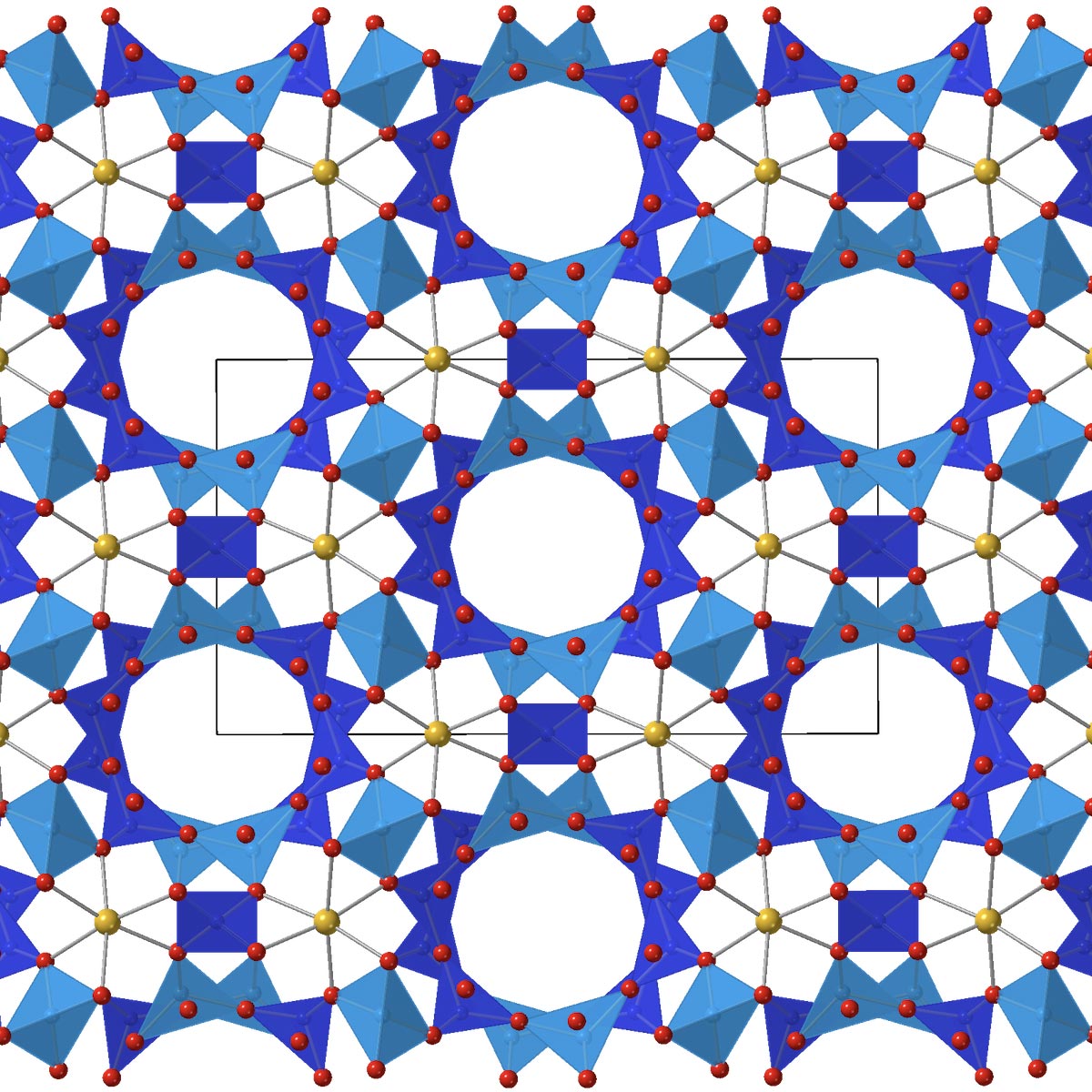
Researchers at Queen Mary University of London have cracked the code behind cordierite’s exceptional thermal stability, a quality that makes it indispensable in high-temperature applications.
By using molecular dynamics simulations, they have uncovered a delicate interplay of forces, providing valuable insights that could lead to the development of advanced materials with customized thermal properties.
Unveiling Cordierite’s Secrets
Cordierite, a fascinating mineral best known for its role in heat-resistant pizza stones, has a unique ability to maintain its size even under extreme temperature changes. This property has made it indispensable in applications ranging from automotive catalytic converters to high-temperature industrial processes. Despite its widespread use, the exact reasons behind cordierite’s exceptional thermal behavior have long been a mystery.
Now, a groundbreaking study from researchers at Queen Mary University of London, published today (January 10) in Matter, offers the first in-depth explanation. This discovery could revolutionize the design and development of advanced materials.
“Modern society demands materials that exhibit minimal dimensional changes with temperature fluctuations, unlike most materials that expand and contract significantly,” explained Professor Martin Dove, lead researcher and Professor of Condensed Matter and Materials at Queen Mary University of London. “Examples of such materials include Pyrex, used for oven-safe dishes, and the glass-ceramic employed in cooking hobs.”
What sets cordierite apart is its unusual thermal expansion pattern: it shows low positive expansion along two perpendicular axes and negative expansion along the third. This rare combination gives cordierite unmatched thermal stability, making it essential for applications where precise size and shape are critical. Yet, until now, the mechanisms behind this behavior have remained unclear.
Advanced Simulation Techniques
To address this, the research team employed advanced lattice dynamics and molecular dynamics simulations, utilizing transferable force fields to model the atomic structure of cordierite under varying thermal conditions. The simulations accurately reproduced experimental data, providing insights into the mineral’s behavior at both low and high temperatures.
“Our research demonstrates that the anomalous thermal expansion of cordierite originates from a surprising interplay between atomic vibrations and elasticity,” stated Professor Dove.
At lower temperatures, the researchers observed that lower-frequency vibrations favor negative thermal expansion (NTE) along all three axes. At higher temperatures, higher-frequency vibrations dominate, leading to the more typical positive expansion. Crucially, these contributions are counterbalanced by the material’s elastic properties, which act like a three-dimensional hinge, effectively canceling out many of the thermal effects.
“This cancellation mechanism explains why cordierite exhibits small positive expansion in two directions and small negative expansion in the third. It is an unexpected outcome that challenges conventional understanding in this field,” added Professor Dove.
Implications for Material Design
These findings open new avenues for the discovery and design of materials with tailored thermal properties. The methodology developed in this study, combining simulations of atomic vibrations with elasticity models, can be directly applied to other anisotropic materials, offering a cost-effective approach for screening potential candidates for specific applications.
“Anisotropic materials like cordierite hold immense potential for developing high-performance materials with unique thermal behaviors,” stated Professor Dove. “Our approach can rapidly predict these properties, significantly reducing the reliance on expensive and time-consuming experimental procedures.”
The study also underscores the importance of challenging established assumptions. “Initially, I was skeptical of the results,” confessed Professor Dove. “The initial data suggested uniform expansion behavior at both high and low temperatures, but the final results revealed a delicate balance of forces. It was a moment of scientific serendipity.”
Conclusion and Future Directions
Cordierite belongs to a family of silicate minerals with promising thermal properties. Understanding its behavior paves the way for innovations in various fields, including automotive engineering, electronics, and materials utilized in extreme environments. The study also contributes to the growing body of research on negative thermal expansion in anisotropic systems – an area that has historically been under-explored.
This research marks a significant advancement in the study of anisotropic materials and their thermal behaviors. With the established methodology, the team plans to investigate other silicate minerals and extend their findings to synthetic materials. “The possibilities are vast,” stated Professor Dove. “This work provides a roadmap for uncovering new materials that could revolutionize industries reliant on thermal stability.”
Reference: “Anomalous thermal expansion of cordierite, Mg2Al4Si5O18, understood through lattice simulations” by Martin T. Dove and Li Li, 10 January 2025, Matter.
DOI: 10.1016/j.matt.2024.101943
Never miss a breakthrough: Join the SciTechDaily newsletter.
Follow us on Google and Google News.
1 Comment
Negative thermal expansion = thermal contraction