
Scientists from Queen Mary University of London and the Russian Academy of Sciences have found a limit to how runny a liquid can be.
Viscosity, the measure of how runny a fluid is, is a property that we experience daily when we fill a kettle, take a shower, pour cooking oil, or move through air.
We know that liquids get thicker when cooled and runnier when heated, but how runny can a liquid ever get if we keep heating it?
Eventually, the liquid boils and becomes a gas or a dense gas-like substance if heated at high enough pressure. At the point where it transitions between the liquid-like and gas-like state is the minimum value of viscosity.
Viscosity is considered impossible to calculate from theory because it strongly depends on liquid structure, composition, and interactions as well as external conditions in a complicated way. Nobel laureate Steven Weinberg compared the difficulty of calculating the viscosity of water to the problem of calculating fundamental physical constants, the constants which shape the fabric of our Universe.
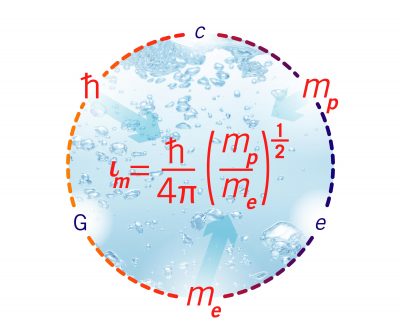
Despite this difficulty, the researchers have developed an equation to do so.
In the study, published in Science Advances, they show that two fundamental physical constants govern how runny a liquid can be. Physical constants, or constants of Nature, are measurable properties of the physical universe that do not change.
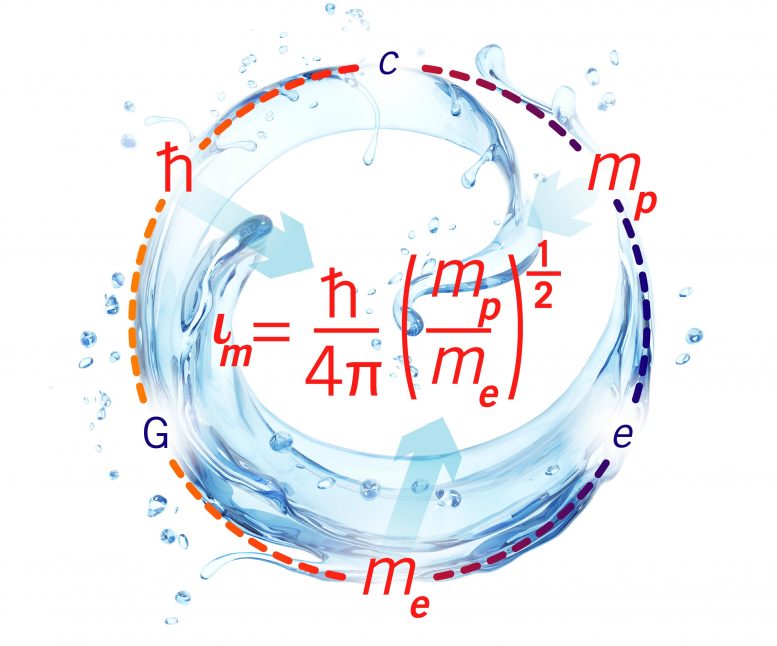
Their equation relates the minimal value of elementary viscosity (the product of viscosity and volume per molecule) to the Planck constant, which governs the quantum world, and the dimensionless proton-to-electron mass ratio.
Professor Kostya Trachenko, lead author of the paper from Queen Mary University of London, said: “This result is startling. Viscosity is a complicated property varying strongly for different liquids and external conditions. Yet our results show that the minimal viscosity of all liquids turns out to be simple and universal.”
There are practical implications of discovering this limit too. It could be applied where a new fluid for a chemical, industrial or biological process with a low viscosity is required. One example where this is important is the recent use of supercritical fluids for green and environmentally clean ways of treating and dissolving complex waste products.
In this instance, the discovered fundamental limit provides a useful theoretical guide of what to aim for. It also tells us that we should not waste resources trying to beat the fundamental limit because the constants of Nature will mold the viscosity at or above this point.
Fundamental physical constants and in particular dimensionless constants (fundamental constants that do not depend on the choice of physical units) are believed to define the Universe we live in. A finely-tuned balance between the proton-to-electron mass ratio and another dimensionless constant, the fine structure constant, governs nuclear reactions and nuclear synthesis in stars leading to essential biochemical elements including carbon.
This balance provides a narrow ‘habitable zone‘ where stars and planets can form and life-supporting molecular structures can emerge. Change one of the dimensionless fundamental constants slightly, and the Universe becomes very different, with no stars, heavy elements, planets, and life.
Professor Trachenko said: “The lower fundamental limit reminds us how fundamental constants of Nature affect us daily, starting from making a morning cup of tea by extending their overarching rule to specific, yet complex, properties such as liquid viscosity.”
Vadim Brazhkin, co-lead author from the Russian Academy of Sciences, added: “There are indications that the fundamental lower limit of liquid viscosity may be related to very different areas of physics: black holes as well as the new state of matter, quark-gluon plasma, which appears at very high temperature and pressure. Exploring and appreciating these and other connections is what makes science ever so exciting.”
Reference: “Minimal quantum viscosity from fundamental physical constants” by K. Trachenko and V. Brazhkin, 24 April 2020, Science Advances.
DOI: 10.1126/sciadv.aba3747
Never miss a breakthrough: Join the SciTechDaily newsletter.
Follow us on Google and Google News.