
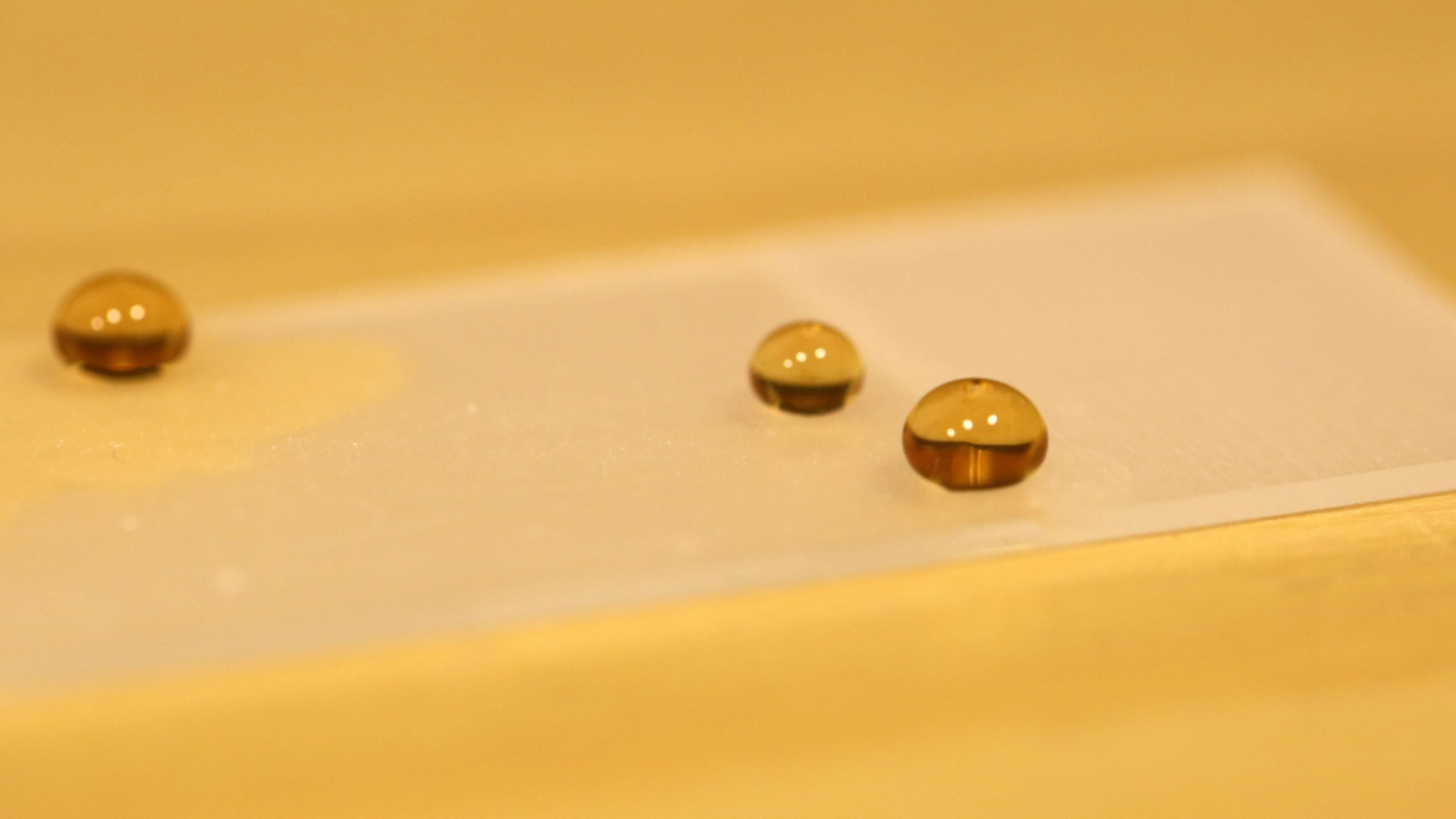
In specially coated tubes, the more viscous a liquid is, the faster it flows.
It’s widely known that thick, viscous liquids — like honey — flow more slowly than low-viscosity liquids, like water. Researchers were surprised to find this behavior flipped on its head when the liquids flow through chemically coated capillaries. In fact, through these specially coated tubes, liquids a thousand times more viscous flow ten times faster.
The speed at which different fluids flow through pipes is important for a large range of applications: from industrial processes such as oil refineries to biological systems like the human heart. Traditionally, if you need to make a fluid flow faster through a pipe, you increase the pressure on it. This technique, however, has its limits; there is only so much pressure you can put into a pipe before you run the risk of bursting it. This is especially true for thin and narrow pipes, like the ones used in microfluidics for producing medicine and other complex chemicals, so researchers are investigating if they can increase the speed at which liquids flow through narrow tubes without having to increase the pressure.
In the paper published on October 16, 2020, in the journal Science Advances, researchers found that by coating the inside of the pipes with compounds that repel liquids, they could make viscous liquids flow faster than those with low viscosity.
“A superhydrophobic surface consists of tiny bumps that trap air within the coating, so that a liquid droplet that rests on the surface sits as if on a cushion of air,” explains Professor Robin Ras, whose research team at Aalto University’s Department of Applied Physics has made a range of interesting discoveries in the area of extremely water repellent coatings, including recent papers in Science and Nature.
Superhydrophobic coatings themselves don’t speed up the flow of the more viscous liquids. If you place a drop of honey and a drop of water on a superhydrophobic coated surface and then tilt the surface so gravity makes the droplets move, the low-viscosity water will flow down faster.
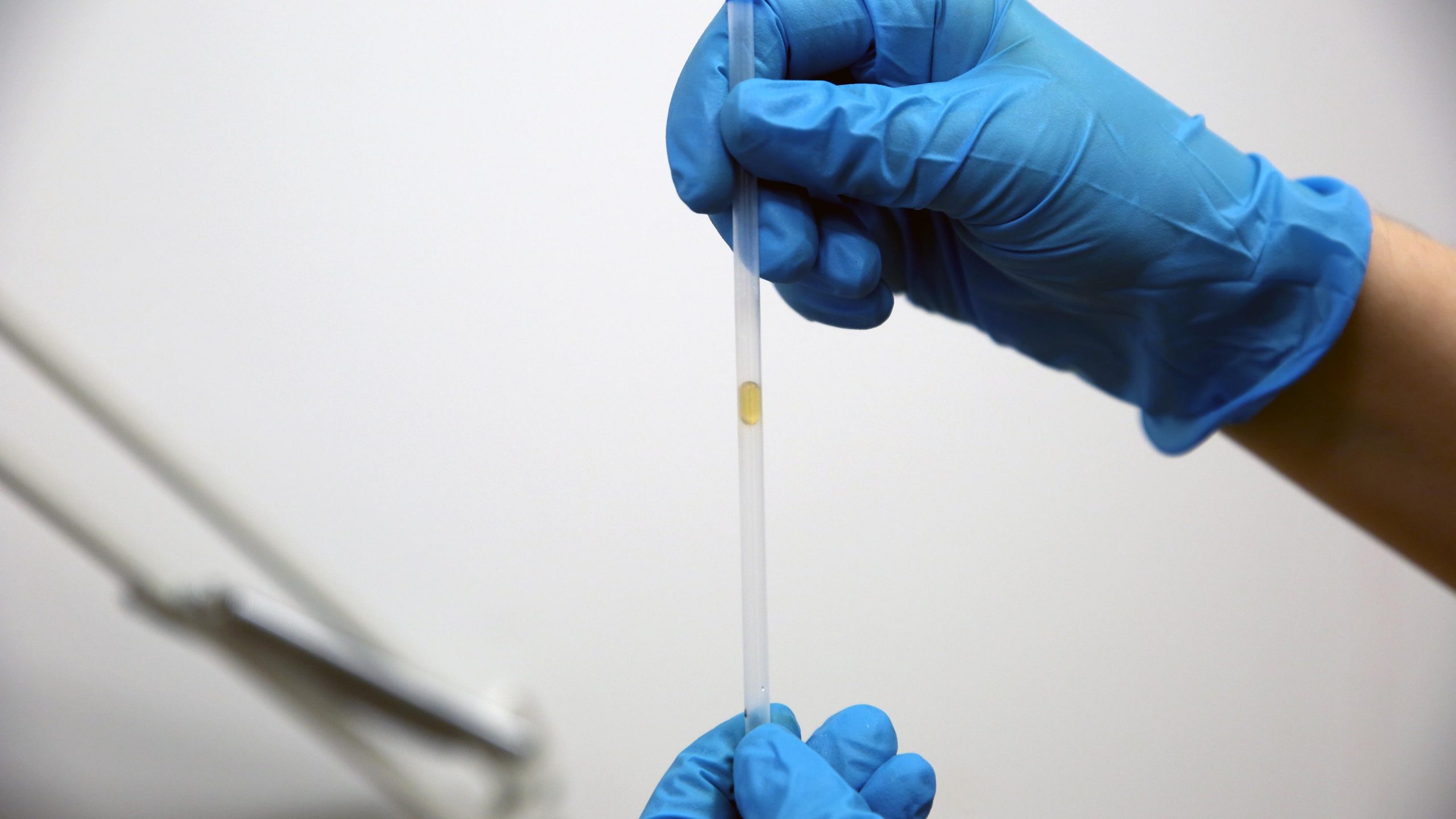
But when a droplet is confined to one of the very narrow tubes used in microfluidics, things change drastically. In this system, the superhydrophobic coating on the walls of the tube creates a small air gap between the inside wall of the tube and the outside of the droplet. “What we found was that when a droplet is confined to a sealed superhydrophobic capillary, the air gap around the droplet is larger for more viscous liquids. This larger air gap is what allowed for the viscous fluids to move through the tube faster than the less viscous ones when flowing due to gravity,” says Dr. Maja Vuckovac, the first author of the paper.
The size of the effect is quite substantial. Droplets of glycerol a thousand times more viscous than water flow through the tube more than ten times faster than water droplets. The researchers filmed the droplets as they moved through the tube, tracking not only how fast the liquid moved through the tube, but also how the liquid flowed inside the droplet. For viscous liquids, the liquid inside the droplet hardly moved around at all, whereas a fast mixing motion was detected in the lower-viscosity droplets.
“The crucial discovery is that the less-viscous liquids also managed to penetrate a bit into the air cushion surrounding the droplets, rendering a thinner air gap around these. This means that the air beneath a low-viscosity droplet in the tube couldn’t move out of the way as fast as for a more viscous droplet with a thicker air gap. With less air managing to squeeze past the low-viscosity droplets, these were forced to move down the tube with a slower speed than their more viscous counterparts,” explains Dr. Matilda Backholm, one of the researchers on the project.
The team developed a fluid dynamics model that can be used to predict how droplets would move in tubes coated with different superhydrophobic coatings. They hope that further work on these systems could have significant applications for microfluidics, a type of chemical engineering technique that is used to precisely control liquids in small quantities and in manufacturing complex chemicals like medicines. By being able to predict how the coatings can be used to modify fluid flow, the coatings may be helpful for engineers developing new microfluidics systems.
Reference: “Viscosity-enhanced droplet motion in sealed superhydrophobic capillaries” by Maja Vuckovac, Matilda Backholm, Jaakko V. I. Timonen and Robin H. A. Ras, 16 October 2020, Science Advances.
DOI: 10.1126/sciadv.aba5197
Never miss a breakthrough: Join the SciTechDaily newsletter.
Follow us on Google and Google News.
6 Comments
Weird science 🤔
Give me a bottle of honey made of that stuff and you will be a literal god to me
They mention flowing down through tube in response to gravity, but what about horizontally in response to pressure? I think the researchers were careful not to mention that in this article.
But does the effect hold true for a continuous stream of liquid as well as for drops?
Desiderius Erasmus had written that oil and honey seemed to contain more liquid that they spread wider and flowed faster, in one of his colloquies published in the 15th century.
if i use this site for a science project would all the stuff being said on here make me restart my research or continue on with my project ?