
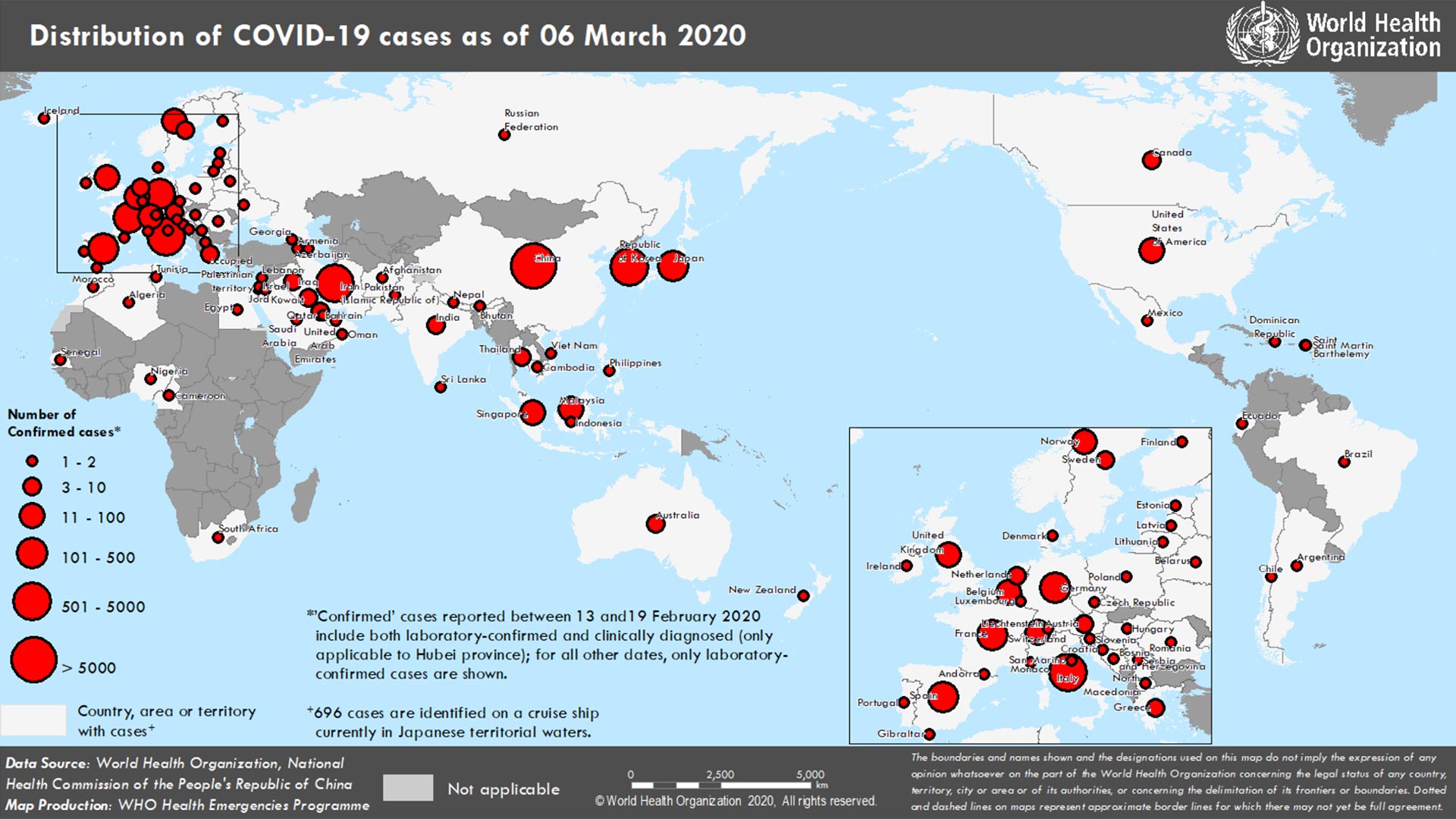
Note: There is now a newer Novel Coronavirus (COVID-19) Situation Report 47.
WHO Novel Coronavirus (COVID-19) Situation Report 46
- 4 new countries/territories/areas (Bhutan, Cameroon, Serbia, and South Africa) have reported cases of COVID-19 in the past 24 hours.
- As the COVID-19 outbreak continues to evolve, comparisons have been drawn to influenza.WHO has provided a Q&A regarding the similarities and differences between the two diseases. Please see the Situation in Focus below for more information.
Risk Assessment
China: Very High
Regional Level: Very High
Global Level: Very High
Coronavirus Situation in Numbers
Globally
- 98192 confirmed cases (2873 new)
China
- 80711 confirmed cases (146 new)
- 3045 deaths (30 new)
Outside of China
- 17481 confirmed cases (2727 new)
- 88 countries/territories (4 new)
- 335 deaths (69 new)
Situation In Focus: Q&A: Similarities and differences – COVID-19 and influenza
As the COVID-19 outbreak continues to evolve, comparisons have been drawn to influenza. Both cause respiratory disease, yet there are important differences between the two viruses and how they spread. This has important implications for the public health measures that can be implemented to respond to each virus.
Q. How are COVID-19 and influenza viruses similar?
Firstly, COVID-19 and influenza viruses have a similar disease presentation. That is, they both cause respiratory disease, which presents as a wide range of illness from asymptomatic or mild through to severe disease and death.
Secondly, both viruses are transmitted by contact, droplets, and fomites. As a result, the same public health measures, such as hand hygiene and good respiratory etiquette (coughing into your elbow or into a tissue and immediately disposing of the tissue), are important actions all can take to prevent infection.
Q. How are COVID-19 and influenza viruses different?
The speed of transmission is an important point of difference between the two viruses. Influenza has a shorter median incubation period (the time from infection to appearance of symptoms) and a shorter serial interval (the time between successive cases) than COVID-19 virus. The serial interval for COVID-19 virus is estimated to be 5-6 days, while for influenza virus, the serial interval is 3 days. This means that influenza can spread faster than COVID-19.
Further, transmission in the first 3-5 days of illness, or potentially pre-symptomatic transmission – transmission of the virus before the appearance of symptoms – is a major driver of transmission for influenza. In contrast, while we are learning that there are people who can shed COVID-19 virus 24-48 hours prior to symptom onset, at present, this does not appear to be a major driver of transmission.
The reproductive number – the number of secondary infections generated from one infected individual – is understood to be between 2 and 2.5 for COVID-19 virus, higher than for influenza. However, estimates for both COVID-19 and influenza viruses are very context and time-specific, making direct comparisons more difficult.
Children are important drivers of influenza virus transmission in the community. For COVID-19 virus, initial data indicates that children are less affected than adults and that clinical attack rates in the 0-19 age group are low. Further preliminary data from household transmission studies in China suggest that children are infected from adults, rather than vice versa.
While the range of symptoms for the two viruses is similar, the fraction with severe disease appears to be different. For COVID-19, data to date suggest that 80% of infections are mild or asymptomatic, 15% are severe infection, requiring oxygen and 5% are critical infections, requiring ventilation. These fractions of severe and critical infection would be higher than what is observed for influenza infection.
Those most at risk for severe influenza infection are children, pregnant women, elderly, those with underlying chronic medical conditions and those who are immunosuppressed. For COVID-19, our current understanding is that older age and underlying conditions increase the risk for severe infection.
Mortality for COVID-19 appears higher than for influenza, especially seasonal influenza. While the true mortality of COVID-19 will take some time to fully understand, the data we have so far indicate that the crude mortality ratio (the number of reported deaths divided by the reported cases) is between 3-4%, the infection mortality rate (the number of reported deaths divided by the number of infections) will be lower. For seasonal influenza, mortality is usually well below 0.1%. However, mortality is to a large extent determined by access to and quality of health care.
Q. What medical interventions are available for COVID-19 and influenza viruses?
While there are a number of therapeutics currently in clinical trials in China and more than 20 vaccines in development for COVID-19, there are currently no licensed vaccines or therapeutics for COVID-19. In contrast, antivirals and vaccines available for influenza. While the influenza vaccine is not effective against COVID-19 virus, it is highly recommended to get vaccinated each year to prevent influenza infection.
Countries, territories or areas with reported laboratory-confirmed COVID-19 cases and deaths, March 6, 2020
| Country/Territory/Area | Confirmed Cases |
|---|---|
| China | 80711 |
| Republic of Korea | 6284 |
| Italy | 3858 |
| Iran | 3513 |
| International (Cruise Ship in Japan) | 706 |
| Germany | 534 |
| France | 420 |
| Japan | 349 |
| Spain | 257 |
| United States of America | 148 |
| United Kingdom | 118 |
| Singapore | 117 |
| Norway | 86 |
| Switzerland | 86 |
| Netherlands | 82 |
| Sweden | 61 |
| Kuwait | 58 |
| Australia | 57 |
| Malaysia | 55 |
| Belgium | 50 |
| Bahrain | 49 |
| Austria | 47 |
| Thailand | 47 |
| Canada | 45 |
| Iraq | 36 |
| Greece | 32 |
| India | 30 |
| United Arab Emirates | 27 |
| Iceland | 26 |
| San Marino | 21 |
| Denmark | 18 |
| Lebanon | 16 |
| Oman | 16 |
| Vietnam | 16 |
| Israel | 15 |
| Ireland | 14 |
| Ecuador | 13 |
| Algeria | 12 |
| Czech Republic | 12 |
| Finland | 12 |
| Croatia | 10 |
| Georgia | 9 |
| Qatar | 8 |
| Saudi Arabia | 8 |
| Brazil | 7 |
| Palestinian Territory | 7 |
| Portugal | 7 |
| Belarus | 6 |
| Romania | 6 |
| Slovenia | 6 |
| Mexico | 5 |
| Pakistan | 5 |
| Philippines | 5 |
| New Zealand | 4 |
| Russian Federation | 4 |
| Senegal | 4 |
| Azerbaijan | 3 |
| Egypt | 3 |
| Estonia | 3 |
| Bosnia and Herzegovina | 2 |
| Hungary | 2 |
| Indonesia | 2 |
| Morocco | 2 |
| Afghanistan | 1 |
| Andorra | 1 |
| Armenia | 1 |
| Argentina | 1 |
| Bhutan | 1 |
| Cambodia | 1 |
| Cameroon | 1 |
| Chile | 1 |
| Dominican Republic | 1 |
| Gibraltar | 1 |
| Jordan | 1 |
| Latvia | 1 |
| Liechtenstein | 1 |
| Lithuania | 1 |
| Luxembourg | 1 |
| Monaco | 1 |
| Nepal | 1 |
| Nigeria | 1 |
| North Macedonia | 1 |
| Poland | 1 |
| Serbia | 1 |
| South Africa | 1 |
| Sri Lanka | 1 |
| Tunisia | 1 |
| Ukraine | 1 |
| Total | 98192 |
Recommendations and Advice for the Public
If you are not in an area where COVID-19 is spreading, or if you have not traveled from one of those areas or have not been in close contact with someone who has and is feeling unwell, your chances of getting it are currently low. However, it’s understandable that you may feel stressed and anxious about the situation. It’s a good idea to get the facts to help you accurately determine your risks so that you can take reasonable precautions.
Your healthcare provider, your national public health authority and your employer are all potential sources of accurate information on COVID-19 and whether it is in your area. It is important to be informed of the situation where you live and take appropriate measures to protect yourself.
If you are in an area where there is an outbreak of COVID-19 you need to take the risk of infection seriously. Follow the advice issued by national and local health authorities. Although for most people COVID-19 causes only mild illness, it can make some people very ill. More rarely, the disease can be fatal. Older people, and those with pre-existing medical conditions (such as high blood pressure, heart problems or diabetes) appear to be more vulnerable.
Never miss a breakthrough: Join the SciTechDaily newsletter.
Follow us on Google and Google News.
1 Comment
A recent site did not recognize my email addres
This is a test