
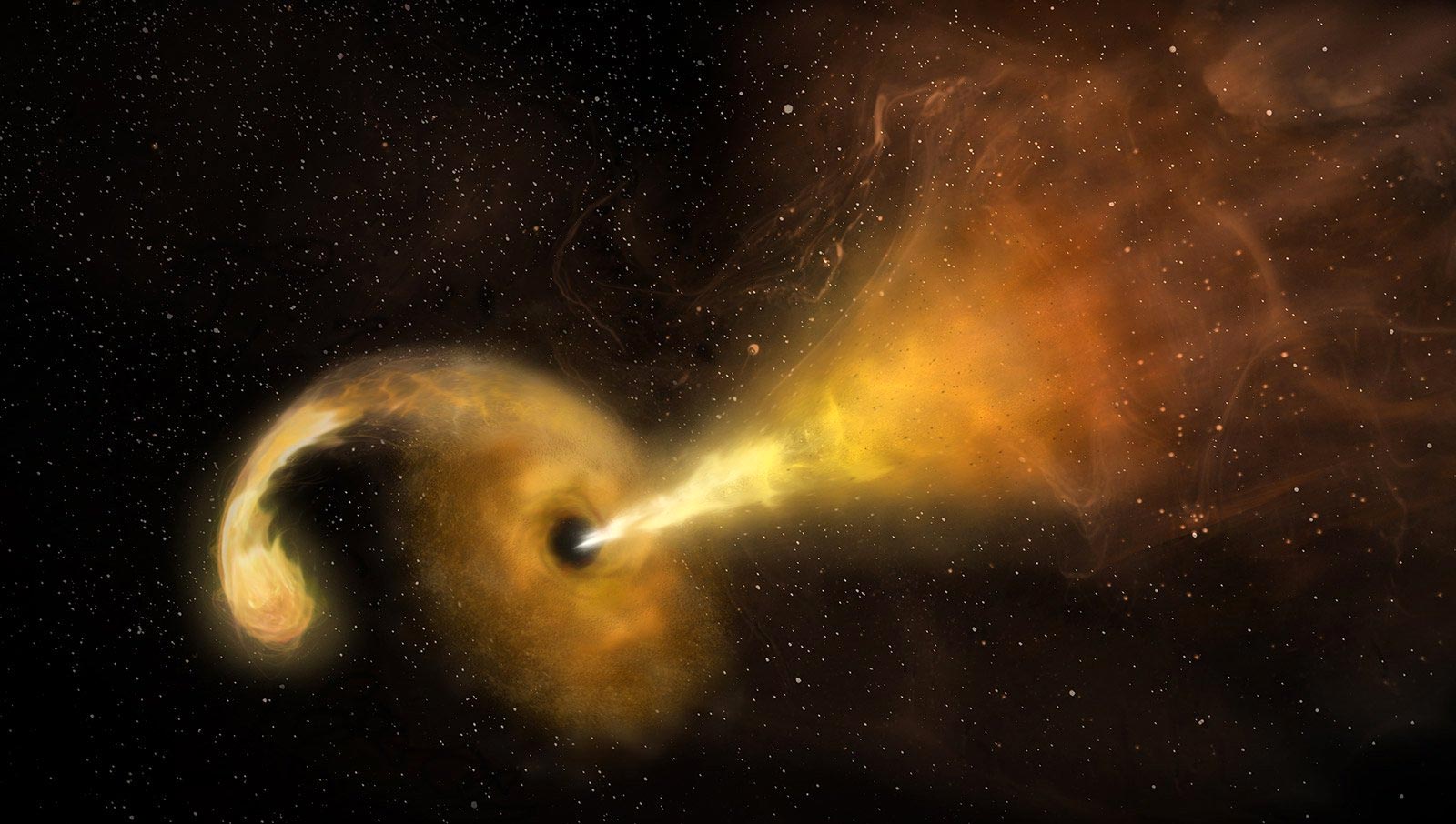
Researchers have developed a method to detect the first stars of the universe by observing the unique flares produced when these stars are torn apart by black holes. These findings could allow us to understand more about the early universe, with the help of NASA’s latest telescopes which can observe the resultant infrared emissions.
Shortly after the Universe began with the Big Bang, the first stars, composed mainly of hydrogen and helium, began to form. The properties of these first-generation stars, Pop III, are very different from stars like our own Sun or even the ones that are forming today. They were tremendously hot, gigantic in size and mass, but very short-lived.
Pop III stars are the first factories to synthesize most elements heavier than hydrogen and helium around us today. They are also very important for forming later generations of stars and galaxies. However, there have not been convincing direct detections of Pop III stars up to now, as these stars formed in the early universe are very far away and way too faint for any of our telescopes on the ground or in space.
New Detection Methods by HKU Scientists
For the first time, scientists from The University of Hong Kong discovered a novel method for detecting these first stars in the early Universe. A recent study led by the research group of Professor Jane Lixin DAI of the Department of Physics at HKU proposed that a Pop III star can be torn apart into pieces by tidal force if it wanders into the vicinity of a massive black hole.
In such a tidal disruption event (TDE), the black hole feasts on the stellar debris and produces very luminous flares. The researchers investigated the complex physical process involved and demonstrated that these flares can shine across billions of light years to reach us today. Most importantly, they have found that the unique signatures of these TDE flares can be used to identify the existence of Pop III stars and gain insights into their properties.
Unique Characteristics and Technological Advances
“As the energetic photons travel from a very faraway distance, the timescale of the flare will be stretched due to the expansion of the Universe. These TDE flares will rise and decay over a very long period of time, which sets them apart from the TDEs of solar-type stars in the nearby Universe,” said Professor Jane Dai, principal investigator and the corresponding author of the project.
“Interestingly, not only are the timescales of the flares are stretched, so is their wavelength. The optical and ultraviolet light emitted by the TDE will be transferred to infrared emissions when reaching the Earth.” Dr. Rudrani Kar Chowdhury, Postdoctoral Fellow of the Department of Physics at HKU and the first author of the paper, further added.
Future Prospects With NASA Missions
What makes the discovery more exciting is that two NASA flagship missions, the recently launched James Webb Space Telescope (JWST) and the upcoming Nancy Grace Roman Space Telescope (Roman), have the capability to observe such infrared emissions from great distances.
Professor Priya Natarajan of the Department of Astronomy and Physics at Yale University and a co-author of the paper mentioned, “Roman’s unique capabilities of simultaneously being able to observe a large area of the sky and peeking deep into early Universe makes it a promising probe for detecting these Pop III TDE flares, which would in turn serve as an indirect discovery of Pop III stars.”
Ms. Janet Chang, a PhD student at the Department of Physics at HKU and co-author of the paper, added, “We expect that a few dozens of these events will be detected by Roman every year if the right observation strategy is pursued.”
With these findings in mind, the next decade presents significant potential for identifying these distinct sources, leading to exciting revelations about Pop III stars and unraveling the mysteries of the universe’s inception.
Reference: “Detecting Population III Stars through Tidal Disruption Events in the Era of JWST and Roman” by Rudrani Kar Chowdhury, Janet N. Y. Chang, Lixin Dai and Priyamvada Natarajan, 8 May 2024, The Astrophysical Journal Letters.
DOI: 10.3847/2041-8213/ad41b7
Never miss a breakthrough: Join the SciTechDaily newsletter.
Follow us on Google and Google News.