
Close Menu
    Facebook X (Twitter) Instagram
    SciTechDaily
    • Biology
    • Chemistry
    • Earth
    • Health
    • Physics
    • Science
    • Space
    • Technology
    Facebook X (Twitter) Pinterest YouTube RSS
    SciTechDaily
    Home»Science»Could Diplodocid Dinosaurs Whip Their Long Tails Fast Enough To Create a Supersonic Boom?
    Science

    Could Diplodocid Dinosaurs Whip Their Long Tails Fast Enough To Create a Supersonic Boom?

    By Scientific ReportsDecember 8, 2022No Comments3 Mins Read
    Facebook Twitter Pinterest Telegram LinkedIn WhatsApp Email Reddit
    Share
    Facebook Twitter LinkedIn Pinterest Telegram Email Reddit
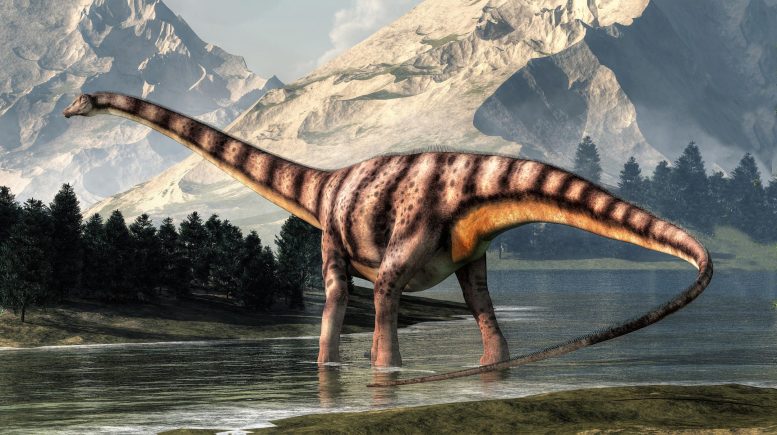
    Diplodocus
    Diplodocus was a genus of diplodocid sauropod dinosaurs, whose fossils were first discovered in 1877 by S. W. Williston.

    Diplodocid tails moved too slowly for supersonic booms but likely served as defensive tools or for combat.

    Diplodocids – large herbivorous dinosaurs with long necks and tails – may have been able to move their tails like bullwhips at speeds of up to 33 meters per second (108 feet per second) or more than 100 kilometers per hour (70 miles per hour). This is according to a modeling study published today (December 8) in the journal Scientific Reports.

    However, these findings contradict those of a previous study, which proposed that a hypothetical structure attached to the end of a diplodocid tail – similar to a tuft at the end of a bullwhip – could move faster than the speed of sound (340 meters per second or 1100 feet per second) and create a small supersonic boom.

    Diplodocids, or members of the family Diplodocidae, are a group of sauropod dinosaurs. The family includes some of the longest creatures ever to walk the Earth, including Diplodocus and Supersaurus, some of which may have reached lengths of up to 42 meters (138 ft).

    Modeling Diplodocid Tail Movements

    Simone Conti and colleagues simulated diplodocid tail movements using a model based on five fossilized diplodocid specimens. The model tail is over 12 meters (39 feet) long, weighs 1,446 kilograms (3,188 pounds), and consists of 82 cylinders – representing vertebrae – attached to an unmovable hip bone base. When the tail base moves in an arc, it generates a whip-like movement with a maximum speed of 33 meters per second (108 feet per second) – more than ten times slower than the speed of sound in standard air and too slow to create a supersonic boom.

    The authors tested whether their model tail would be able to withstand the stress of moving fast enough to create a supersonic boom. They found that the thin whip-like tail could not move at a maximum speed of 340 meters per second (1100 feet per second) without breaking.

    The authors then assessed whether adding three different one-meter-long hypothetical structures – mimicking the end of a bullwhip – to the end of the model tail could allow it to travel at the speed of sound without rupturing. The first structure consisted of three segments made of skin and keratin, the second consisted of braided keratin filaments, and the third had a flail-like structure composed of soft tissues.

    None of the structures was able to withstand the stress of moving at 340 meters per second (1100 feet per second) without the tail breaking.

    Together, the findings indicate that diplodocid tails may not have been able to move fast enough to create a small supersonic boom. However, the authors speculate that diplodocids may have still been able to move their tails fast enough to use them as defensive weapons or for combat with other diplodocids.

    Reference: “Multibody analysis and soft tissue strength refute supersonic dinosaur tail” by Simone Conti, Emanuel Tschopp, Octávio Mateus, Andrea Zanoni, Pierangelo Masarati and Giuseppe Sala, 8 December 2022, Scientific Reports.
    DOI: 10.1038/s41598-022-21633-2

    Never miss a breakthrough: Join the SciTechDaily newsletter.
    Follow us on Google and Google News.

    Dinosaurs Scientific Reports
    Share. Facebook Twitter Pinterest LinkedIn Email Reddit

    Related Articles

    Wings of Fear: Unveiling the Prehistoric Scare Tactics of Feathered Dinosaurs

    “Big John” Triceratops Specimen Has Skull Injuries That May Have Come From Combat With Another Dinosaur

    Scientists Uncover First Evidence of Respiratory Infection in a Dinosaur

    Fossil Treasure Trove: Earliest Evidence of Complex Social Behavior in Dinosaurs

    Newly Discovered Prehistoric Armored Dinosaur May Have Been Able to Dig

    First Plant-Eating Dinosaur Discovered in Antarctica

    New Dinosaur Species Announced

    ‘Skin Bones’ Helped Large Dinosaurs Survive In Harsh Times

    Nest of Juvenile Protoceratops Andrewsi Dinosaurs Discovered

    Leave A Reply Cancel Reply

    • Facebook
    • Twitter
    • Pinterest
    • YouTube

    Don't Miss a Discovery

    Subscribe for the Latest in Science & Tech!

    Trending News

    New “Nanozyme Hypothesis” Could Rewrite the Story of Life’s Origins

    Anatomy Isn’t Finished: The Human Body Still Holds Secrets

    “Pretty Close to Home”: The Hidden Earthquake Threat Beneath Seattle

    The Surprising Reason You Might Want To Sleep Without a Pillow

    Scientists Say This Natural Hormone Reverses Obesity by Targeting the Brain

    35-Million-Year-Old Mystery: Strange Arachnid Discovered Preserved in Amber

    Is AI Really Just a Tool? It Could Be Altering How You See Reality

    JWST Reveals a “Forbidden” Planet With a Baffling Composition

    Follow SciTechDaily
    • Facebook
    • Twitter
    • YouTube
    • Pinterest
    • Newsletter
    • RSS
    SciTech News
    • Biology News
    • Chemistry News
    • Earth News
    • Health News
    • Physics News
    • Science News
    • Space News
    • Technology News
    Recent Posts
    • New Study Challenges Alzheimer’s Theories: It’s Not Just About Plaques
    • Scientists Discover Way To Treat Lung Cancer and Its Deadly Side Effect Together
    • Artificial Sweeteners May Harm Future Generations, Study Suggests
    • The Ocean Current Stronger Than All Rivers Changed Earth Forever
    • NASA Artemis II Splashdown and Astronaut Recovery Operation [Image Gallery]
    Copyright © 1998 - 2026 SciTechDaily. All Rights Reserved.
    • Science News
    • About
    • Contact
    • Editorial Board
    • Privacy Policy
    • Terms of Use

    Type above and press Enter to search. Press Esc to cancel.