
A rare visitor from another star system prompted SETI to hunt for alien technology, but the mysterious object appears to be a natural cosmic traveler after all.
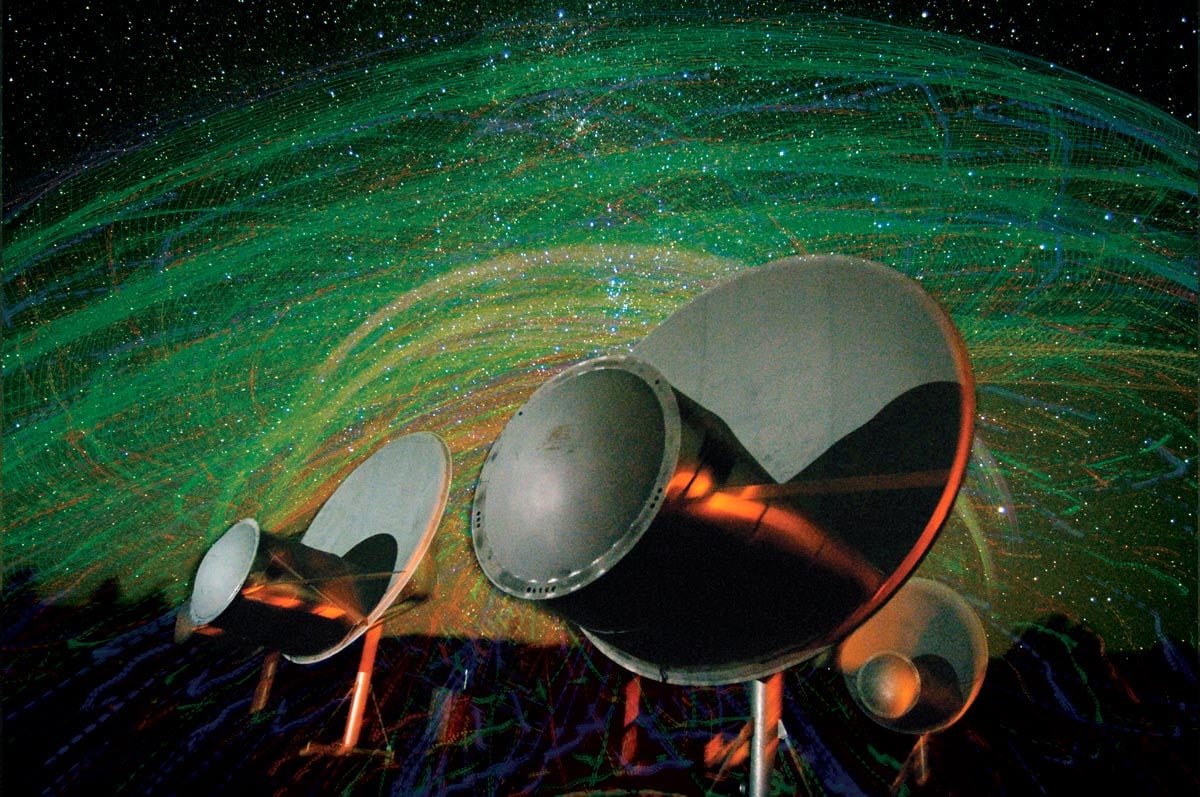
Scientists have completed a search for signs of alien technology from 3I/ATLAS, the third known interstellar object ever observed passing through our Solar System. Using the Allen Telescope Array (ATA) at the Hat Creek Radio Observatory in Northern California, researchers scanned a broad range of radio frequencies for artificial signals. As expected from previous observations showing that 3I/ATLAS behaves like a natural comet, they found no evidence of extraterrestrial technology.
A Rare Visitor From Another Star System
Discovered in July 2025, 3I/ATLAS is only the third confirmed object from another star system to enter our Solar System, following 1I/’Oumuamua and 2I/Borisov. These rare visitors give scientists a unique chance to examine material formed around other stars, offering valuable clues about how planetary systems develop and evolve.
Although every observation so far points to 3I/ATLAS being a natural object, researchers say interstellar visitors are still important targets in the search for technosignatures. In the unlikely event that one of these objects were artificial, it could carry detectable signs of extraterrestrial technology and potentially provide the first evidence of life beyond Earth.
“Eventually, our own Voyager spacecraft will be extraterrestrial artifacts in other stellar systems,” said Dr. Sofia Sheikh, lead author on the paper. “Given that, it is important that we understand the natural distribution of interstellar objects so that we will be able to identify any anomalies that could one day be signs of an artificial interstellar object.”
Scanning Millions of Radio Signals
The research team observed 3I/ATLAS for more than seven hours using the ATA, monitoring frequencies from 1 to 9 gigahertz. This range allows scientists to search for narrowband radio signals, which are not known to occur naturally and could indicate the presence of technology.
During the observations, the scientists detected nearly 74 million narrowband signals. After filtering out radio interference from human activity and selecting only signals that matched the object’s motion, roughly 200 candidates remained.
A closer investigation showed that every one of those remaining signals originated from technology on Earth or from satellites orbiting our planet.
What the Search Revealed
Although the search uncovered no technosignatures, it placed new limits on what could be hiding near 3I/ATLAS and further supports the conclusion that it is a natural object. The observations ruled out radio transmitters stronger than roughly 10–110 watts across the frequencies examined, about the amount of power used by a typical household appliance.
“The results from 3I/ATLAS show how realistic it is to detect a signal with the technology we have today,” said Valeria Garcia Lopez, co-author. “That is why it is important to keep searching for technosignatures, even from objects we might not expect to have signals.”
Preparing for Future Interstellar Visitors
The project also highlighted how quickly the Allen Telescope Array can respond to unexpected discoveries. Observations of 3I/ATLAS began less than a day after the object’s announcement, demonstrating the system’s ability to rapidly investigate newly discovered interstellar visitors.
Beyond the search for intelligent life, studying these objects helps scientists better understand the natural properties of material traveling between star systems as it passes through our Solar System.
As astronomers continue discovering more interstellar visitors, each one will provide another opportunity to search for technosignatures while expanding our knowledge of both natural cosmic objects and the possibility of advanced technology beyond our Solar System.
Reference: “A Search for Radio Technosignatures from Interstellar Object 3I/ATLAS with the Allen Telescope Array” by Sofia Z. Sheikh, Valeria Garcia Lopez, Isabel Gerrard, James R. A. Davenport, Wael Farah, Blayne Griffin, Steve Croft, Luigi F. Cruz, Imke de Pater, Ben Jacobson-Bell, Mark Masters, Karen I. Perez, Alexander W. Pollak, Carol Shumaker and Andrew Siemion, 3 June 2026, The Astronomical Journal.
DOI: 10.3847/1538-3881/ae6651
Never miss a breakthrough: Join the SciTechDaily newsletter.
Follow us on Google and Google News.
1 Comment
Few civilizations even use radio. Invalid exercise.