
Close Menu
    Facebook X (Twitter) Instagram
    SciTechDaily
    • Biology
    • Chemistry
    • Earth
    • Health
    • Physics
    • Science
    • Space
    • Technology
    Facebook X (Twitter) Pinterest YouTube RSS
    SciTechDaily
    Home»Space»ISON Comet May Become Brightest Object in the Night Skies
    Space

    ISON Comet May Become Brightest Object in the Night Skies

    By SciTechDailyOctober 3, 2012No Comments2 Mins Read
    Facebook Twitter Pinterest Telegram LinkedIn WhatsApp Email Reddit
    Share
    Facebook Twitter LinkedIn Pinterest Telegram Email Reddit
    comet-ison-location
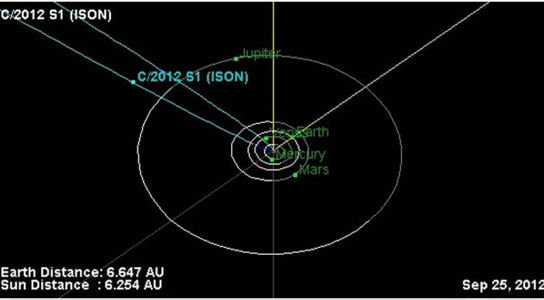
    Comet C/2012 S1 (ISON). Currently located beyond the orbit of Jupiter, Comet ISON is heading for a very close encounter with the sun next year. In November 2013, it will pass less than 0.012 AU (1.8 million km) from the solar surface. Credit: NASA

    The comet ISON was recently discovered and it could possibly become the brightest object in the night skies. The comet was discovered a week ago by Russian astronomers and it’s currently between the orbits of Jupiter and Saturn, heading for a very close encounter with the Sun.

    C/2012 S1 (ISON) might also develop a spectacular tail. There’s also the possibility that it could break up when it gets closer to the Sun. Russian astronomers Vitali Nevski and Artyom Novichonok will continue examining it for the next 15 months. Astronomers will try to figure out the exact nature of this comet. It will pass Earth in late December 2013 and will pass less than 0.012 AU (1.8 million km) from the surface of Sol.
    comet-ison-sky
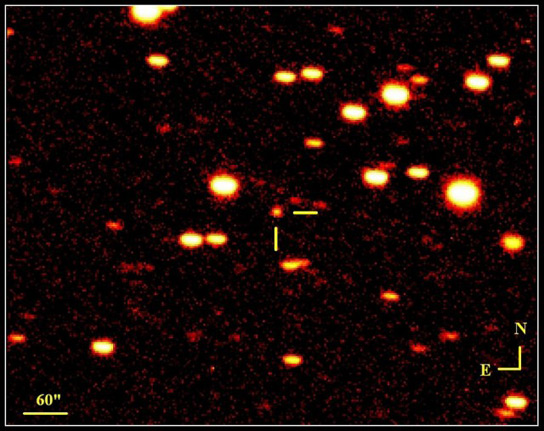
    A new comet was discovered that may become one of the brightest in history. Next year, this dim spot, comet ISON might outshine the moon Credit: NASA

    The comet may be bright enough to be visible in broad daylight with the naked eye when it gets closer. Currently, ISON is quite faint, fainter than any stars that are visible without a telescope. It was first sighted 6.68 AU away from Earth and 6.27 AU from Sol, in the constellation of Cancer.

    Never miss a breakthrough: Join the SciTechDaily newsletter.
    Follow us on Google and Google News.

    Astronomy Comet ISON Observation
    Share. Facebook Twitter Pinterest LinkedIn Email Reddit

    Related Articles

    Spitzer Views Gas Emissions From Comet ISON

    Comet ISON’s Journey Toward the Sun

    Time-Lapse Video Captures Comet ISON Heading Toward the Sun

    Astronomers Watch as Comet 2013 A1 Heads Towards Mars

    Comet 2013 A1 to Make a Very Close Flyby of Mars

    Trillions of Comet Collisions Explain 17-Year-Old Stellar Mystery

    Trajectory Models of Refractory Particles Help Solve Two Solar System Puzzles

    View the Eta Aquarid Meteor Shower From Halley’s Comet

    Using ALMA and VLA to Unveil Astronomical Mysteries

    Leave A Reply Cancel Reply

    • Facebook
    • Twitter
    • Pinterest
    • YouTube

    Don't Miss a Discovery

    Subscribe for the Latest in Science & Tech!

    Trending News

    Sitting Up Straight Could Actually Help You Make Better Decisions

    Never-Before-Seen Vortices Are Swirling Across the Sun

    This Common Amino Acid May Help the Body Fight Cancer and Viruses

    Low-Protein “Longevity Diet” Linked to Fat Loss, Muscle Preservation, and Healthy Aging

    How Prehistoric Poop Changed Earth’s Ecosystems Forever

    This Fossil Upends a Decades-Old Debate About Snake Evolution

    A Blood Test Years Before Cancer May Reveal a Hidden Warning Sign

    Starlink Satellites Reveal a Hidden Atmosphere 300 Miles Above Earth

    Follow SciTechDaily
    • Facebook
    • Twitter
    • YouTube
    • Pinterest
    • Newsletter
    • RSS
    SciTech News
    • Biology News
    • Chemistry News
    • Earth News
    • Health News
    • Physics News
    • Science News
    • Space News
    • Technology News
    Recent Posts
    • A Simple Feeding Change Makes Zoo Lions Behave More Like They Do in the Wild
    • Scientists Discover a Hidden World of Fungi 1,640 Feet Beneath Michigan
    • Where Were All the Tiny Dinosaurs? Scientists May Finally Have an Answer
    • Astronomers Caught a Star Exploding Almost the Instant It Began
    • Empty Space May Not Be Empty After All: Magnetar Reveals a Bizarre Quantum Effect
    Copyright © 1998 - 2026 SciTechDaily. All Rights Reserved.
    • Science News
    • About
    • Contact
    • Editorial Board
    • Privacy Policy
    • Terms of Use

    Type above and press Enter to search. Press Esc to cancel.