
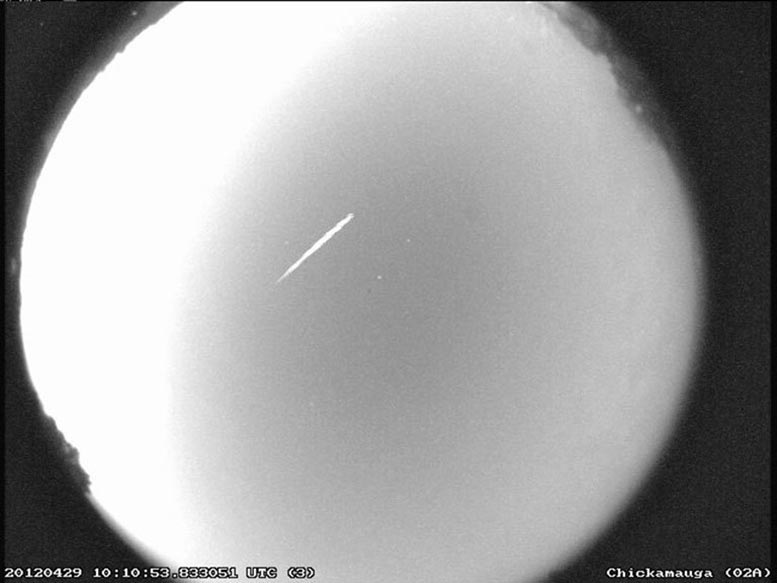
Star gazing fans will get to enjoy the peek display of the annual Eta Aquarid meteor shower from Halley’s Comet on the night of May 5 and into the morning of May 6. With ideal conditions, NASA is predicting meteor rates of about 40-60 meteors per hour.
Each spring as Earth passes through the debris trail from Halley’s Comet (1P/Halley), the cosmic bits burn up in our atmosphere and result in the annual Eta Aquarid meteor shower. This year the peak will occur on the night of May 5 and into the morning of May 6, with meteor rates of about 40-60 meteors per hour under ideal conditions.
A full moon occurs on May 6, just a day after the Eta Aquarids’s peak on the 5th. The light of the bright full moon will wash out the fainter Eta Aquarid meteors, but all is not lost! The Etas have a decent rate — 60 per hour — and contain quite a few fireballs.
NASA fireball cameras have already detected several bright Eta Aquarid meteors this year, so the odds are pretty good that a bit of Halley’s Comet can be seen over the next few days. Ideal viewing conditions are clear skies away from city lights, especially just before dawn.
Viewing the Eta Aquarids: Live Ustream Allsky Camera, Viewing Tips
A live Ustream video feed of the Eta Aquarid meteor shower will be embedded on this page by late afternoon on Friday, May 4. The allsky camera is mounted at NASA’s Marshall Space Flight Center in Huntsville, Alabama. During the day, you’ll see a dark gray box or perhaps some very colorful static — the camera is light-activated and will turn on at dusk.
You can also check out other allsky camera links to see alternate views of the meteor shower. Find an area well away from city or street lights. Lie flat on your back on a blanket, lawn chair or sleeping bag and look up, taking in as much of the sky as possible. After about 30 minutes in the dark, your eyes will adapt and you will begin to see meteors. Be patient — the show will last until dawn, so you have plenty of time to catch a glimpse.
More About the Eta Aquarids
The Eta Aquarids are pieces of debris from Halley’s Comet, which is a well-known comet that is viewable from Earth approximately every 76 years. Also known as 1P/Halley, this comet was last viewable from Earth in 1986 and won’t be visible again until the middle of 2061. The annual Eta Aquarid meteor shower gets its name because the radiant — or direction of origin — of the meteors appears to come from the constellation Aquarius.
Never miss a breakthrough: Join the SciTechDaily newsletter.
Follow us on Google and Google News.
4 Comments
Hello, can you please specify/provide the timezone? Or perhaps, provide the continents in which the meteor shower could be viewable to observers?
Sorry, but that was all the information NASA gave…Looked at a few other sources and still didn’t see anything specific. Here is a clip from another source:
“The annual Eta Aquarid meteor shower is expected to peak this weekend. The mornings of May 5 and 6, 2012 are probably best for meteor-watching. But the largest full moon of 2012 on May 5 will drown these meteors in its glare.”
Here is the media contact for the article:
NASA Media Contact:
Janet Anderson, 256-544-0034
NASA Marshall Space Flight Center, Ala.
[email protected]
Hi, thank you for the prompt reply. I appreciate it a lot.
I tried to look for other sources too and found this: “The radiant for this shower appears in the east-southeast at about 4 a.m. local time (the time at all locations) and the hour or two before dawn offers the most meteors.” So, I guess, the meteor shower can be seen by every one. I hope I could spot some of them tomorrow. Anyway, thank you for your time and more power to your site! 😀
Thanks 🙂