
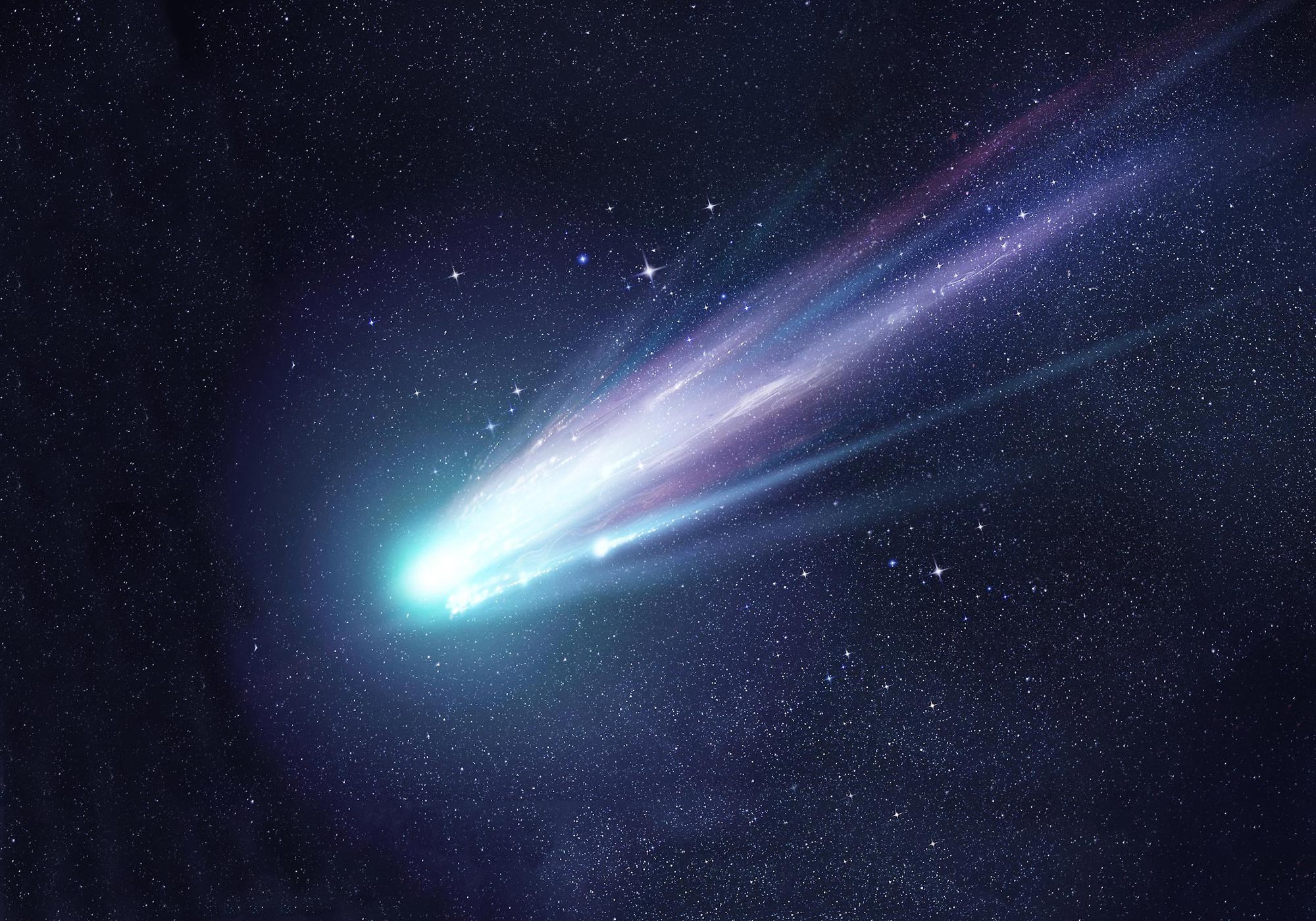
Astronomers are eagerly tracking Comet C/2023 A3, which could shine as brightly as the North Star this fall.
Originating from the Oort Cloud and observed globally, its approaching perihelion could mark a major celestial event, provided it survives its solar encounter.
Discovered in early 2023 by observatories in South Africa and China, Comet C/2023 A3 (Tsuchinshan-Atlas) originates from the distant Oort Cloud. For a year, it has aroused keen interest among astronomers and astronomy enthusiasts, including the Unistellar community. Nearly 90 observers have contributed to collecting data on the evolution of its brightness, thus refining predictions about its behavior as it approaches the center of the solar system.
Models developed by Ariel Graykowski, a researcher at the SETI Institute and head of the cometary activity program for Unistellar, suggest that the comet could become as bright as the North Star this fall, offering a spectacular sight to the naked eye.

Unraveling the Mysteries of this Celestial Visitor
New observations this fall, between perihelion on September 27th and November 2nd when it is visible, will shed light on some of the mysteries surrounding Comet A3. Previous observations have revealed anomalies, intriguing the scientific community. After an unexpected period of dimming, Comet A3 now seems to be regaining its brightness. Several hypotheses are being considered: this phenomenon could be linked to the comet’s phase angle (the angle between the Sun, the comet, and the observer on Earth) or a possible fragmentation of the comet.
According to Franck Marchis, co-founder of Unistellar and director of citizen science at the SETI Institute: “If it survives its passage near the Sun, becoming one of the brightest objects visible in the northern hemisphere – like Comet McNaught in 2007 – Comet A3 could prove to be one of the most significant celestial events of the year or even the decade. Observations will, in theory, provide answers to whether it will reach a magnitude of -2. As unpredictable as it is magnificent, it’s an event not to be missed!”

The Unistellar Community at the Service of Space Observation
On this occasion, Unistellar is inviting its community of over 25,000 users to contribute to a citizen science campaign. Comet C/2023 A3 is already available in the Unistellar app catalog, making it easy to track. To record their observed data, participants can follow the instructions available on the comet-dedicated tutorial page.
The SETI Institute, Unistellar’s scientific partner, is organizing a contest through the Unistellar network, where the winners will have successfully observed the comet as it moves away from the sun after September 27th. Observations right after Comet A3’s passage by the sun could be the most rewarding in case the comet breaks up. “Those will be difficult observations that will be done early in the morning, but are worth the loss of sleep,” says Franck Marchis.
About Unistellar
With UNISTELLAR, everyone can enjoy discovering and understanding the universe. The company has reinvented the telescope with the eVscope, a combination of optical and digital innovations, using a high-precision optical architecture, a highly sensitive digital sensor, and onboard intelligence for live image processing.
The market leader in smart telescopes, UNISTELLAR was awarded a prize at CES in 2018 and again in 2022. In 2021, it began a strategic partnership with Nikon, which invested in the company in 2023. The French firm has diversified by launching the first augmented binoculars during a Kickstarter campaign in the summer of 2024.
Unistellar has partnered with NASA and the SETI Institute to create a unique citizen science program. Our users are regularly rewarded for their participation by making discoveries, as confirmed by an article published in March 2023 in the reference scientific journal Nature.
Never miss a breakthrough: Join the SciTechDaily newsletter.
Follow us on Google and Google News.
2 Comments
Comets are fragments of planets that enter the solar system from the arm of the galaxy and disintegrate after hitting the sun. They are made of hard metals. The cores of the disintegrated planets are dozens of them and they have elliptical orbits around the sun. Comets are dangerous. Very few have planet earth, the probability of it hitting the earth is very low
Very cool 😎 to read about space and what is going on out there 😔. My grandson is attending OSU in Oklahoma doing space and NASA to be come a engineering for space… I will 😊 be happier to read more about it ☺️.. Brenda Hogan