
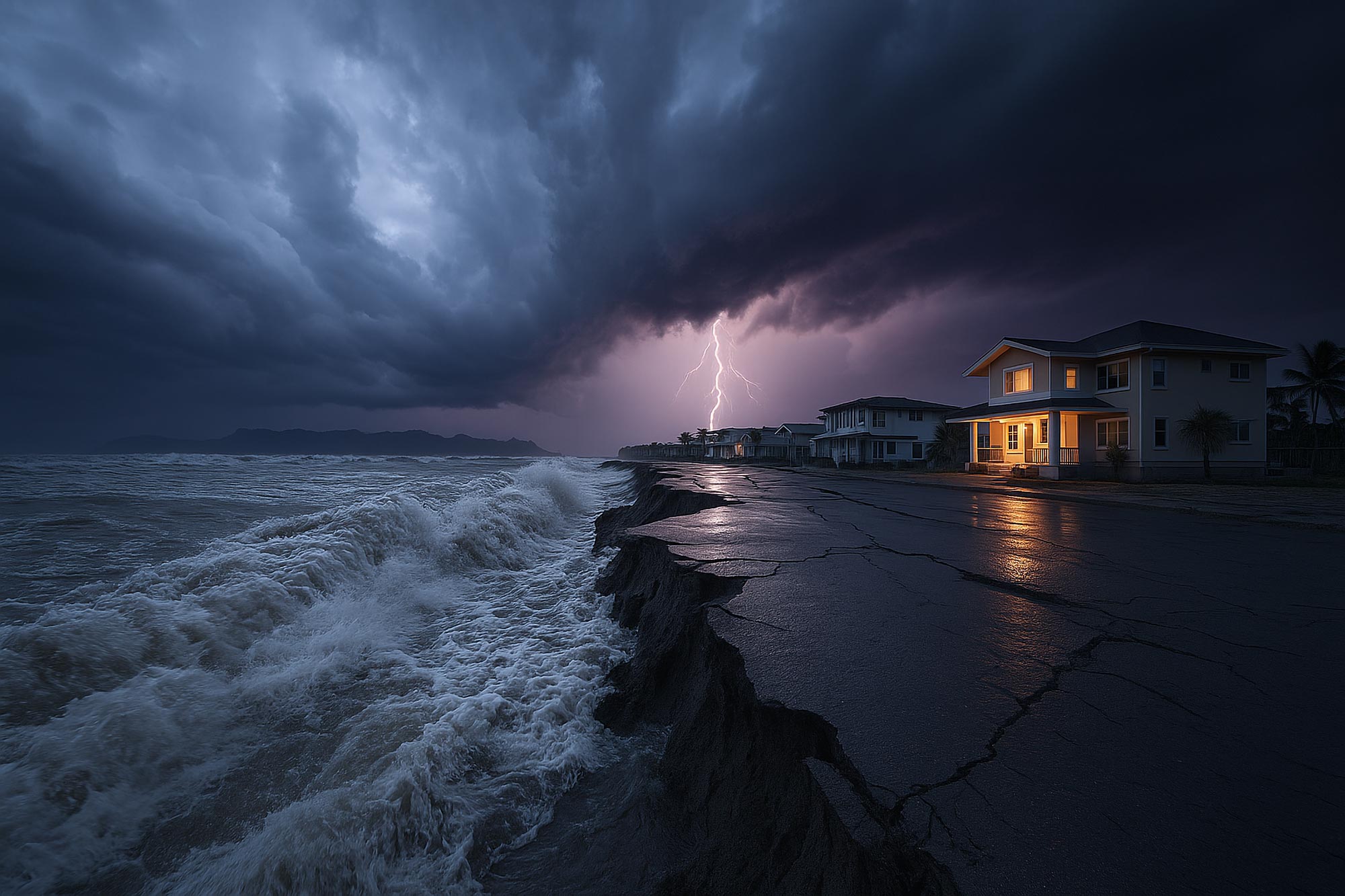
A future Cascadia earthquake could unleash far more than just devastating shaking — it could sink large parts of the Pacific Northwest coastline, dramatically expanding flood zones and leaving thousands more residents and buildings vulnerable to rising waters.
Combined with climate-driven sea-level rise, entire communities may become uninhabitable, natural coastal defenses could erode away, and the region could face a prolonged and painful recovery. Scientists warn that this risk isn’t isolated to Cascadia; subduction zones worldwide are ticking time bombs waiting to reshape coastlines in minutes.
Earthquake Threats Beyond the Big One
The Pacific Northwest faces more than just the next great earthquake.
New research from Virginia Tech warns that a powerful earthquake, combined with rising sea levels, could dramatically increase flooding across northern California, Oregon, and Washington, affecting thousands of residents and properties.
A new study published in the Proceedings of the National Academy of Sciences found that a major earthquake along the Cascadia subduction zone could cause coastal land to sink by as much as 6.5 feet. This sinking would expand the federally designated 1 percent coastal floodplain, areas with a 1-in-100 annual chance of flooding, by an additional 35 to 116 square miles.
“The expansion of the coastal floodplain following a Cascadia subduction zone earthquake has not been previously quantified, and the impacts to land use could significantly increase the timeline to recovery,” said researcher Tina Dura, lead author of the study and assistant professor of geosciences in the College of Science.
Mapping the Risk: Modeling Earthquake Impact
The study shows the greatest impacts would strike southern Washington, northern Oregon, and northern California, some of the region’s most densely populated areas.
To predict the potential damage, Dura’s team created tens of thousands of earthquake models to estimate the expected land subsidence, or sinking, from a future Cascadia megaquake. Using geospatial analysis, they then calculated how much the 1 percent floodplain would expand across 24 estuaries and coastal communities along the fault zone.
Because no one can predict exactly when the next large earthquake will occur, the researchers modeled two scenarios: an earthquake happening today, and one striking in 2100, when rising seas from climate change would make the flooding even worse.
Massive Increase in Flood Exposure
The study estimates that following an earthquake today, an additional 14,350 residents, 22,500 structures, and 777 miles of roadway would fall within the post-earthquake floodplain, more than doubling flood exposure. Potential flooding would affect five airports; 18 critical facilities, including public schools, hospitals, police stations, and fire stations; eight wastewater treatment plants; one electric substation; and 57 potential contaminant sources, including animal feeding operations, gas stations, and solid waste facilities.
By 2100, the Intergovernmental Panel on Climate Change (IPCC) localized relative sea-level rise projections show that sea levels along the Cascadia subduction zone could be up to 3 feet higher than today. This climate-driven sea-level rise will amplify the impacts of future earthquake-driven subsidence, more than tripling the flood exposure of residents, structures, and roads.
Long-Term Impacts: Uninhabitable Coastal Communities
“Today, and more so in 2100 as background sea levels rise, the immediate effect of earthquake-driven subsidence will be a delay in response and recovery from the earthquake due to compromised assets. Long-term effects could render many coastal communities uninhabitable,” said Dura, an affiliate with the Global Change Center.
Current low-lying land developed for cattle grazing and farming through diking and draining will experience heavy economic loss as increased tidal inundation will cause over salinization of soils and render them unusable. Additional impacts include erosion of natural systems, particularly coastal estuaries, intertidal wetlands and protective dunes and beaches. These act as buffers against storm surges and help to dissipate wave energy to prevent sediment erosion and protect property damage. According to Dura, the loss of these ecosystems may not be recoverable, and inland movement may be constrained by topography and human development.
Intertidal Wetlands: A Critical Loss
“The loss of intertidal wetlands directly impacts ecosystem services such as water filtration, habitat for fisheries and shorebirds, and carbon storage capacity,” said Dura, an affiliate with the Fralin Life Sciences Institute. “Intertidal wetlands function as natural carbon sinks, and their erosion or conversion to tidal flats significantly reduces their ability to sequester carbon.”
The Cascadia subduction zone is one of many regions in the “Ring of Fire,” where the Pacific Plate meets another tectonic plate, causing the strongest earthquakes in the world and the majority of volcanic eruptions. However, a great earthquake — those with a seismic magnitude over 8.0 — has not occurred along the Cascadia subduction zone since Jan. 26, 1700, making coastal geologic records of past earthquakes and associated subsidence critical for understanding this hazard.
Documenting Ancient Earthquake Clues
Dura and her team are documenting geologic evidence of past earthquake-driven subsidence as the Paleoseismology Working Group Lead within the Cascadia Region Earthquake Science Center (CRESCENT), a center at the University of Oregon funded by the National Science Foundation that is providing a collaborative framework to tackle multidisciplinary scientific and societal challenges at the Cascadia subduction zone.
Their research of geologic evidence from the last six to seven thousand years indicates that 11 great earthquakes have happened approximately every 200 to 800 years in the Pacific Northwest. The last earthquake in the region resulted in between 1.5 to 6.5 feet of land along the coastline immediately sinking.
“Cascadia is a unique place. It’s not super heavily populated, but most estuaries have a community in them, and they’re all right in the zone of subsidence,” said Dura. “This is honestly where I think the subsidence could have bigger impacts than it has during other recent large earthquakes around the world.”
Subduction Zones: A Global Pattern
Subduction zones, which can also be found off the coasts of Alaska, Russia, Japan, Indonesia, New Zealand, and South America, are all similar in that one tectonic plate slides beneath another. Along portions of these subduction zones, there is an initial uplift in the top plate. Pressure between the two plates gradually builds over centuries. The resultant earthquake is created when the plate above become unstuck. Offshore, the plate rises, forcing an upward water surge that leads to a tsunami. Onshore, the plate subsides, immediately dropping the coastline up to 6.5 feet.
The earthquake shaking begins the process. For a magnitude 9 earthquake or over, that takes about four to six minutes. While the shaking is occurring the land is dropping, and, depending on tidal conditions, low-lying areas may experience immediate flooding. Within 15 to 20 minutes the tsunami hits with further flooding. The entire process takes no longer than 30 minutes, and multiple tsunami waves may occur over one to two hours. However, the sinking of the land will persist for decades to centuries after the earthquake.
Lessons from Past Megaquakes
According to Dura, the 1960 Chile earthquake submerged a pine forest and farms, converting them to tidal marshes, and it flooded coastal towns, forcing residents to abandon their homes; the 1964 Alaska earthquake forced the relocation of communities and airstrips to higher ground; the 2004 Sumatra-Andaman earthquake destroyed waterfront aquaculture and caused coastal erosion; and the 2011 earthquake in Japan caused erosion, disrupted ports, and contributed to a nuclear disaster.
“Given the global prevalence of subduction zones, these insights hold relevance beyond Cascadia, informing hazard assessments and mitigation strategies for tectonically active regions worldwide,” Dura said.
Reference: 28 April 2025, Proceedings of the National Academy of Sciences.
Other Virginia Tech affiliates who contributed to the paper:
- Robert Weiss, professor of geosciences
- Mike Willis, associate professor of geosciences
- David Bruce, postdoctoral fellow in geosciences
- William Chilton Ph.D. ’23, now in private industry
- Jessica DePaolis, postdoctoral fellow in geosciences
- Mike Priddy, a former Ph.D. student in geosciences for this research
Never miss a breakthrough: Join the SciTechDaily newsletter.
Follow us on Google and Google News.
3 Comments
Thank You
The Napier earthquake in NZ in the 1930s produced uplift that released lots of new Real Estate opportunities…………..that is, besides flattening Napier and doing the normal sort of damage earthquakes do to buildings not earthquake-resistant or made of wood and, whilst earthquake-resistant, subject to burning easily.
I think the world had better prepare for a lost continent and more tgan lost coastal areas, training survival and basis to our chilldren because the inner core is constantly needing material to burn its taking what it can suck down as feul ,the plant dosent have time to look for another planet we may have time to eject a survival type spacecraft with tec and knowlegde a sprinkle of spiecies and nationalities maybe even two or three but they better hurry as for suvivors they had better prepare 7 years of rice 7 years of famine its coming again and its coming soon there too many earthquakes and slips in plates in the next 40 or less years