
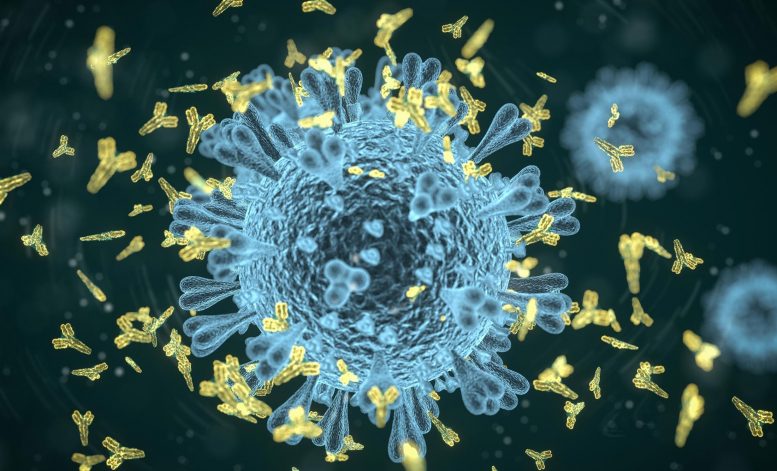
The SEROCOV study also provides evidence that pre-existing antibodies to common cold coronaviruses may be protective.
The levels of IgG antibodies against SARS-CoV-2 spike protein remain stable, or even increase, seven months after infection, according to a follow-up study in a cohort of healthcare workers coordinated by the Barcelona Institute for Global Health (ISGlobal), an institution supported by “la Caixa” Foundation, in collaboration with the Hospital Clinic of Barcelona. The results, published in Nature Communications, also support the idea that pre-existing antibodies against common cold coronaviruses could protect against COVID-19.
In order to predict the pandemic’s evolution and develop effective strategies, it is critical to better understand the dynamics and duration of immunity to SARS-CoV-2 as well as the possible role of pre-existing antibodies against the coronaviruses that cause common colds. With this goal in mind, the team led by ISGlobal researcher Carlota Dobaño followed a cohort of healthcare workers at the Hospital Clinic (SEROCOV study) from the beginning of the pandemic, in order to evaluate the levels of antibodies against different SARS-CoV-2 antigens over time. “This is the first study that evaluates antibodies to such a large panel of SARS-CoV-2 antibodies over 7 months,” says Dobaño.
The research team analyzed blood samples from 578 participants, taken at four different timepoints between March and October 2020. They used the Luminex technology to measure, in the same sample, the level and type of IgA, IgM or IgG antibodies to 6 different SARS-CoV-2 antigens as well as the presence of antibodies against the four coronaviruses that cause common colds in humans. They also analyzed the neutralizing activity of antibodies in collaboration with researchers at the University of Barcelona. The study had funding from the European innovation network EIT Health.
Consistent IgG and Neutralizing Antibody Levels
The results show that the majority of infections among healthcare workers occurred during the first pandemic wave (the percentage of participants with SARS-CoV-2 antibodies increased only slightly between March and October – from 13.5% to 16.4%). With the exception of IgM and IgG antibodies against the nucleocapsid (N), the rest of IgG antibodies (including those with neutralizing activity) remained stable over time, confirming results from other recent studies.
“Rather surprisingly, we even saw an increase of IgG anti-Spike antibodies in 75% of the participants from month five onwards, without any evidence of re-exposure to the virus,” says Gemma Moncunill, senior co-author of the study. No reinfections were observed in the cohort.
Regarding antibodies against human cold coronaviruses (HCoV), the results suggest that they could confer cross-protection against COVID-19 infection or disease. People who were infected by SARS-CoV-2 had lower levels of HCoV antibodies. Moreover, asymptomatic individuals had higher levels of anti-HCoV IgG and IgA than those with symptomatic infections. “Although cross-protection by pre-existing immunity to common cold coronaviruses remains to be confirmed, this could help explain the big differences in susceptibility to the disease within the population,” says Dobaño.
Reference: “Seven-month kinetics of SARS-CoV-2 antibodies and protective role of pre-existing antibodies to seasonal human coronaviruses on COVID-19” by Natalia Ortega, Marta Ribes, Marta Vidal, Rocío Rubio, Ruth Aguilar, Sarah Williams, Diana Barrios, Selena Alonso, Pablo Hernández-Luis, Robert A. Mitchell, Chenjerai Jairoce, Angeline Cruz, Alfons Jimenez, Rebeca Santano, Susana Méndez, Montserrat Lamoglia, Neus Rosell, Anna Llupià, Laura Puyol, Jordi Chi, Natalia Rodrigo Melero, Daniel Parras, Pau Serra, Edwards Pradenas, Benjamin Trinité, Julià Blanco, Alfredo Mayor, Sonia Barroso, Pilar Varela, Anna Vilella, Antoni Trilla, Pere Santamaria, Carlo Carolis, Marta Tortajada, Luis Izquierdo, Ana Angulo, Pablo Engel, Alberto L. García-Basteiro, Gemma Moncunill and Carlota Dobaño, 6 August 2021, Nature Communications.
DOI: 10.1038/s41467-021-24979-9
Never miss a breakthrough: Join the SciTechDaily newsletter.
Follow us on Google and Google News.