
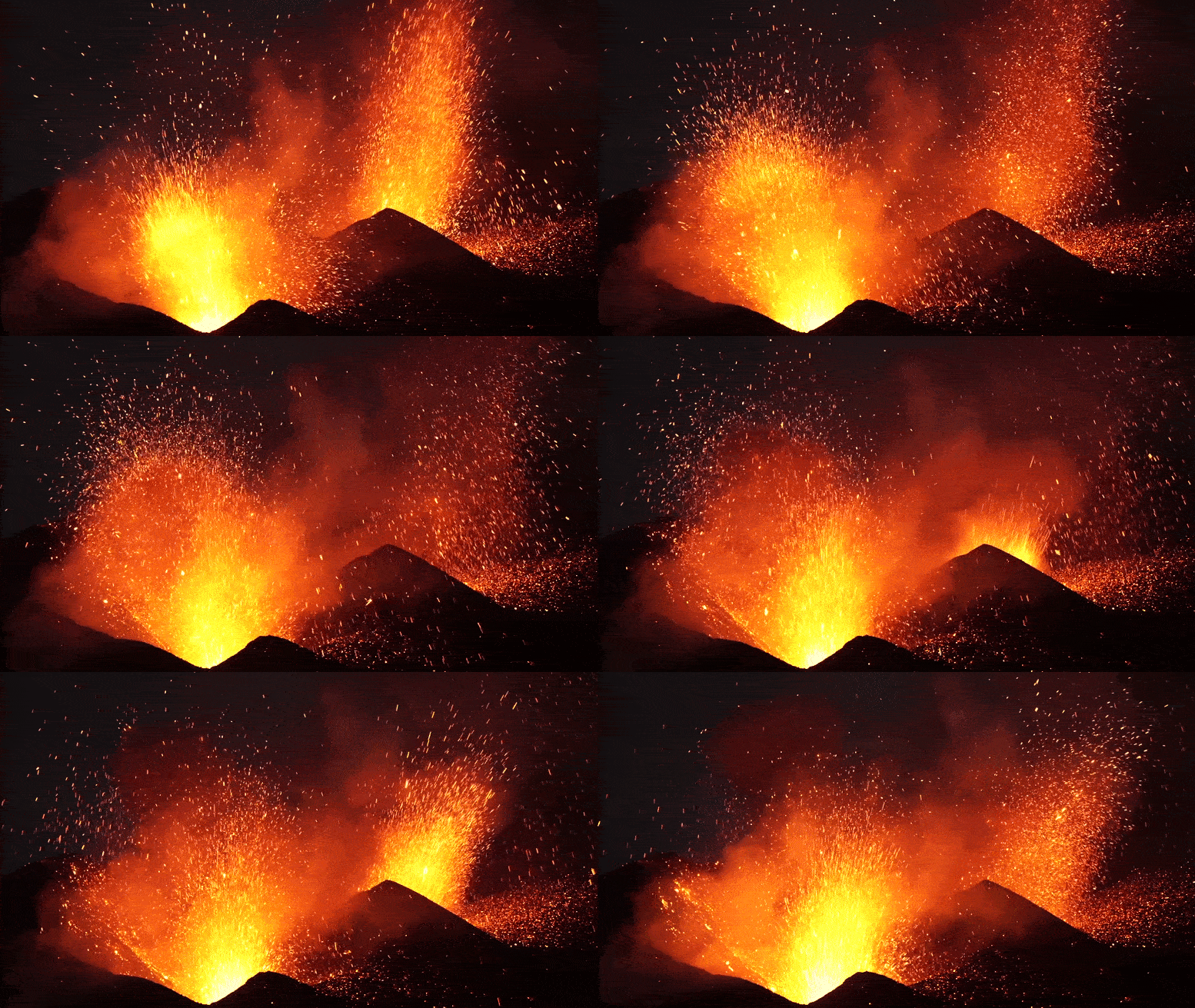
Moderate volcanoes near vital hubs may disrupt global systems more than rare mega-eruptions.
Currently, much of the thinking around risks posed by volcanoes follows a simple equation: the bigger the likely eruption, the worse it will be for society and human welfare.
However, a team of experts now argues that too much focus is on the risks of massive yet rare volcanic explosions, while far too little attention is paid to the potential domino effects of moderate eruptions in key parts of the planet.
Researchers led by the University of Cambridge’s Centre for the Study of Existential Risk (CSER) have identified seven “pinch points” where clusters of relatively small but active volcanoes sit alongside vital infrastructure that, if paralyzed, could have catastrophic global consequences.
These regions include volcano groups in Taiwan, North Africa, the North Atlantic, and the northwestern United States. The report is published today (August 6, 2021) in the journal Nature Communications.
“Even a minor eruption in one of the areas we identify could erupt enough ash or generate large enough tremors to disrupt networks that are central to global supply chains and financial systems,” said Dr. Lara Mani from CSER, lead author of the latest report.
“At the moment, calculations are too skewed towards giant explosions or nightmare scenarios, when the more likely risks come from moderate events that disable major international communications, trade networks or transport hubs. This is true of earthquakes and extreme weather as well as volcanic eruption.”
Mani and colleagues say that smaller eruptions ranking up to 6 on the “volcanic explosivity index”– rather than the 7s and 8s that tend to occupy catastrophist thinking – could easily produce ash clouds, mudflows, and landslides that scupper undersea cables, leading to financial market shutdowns, or devastate crop yields, causing food shortages that lead to political turmoil.
As an example from recent history, the team point to events of 2010 in Iceland, where a magnitude 4 eruption from the Eyjafjallajökull volcano, close to the major “pinch point” of mainland Europe, saw plumes of ash carried on northwesterly winds close European airspace at a cost of US$5 billion to the global economy.
Yet when Mount Pinatubo in the Philippines erupted in 1991, a magnitude 6 eruption some 100 times greater in scale than the Icelandic event, its distance from vital infrastructure meant that overall economic damage was less than a fifth of Eyjafjallajökull. (Pinatubo would have a global economic impact of around US$740 million if it occurred in 2021.)
From Taiwan Chips to the Suez Canal
The seven “pinch point” areas identified by the experts – within which relatively small eruptions could inflict maximum global mayhem – include the volcanic group on the northern tip of Taiwan. Home to one of the largest producers of electronic chips, if this area – along with the Port of Taipei – was indefinitely incapacitated, the global tech industry could grind to a halt.
Another pinch point is the Mediterranean, where legends of the classical world such as Vesuvius and Santorini could induce tsunamis that smash submerged cable networks and seal off the Suez Canal. “We saw what a six-day closure to the Suez Canal did earlier this year, when a single stuck container ship cost up to ten billion dollars a week in global trade,” said Mani.
Eruptions in the US state of Washington in the Pacific Northwest could trigger mudflows and ash clouds that blanket Seattle, shutting down airports and seaports. Scenario modeling for a magnitude 6 eruption from Mount Rainier predicts potential economic losses of more than US$7 trillion over the ensuing five years.
The highly active volcanic centers along the Indonesian archipelago – from Sumatra to Central Java – also line the Strait of Malacca: one of the busiest shipping passages in the world, with 40% of global trade traversing the narrow route each year.
The Luzon Strait in the South China Sea, another key shipping route, is the crux of all the major submerged cabling that connects China, Hong Kong, Taiwan, Japan, and South Korea. It is also encircled by the Luzon Volcanic Arc.
The researchers also identify the volcanic region straddling the Chinese-North-Korean border, from which plumes of ash would disrupt the busiest air routes in the east, and point out that a reawakening of Icelandic volcanoes would do the same in the west.
New Perspective on Volcanic Hazards
“It’s time to change how we view extreme volcanic risk,” added Mani. “We need to move away from thinking in terms of colossal eruptions destroying the world, as portrayed in Hollywood films. The more probable scenarios involve lower-magnitude eruptions interacting with our societal vulnerabilities and cascading us towards catastrophe.”
Reference: “Global catastrophic risk from lower magnitude volcanic eruptions” by Lara Mani, Asaf Tzachor and Paul Cole, 6 August 2021, Nature Communications.
DOI: 10.1038/s41467-021-25021-8
Never miss a breakthrough: Join the SciTechDaily newsletter.
Follow us on Google and Google News.
3 Comments
Experts warn that you should be afraid of everything all the time!
Something else to be terrified of? I’ll have to pass.
I just don’t have time in my fear schedule for a whole new type of dread.
If it happens it happens you can’t stop it so quit worrying about