
Close Menu
    Facebook X (Twitter) Instagram
    SciTechDaily
    • Biology
    • Chemistry
    • Earth
    • Health
    • Physics
    • Science
    • Space
    • Technology
    Facebook X (Twitter) Pinterest YouTube RSS
    SciTechDaily
    Home»Technology»Cracking the Quantum Black Box: A New Benchmarking Tool From Mathematical Physics
    Technology

    Cracking the Quantum Black Box: A New Benchmarking Tool From Mathematical Physics

    By Helmholtz-Zentrum Berlin (HZB)November 8, 20232 Comments3 Mins Read
    Facebook Twitter Pinterest Telegram LinkedIn WhatsApp Email Reddit
    Share
    Facebook Twitter LinkedIn Pinterest Telegram Email Reddit
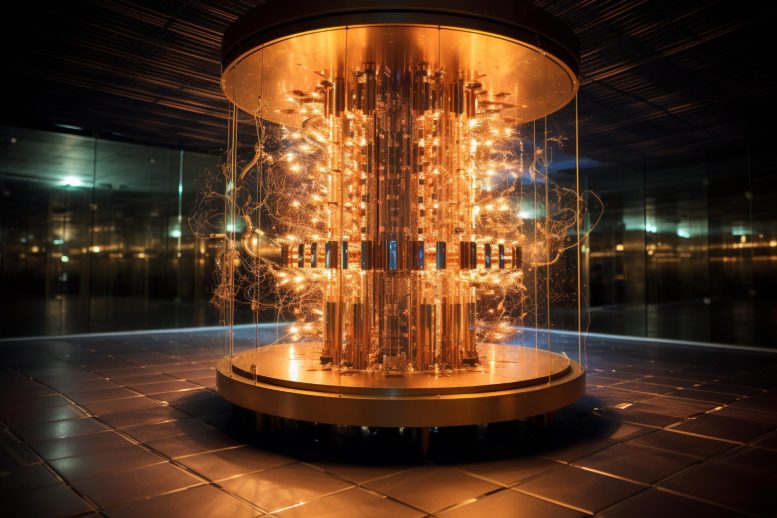
    Quantum Computer Technology Concept
    A team of international experts has developed a new method for benchmarking quantum computers, using mathematical physics to derive meaningful performance metrics from random data sequences. This tool can characterize quantum operations and compare them to traditional computing, requiring logarithmically less data for greater insights.

    The field of quantum computing is rapidly advancing, but as quantum computers increase in size and complexity, they become less like a tool and more like a mysterious ‘black box’. A team utilizing mathematical physics has now cracked this box open, managing to extract concrete metrics from seemingly random data sequences. These metrics serve as benchmarks for assessing quantum computer performance.

    Experts from Helmholtz-Zentrum Berlin, Freie Universität Berlin, Qusoft Research Centre Amsterdam, the University of Copenhagen, and the Technology Innovation Institute Abu Dhabi were involved in the work, which has now been published in Nature Communications.

    Efficiency in Quantum Calculations

    Quantum computers can be used to calculate quantum systems much more efficiently and solve problems in materials research, for example. However, the larger and more complex quantum computers become, the less transparent the processes that lead to the result. Suitable tools are therefore needed to characterize such quantum operations and to fairly compare the capabilities of quantum computers with classical computing power for the same tasks. Such a tool with surprising talents has now been developed by a team led by Prof. Jens Eisert and Ingo Roth.
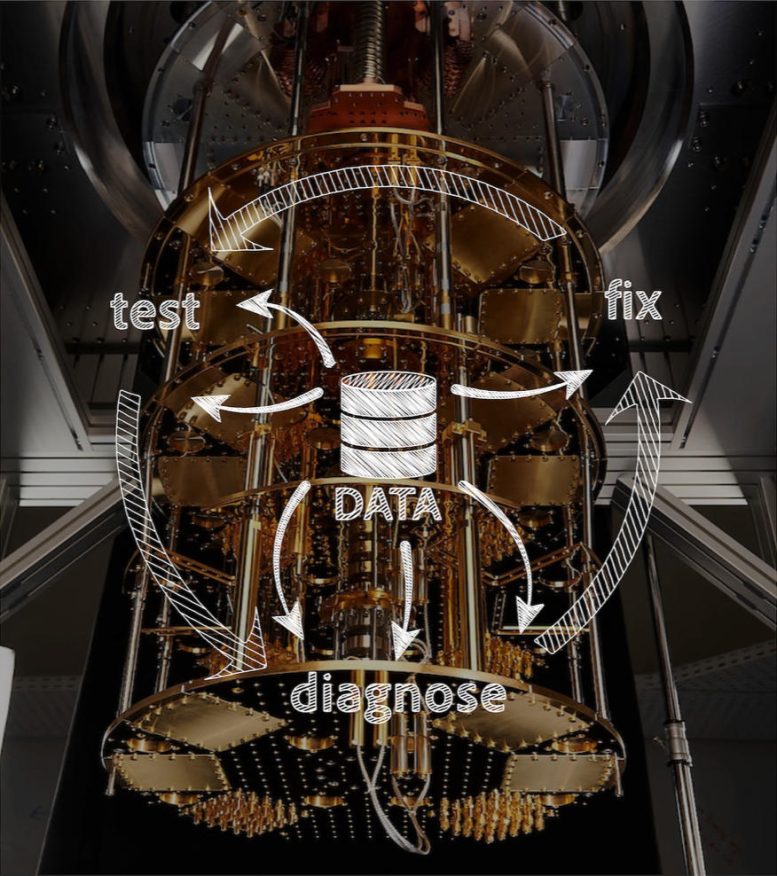
    Quantum Computing Technology Innovation Institute in Abu Dhabi
    Quantum computers (here an experiment at the Technology Innovation Institute in Abu Dhabi) work at very low temperatures to minimize noise and unwanted disturbances. With a new developed mathematical tool, it is now possible to evaluate the performance of a quantum computer by random test data and diagnose possible bugs. Credit: Roth/Quantum research center, TII

    Insights from Random Test Sequences

    Roth, who is currently setting up a group at the Technology Innovation Institute in Abu Dhabi, explains: “From the results of random test sequences, we can now extract different numbers that show how close the operations are on statistical average to the desired operations. This allows us to learn much more from the same data than before. And what is crucial: the amount of data needed does not grow linearly but only logarithmically.”

    This means: to learn a hundred times as much, only twice as much data is needed. An enormous improvement. The team was able to prove this by using methods from mathematical physics.

    “This is about benchmarking quantum computers,” says Eisert, who heads a joint research group on theoretical physics at Helmholtz-Zentrum Berlin and Freie Universität Berlin. “We have shown how randomized data can be used to calibrate such systems. This work is important for the development of quantum computers.”

    Reference: “Shadow estimation of gate-set properties from random sequences” by J. Helsen, M. Ioannou, J. Kitzinger, E. Onorati, A. H. Werner, J. Eisert and I. Roth, 19 August 2023, Nature Communications.
    DOI: 10.1038/s41467-023-39382-9

    Never miss a breakthrough: Join the SciTechDaily newsletter.
    Follow us on Google and Google News.

    Helmholtz Centre Quantum Computing
    Share. Facebook Twitter Pinterest LinkedIn Email Reddit

    Related Articles

    Physicists Use Cloud of Rubidium Atoms as Optical Memory Device

    Using Photons for Quantum Computer Memory

    Quantum Computing Continues to Move Forward

    New Spin Technique Moves Quantum Computers a Step Closer

    Engineers Show Feasibility of Organic Topological Insulators

    Yale Physicists Observe Quantum Information While Preserving Its Integrity

    Photon Devices Could Outperform Traditional Computers

    Samarium Hexoboride Behaves Like a Topological Insulator

    Electronic Read-Out of the Quantum State of an Atom

    2 Comments

    1. Faranak595 on November 9, 2023 1:26 am

      Years..wooow.abruptly yes .ok!! Nicola tesslla//⏰⏳🌠🏆✌💯🎁 nicolla tesslla

      Reply
    2. Faranak595 on November 9, 2023 1:31 am

      Tanx ..love my illan musk. (ایران ماسک)👌👍👍👍💜💜💜💜🚀🌌👽🆒📧

      Reply
    Leave A Reply Cancel Reply

    • Facebook
    • Twitter
    • Pinterest
    • YouTube

    Don't Miss a Discovery

    Subscribe for the Latest in Science & Tech!

    Trending News

    The Universe Is Expanding Too Fast and Scientists Can’t Explain Why

    “Like Liquid Metal”: Scientists Create Strange Shape-Shifting Material

    Early Warning Signals of Esophageal Cancer May Be Hiding in Plain Sight

    Common Blood Pressure Drug Shows Surprising Power Against Deadly Antibiotic-Resistant Superbug

    Scientists Uncover Dangerous Connection Between Serotonin and Heart Valve Disease

    Scientists Discover a “Protector” Protein That Could Help Reverse Hair Loss

    Bone-Strengthening Discovery Could Reverse Osteoporosis

    Scientists Uncover Hidden Trigger Behind Stem Cell Aging

    Follow SciTechDaily
    • Facebook
    • Twitter
    • YouTube
    • Pinterest
    • Newsletter
    • RSS
    SciTech News
    • Biology News
    • Chemistry News
    • Earth News
    • Health News
    • Physics News
    • Science News
    • Space News
    • Technology News
    Recent Posts
    • Scientists Overcome Major Quantum Bottleneck, Potentially Transforming Teleportation and Computing
    • Quantum Physics’ Strangest Problem May Hold the Key to Time Itself
    • Scientists Create “Liquid Gears” That Spin Without Touching
    • The Simple Habit That Could Help Prevent Cancer
    • Forgotten Medicinal Plant Shows Promise in Fighting Dangerous Superbugs
    Copyright © 1998 - 2026 SciTechDaily. All Rights Reserved.
    • Science News
    • About
    • Contact
    • Editorial Board
    • Privacy Policy
    • Terms of Use

    Type above and press Enter to search. Press Esc to cancel.