
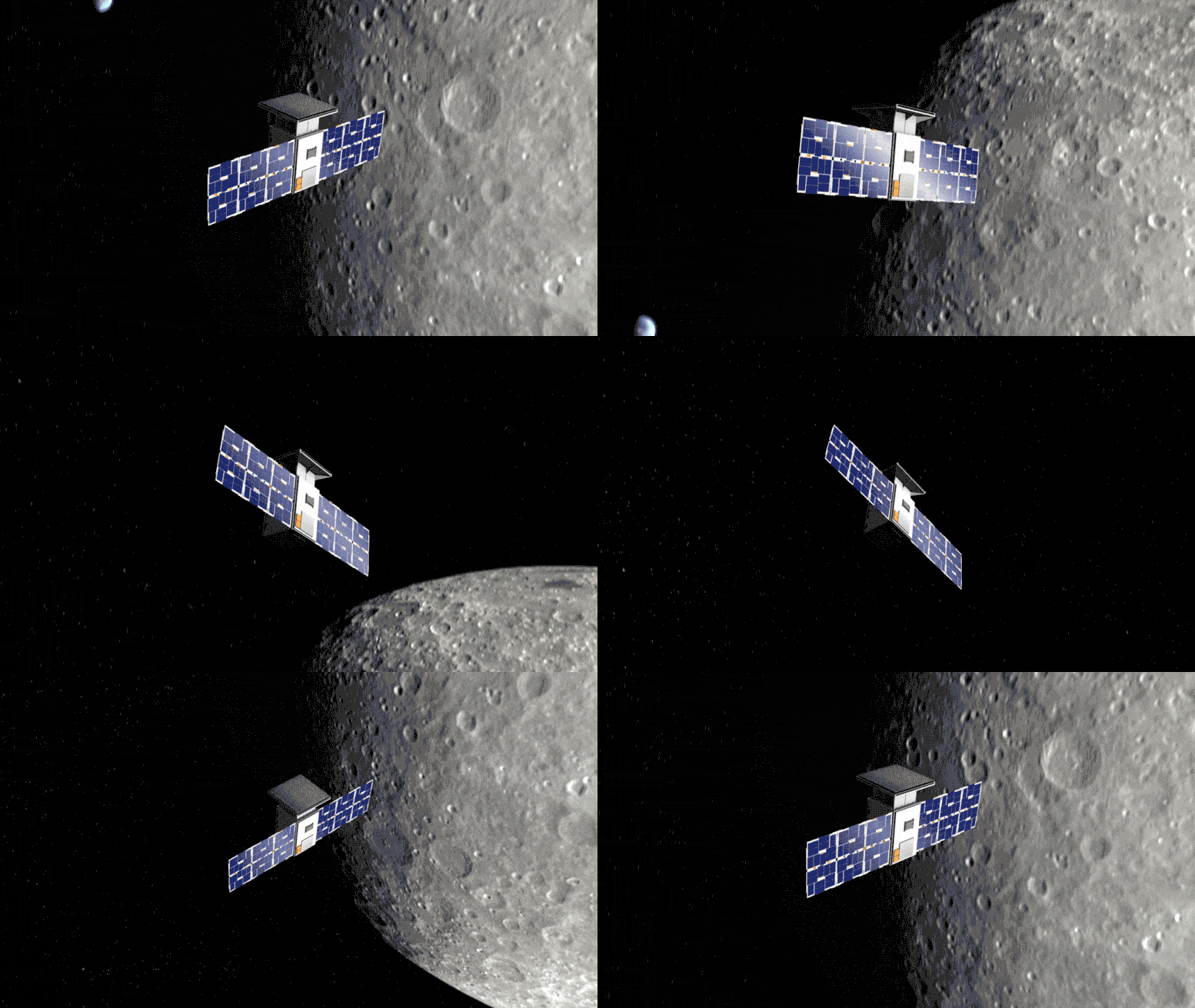
CAPSTONE’s Historic Arrival at the Moon
Today, November 13, CAPSTONE will reach the Moon and become the first spacecraft to enter into a unique, elongated orbit that will support NASA’s Artemis missions.
Cislunar Autonomous Positioning System Technology Operations and Navigation Experiment (CAPSTONE) is a microwave oven-sized satellite, weighing just 55 pounds (25 kilograms), that will be the first CubeSat to fly to and operate at the Moon. It serves as a pathfinder for Gateway, a Moon-orbiting space station that is part of NASA’s Artemis program. CAPSTONE’s mission will help reduce risk for future spacecraft, including Orion, by validating innovative navigation technologies and verifying the dynamics of a type of halo-shaped orbit that has never been flown before.
The pull of gravity from Earth and the Moon interact in this unique orbit – formally known as a near rectilinear halo orbit (NRHO) – to allow for a semi-stable orbit. There, physics does most of the work of keeping spacecraft in orbit at the Moon. This reduces the need for spacecraft to use fuel to maintain the NRHO compared to other similar orbits. NASA already has big plans for this special type of orbit. Engineers expect it will allow them to park bigger spacecraft – including Gateway – in orbit at the Moon for at least 15 years. Fuel efficiency is key for such long-duration missions.
In this animation, the planned trajectory for CAPSTONE’s near rectilinear halo orbit (NRHO) is shown in red. The NRHO insertion maneuver and two subsequent correction maneuvers ensure that the spacecraft accurately inserts into the NRHO. Without a properly executed insertion maneuver, CAPSTONE will fly by the Moon without making it into orbit, as shown in blue. Credit: Advanced Space/Matt Bolliger
Over the past four months, CAPSTONE has been navigating an unusual yet efficient deep-space route to the Moon. This route – called a ballistic lunar transfer – follows gravitational contours in deep space and allows spacecraft to reach their destination expending little energy. Advanced Space, a Colorado small business that owns and operates CAPSTONE on behalf of NASA designed this unique trajectory.
CAPSTONE has performed five maneuvers over the past few months to line up its trajectory for orbit insertion, with the team adapting to unexpected challenges to keep CAPSTONE on track. A final maneuver on October 27 teed up the spacecraft’s arrival to the Moon.
“What this CAPSTONE team has overcome to date has been incredible, showing resilience while gaining valuable knowledge. We are grateful to the exceptional individuals who have gone above and beyond in NASA, Terran Orbital, Stellar Exploration, NASA’s Deep Space Network, and Advanced Space for their tireless work on recovery efforts,” said Bradley Cheetham, principal investigator for CAPSTONE and chief executive officer of Advanced Space. “Overcoming challenges is the purpose of a pathfinding mission – CAPSTONE is capitalizing on that objective.”
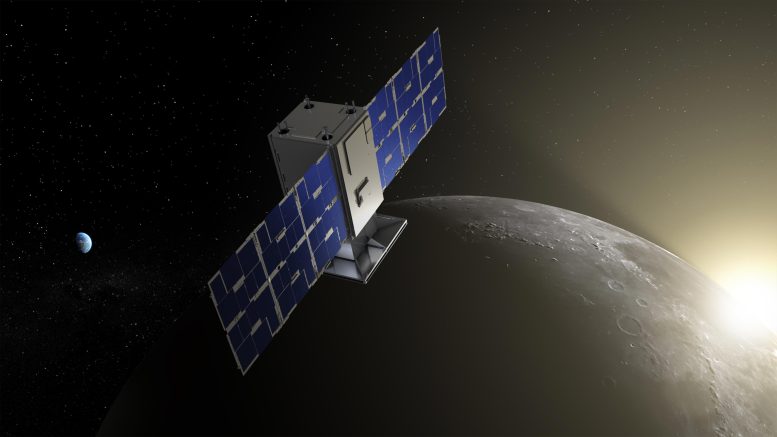
When CAPSTONE reaches the end of its gravity-driven track and arrives at the Moon, its approach will be perfectly aligned for NRHO insertion – the critical point of its route. Though the schedule of CAPSTONE’s prior maneuvers was flexible based on the spacecraft’s performance and other factors, this orbit insertion must take place at exactly the right time to put CAPSTONE in the correct orbit. While traveling 3,800 miles (6,100 kilometers) per hour, it will perform its delicate, precisely timed propulsive maneuver to enter orbit, like a flying trapeze artist who jumps from one arc to another with a decisive, acrobatic motion.
The initial orbit insertion maneuver is planned for Sunday, November 13, at 7:18 p.m. EST (4:18 p.m. PST). The CAPSTONE team expects it will take at least five days to analyze data, perform two clean-up maneuvers, and confirm successful insertion into the near rectilinear halo orbit.
Beyond that, other goals still lay ahead for this pathfinder CubeSat. Once in lunar orbit, CAPSTONE is scheduled to fire its thrusters once every six-and-a-half days, if needed, to stay on its orbit for at least six months, allowing NASA and its partners to understand how to operate in this unique orbit. Specifically, CAPSTONE will validate the propulsion requirements for maintaining its orbit as predicted by models, reducing logistical uncertainties for future spacecraft.
Additionally, a key software technology – the Cislunar Autonomous Positioning System (CAPS) – will be tested in the coming months. CAPS will demonstrate innovative spacecraft-to-spacecraft navigation solutions that will allow future spacecraft to determine their location without having to rely exclusively on tracking from Earth. CAPSTONE will do this by communicating directly with NASA’s Lunar Reconnaissance Orbiter – which has been in orbit around the Moon since 2009 – to determine its own position in space. This capability could enable future spacecraft to perform on their own with less support from the ground and allow ground-based antennas to prioritize valuable science data over more routine operational tracking.
CAPSTONE’s mission will demonstrate multiple technologies that will lay a foundation for commercial support of future lunar operations. NASA partners are testing cutting-edge tools for mission planning and operations, paving the way and expanding opportunities for small and more affordable space and exploration missions to the Moon, Mars, and other destinations throughout the solar system.
CAPSTONE is commercially owned and operated by Advanced Space in Westminster, Colorado. It represents an innovative collaboration between NASA and industry to provide rapid results and feedback to inform future exploration and science missions. The spacecraft was designed and built by Terran Orbital. Operations are performed jointly by teams at Advanced Space and Terran Orbital.
NASA’s Small Spacecraft Technology program within the agency’s Space Technology Mission Directorate (STMD) funds the demonstration mission. The program is based at NASA’s Ames Research Center in California’s Silicon Valley. The development of CAPSTONE’s navigation technology is supported by NASA’s Small Business Innovation Research and Small Business Technology Transfer (SBIR/STTR) program, also within STMD. The Artemis Campaign Development Division within NASA’s Exploration Systems Development Mission Directorate funded the launch and supports mission operations.
Never miss a breakthrough: Join the SciTechDaily newsletter.
Follow us on Google and Google News.
2 Comments
Fascinating. Congrats to the engineers. May a plethora of advances follow.
It seems to me that the brains would put windshield wipers/washers on those contraptions the send to mars, a small item like that might make them last a little longer