
Close Menu
    Facebook X (Twitter) Instagram
    SciTechDaily
    • Biology
    • Chemistry
    • Earth
    • Health
    • Physics
    • Science
    • Space
    • Technology
    Facebook X (Twitter) Pinterest YouTube RSS
    SciTechDaily
    Home»Space»Cruising Past a Spectacular Aurora Borealis on the International Space Station
    Space

    Cruising Past a Spectacular Aurora Borealis on the International Space Station

    By Kathryn Hansen, NASA Earth ObservatoryMarch 1, 2021No Comments3 Mins Read
    Facebook Twitter Pinterest Telegram LinkedIn WhatsApp Email Reddit
    Share
    Facebook Twitter LinkedIn Pinterest Telegram Email Reddit
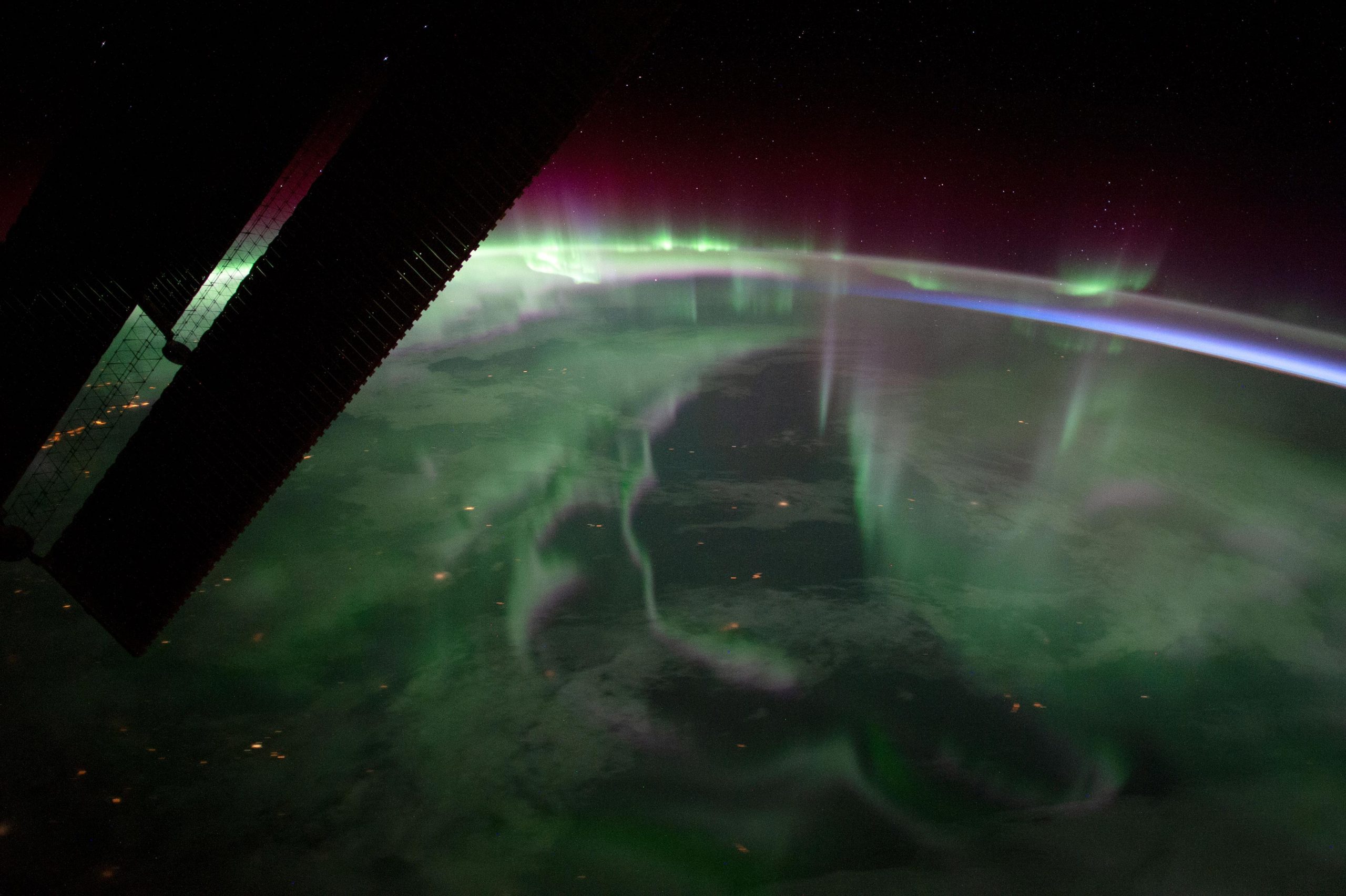
    Aurora Borealis ISS 2017
    Aurora borealis seen from the International Space Station.  September 15, 2017

    Astronauts have snapped numerous photos of the light show from their unique perch on the International Space Station.

    There are few experiences quite like witnessing the aurora borealis. Commonly known as the northern lights, these colorful ribbons of light appear to dance in the sky over the planet’s high latitudes, attracting sky chasers and photographers. The light also catches the eye of astronauts, who have snapped numerous photos of northern and southern lights from their unique perch on the International Space Station.

    Astronaut Randy “Komrade” Bresnik shot this photograph on September 15, 2017, as the space station passed over Ontario, Canada. Curtains of green—the most familiar color of auroras—dominate the light show, with hints of purple and red.

    What Causes the Dazzling Light Show?

    The lights are the result of interactions between solar emissions and Earth’s magnetic field. The specific color depends on the atmospheric gas and the amount of energy involved. For example, bursts of green light occur after oxygen atoms are energized by collisions with fast-moving electrons.

    Other sources of light are also visible, including high-latitude cities that dot the landscape below. And looking in the distance toward the Earth’s limb, you can see the distinct layer of airglow—light emitted from chemical reactions caused by sunlight in the upper atmosphere. Finally, the bright blue-white glow near the horizon is the pending sunrise—one of 16 sunrises visible from the space station each day.

    About a week after Bresnik acquired the image at the top of this page, astronauts captured another display of the northern lights over Canada featured in the video below. The video is a time-lapse, compiled from nearly 1,000 still frames shot over a span of 15 minutes on September 28, 2017. The space station was passing from the northwestern United States toward the southeast at the time.

    The time-lapse imagery that we’ve been able to get of auroras is just fascinating to watch,” said Will Stefanov, ISS program scientist for Earth observations at Johnson Space Center. “And just strikingly beautiful to be able to see that process, how the aurora shifts and moves like a live thing. And knowing that for that particular stretch of time, you are pretty much seeing what the crew saw in orbit.”

    Learn more about astronaut photography in the Picturing Earth video series: part 1 Astronaut Photography in Focus; part 2 Window on the World; and part 3 Behind the Scenes.

    Astronaut photograph ISS053-E- 23965 was acquired on September 15, 2017, with a Nikon D4 digital camera using a 24 millimeter lens and is provided by the ISS Crew Earth Observations Facility and the Earth Science and Remote Sensing Unit, Johnson Space Center. The image was taken by a member of the Expedition 53 crew. The image has been cropped and enhanced to improve contrast, and lens artifacts have been removed. The International Space Station Program supports the laboratory as part of the ISS National Lab to help astronauts take pictures of Earth that will be of the greatest value to scientists and the public, and to make those images freely available on the Internet.

    Never miss a breakthrough: Join the SciTechDaily newsletter.
    Follow us on Google and Google News.

    Astronaut Aurora Borealis International Space Station NASA NASA Earth Observatory Popular
    Share. Facebook Twitter Pinterest LinkedIn Email Reddit

    Related Articles

    Splashdown! NASA’s SpaceX Crew-4 Safely Returns to Earth

    NASA’s SpaceX Crew-5 Picture-Perfect Launch to International Space Station

    Splashdown! NASA SpaceX Crew-3 Astronauts Safely Return to Earth

    LIFTOFF! NASA SpaceX Crew-4 Astronauts Begin Their Journey to the Space Station

    Axiom Mission 1 Private Astronaut Crew Safely Splashes Down Near Florida

    Dragon Endeavour Departs Space Station – Axiom Astronauts Finally Returning to Earth

    Russian Cosmonauts Complete Spacewalk To Set Up 37-Foot-Long Robotic Arm

    Record-Setting NASA Astronaut and Two Cosmonauts Return From International Space Station

    NASA Astronaut Mark Vande Hei Breaks American Spaceflight Record

    Leave A Reply Cancel Reply

    • Facebook
    • Twitter
    • Pinterest
    • YouTube

    Don't Miss a Discovery

    Subscribe for the Latest in Science & Tech!

    Trending News

    Scientists Discover How Coffee Impacts Memory, Mood, and Gut Health

    Why Did the Neanderthals Disappear? Scientists Reveal Humans Had a Hidden Advantage

    Physicists Propose Strange Experiment Where Time Goes Quantum

    Magnesium Magic: New Drug Melts Fat Even on a High-Fat, High-Sugar Diet

    Weight-Loss Drugs Like Ozempic May Come With an Unexpected Cost

    Mezcal “Worm” in a Bottle Mystery: DNA Testing Reveals a Surprise

    New Research Reveals That Your Morning Coffee Activates an Ancient Longevity Switch

    This Is What Makes You Irresistible to Mosquitoes

    Follow SciTechDaily
    • Facebook
    • Twitter
    • YouTube
    • Pinterest
    • Newsletter
    • RSS
    SciTech News
    • Biology News
    • Chemistry News
    • Earth News
    • Health News
    • Physics News
    • Science News
    • Space News
    • Technology News
    Recent Posts
    • Quantum Breakthrough Turns Simple Forces Into Powerful New Interactions
    • Blue Origin’s New Moon Lander Passes a Crucial Test for NASA Missions
    • NASA Fires Up Record-Breaking Plasma Thruster for Future Mars Missions
    • This Popular Supplement May Boost Your Brain, Not Just Your Muscles
    • What Happened in Childhood Could Be Causing Your Gut Issues Today
    Copyright © 1998 - 2026 SciTechDaily. All Rights Reserved.
    • Science News
    • About
    • Contact
    • Editorial Board
    • Privacy Policy
    • Terms of Use

    Type above and press Enter to search. Press Esc to cancel.