
Close Menu
    Facebook X (Twitter) Instagram
    SciTechDaily
    • Biology
    • Chemistry
    • Earth
    • Health
    • Physics
    • Science
    • Space
    • Technology
    Facebook X (Twitter) Pinterest YouTube RSS
    SciTechDaily
    Home»Space»Curiosity Assesses a Small Plastic Object Found on the Surface of Mars
    Space

    Curiosity Assesses a Small Plastic Object Found on the Surface of Mars

    By Jet Propulsion LaboratoryOctober 10, 20122 Comments2 Mins Read
    Facebook Twitter Pinterest Telegram LinkedIn WhatsApp Email Reddit
    Share
    Facebook Twitter LinkedIn Pinterest Telegram Email Reddit
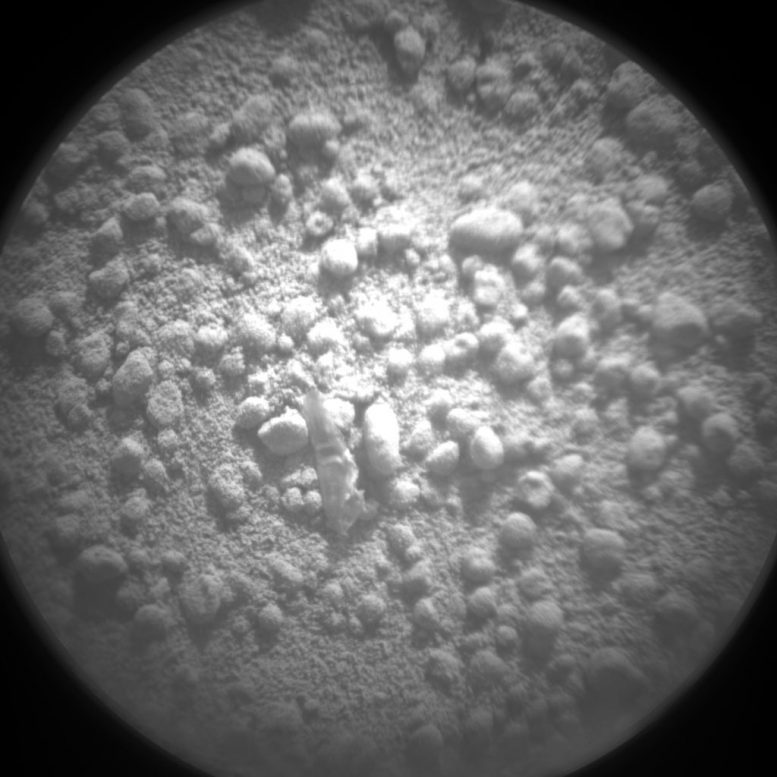
    Curiosity assess a small object on the ground, which appears to be a shred of plastic material
    This image was taken by ChemCam: Remote Micro-Imager (CHEMCAM_RMI) onboard NASA’s Mars rover Curiosity on Sol 62 (2012-10-08 22:00:04 UTC). The object in question is just to the left of the center of the image. Credit: NASA/JPL-Caltech/LANL

    NASA’s Curiosity rover continues to assess a small plastic object discovered on the surface of Mars. It is believed that the object is something from the rover, not Martian material.

    Curiosity’s main activity in the 62nd sol of the mission (October 8, 2012) was to image a small, bright object on the ground using the Remote Micro-Imager of the Chemistry and Camera (ChemCam) instrument.

    The rover team’s assessment is that the bright object is something from the rover, not Martian material. It appears to be a shred of plastic material, likely benign, but it has not been definitively identified.

    To proceed cautiously, the team is continuing the investigation for another day before deciding whether to resume processing of the sample in the scoop. Plans include imaging of surroundings with the Mastcam.


    This video clip shows the first Martian material collected by the scoop on the robotic arm of NASA’s Mars Curiosity rover, being vibrated inside the scoop after it was lifted from the ground on October 7, 2012.

    A sample of sand and dust scooped up on Sol 61 remains in the scoop. Plans to transfer it from the scoop into other chambers of the sample-processing device were postponed as a precaution during planning for Sol 62 after the small, bright object was detected in an image from the Mast Camera (Mastcam).

    A Sol 62 raw image from ChemCam (at the top of this article) shows the object in question just to left of center of the image.

    Sol 62, in Mars local mean solar time at Gale Crater, will end at 12:23 a.m. October 9, PDT (3:23 a.m., EDT).

    Never miss a breakthrough: Join the SciTechDaily newsletter.
    Follow us on Google and Google News.

    Astronomy Curiosity Rover JPL Planetary Science Popular
    Share. Facebook Twitter Pinterest LinkedIn Email Reddit

    Related Articles

    Curiosity Discovers More Hydration of Minerals Near Clay-Bearing Rocks

    NASA’s Curiosity Rover Reveals That Mars Could Have Supported Life

    NASA Completes Computer Swap for Curiosity Rover

    NASA’s Curiosity Rover Drills and Collects First Martian Bedrock Sample

    Mineralogy of Martian Soil Is Similar to Soils of Volcanic Origin in Hawaii

    Curiosity Prepares to Take Its First Scoop of Soil for Analysis

    Curiosity Finds Ancient Streambed on Mars

    NASA’s Curiosity Readies for First Drive on Mars

    Color HiRISE Image of Curiosity Rover on Mars

    2 Comments

    1. Russell Johnson on October 10, 2012 8:55 am

      What are the odds that we would pick up a piece of our own trash in the first scoop of martian dirt!?!

      Reply
    2. Darin Selby on October 14, 2012 9:40 am

      As ‘remarkable’ as landing on Mars was, it still does not take away from the fact of the HUGE amount of rocket pollution left behind as it went into space, and the risk of 10 lbs. of plutonium disbursement in a launch accident.

      I see this landing on Mars as no triumph, but more like a casino roulette game that just so happen to be won.

      So now, what will be the outcome? More of the same, with more rocket launches and funding for more nuclear-powered spacecraft. As long as humanity supports this kind of activity, a devistating radioactive fallout accident waiting to happen is no longer ‘if’, it is ‘when’.

      As amazing as this technology seems to be, it still is only a type of insanity to pursue such a course. Because NASA has its own agenda, which does not include taking care of the environment, that we all rely upon for our daily sustenance.

      So I maintain my position that going to Mars to laser-beam some rocks is an extremely unconscious and self-serving act, on the part of certain people who have a complete disregard for preserving and caring for the fragile balance of life on THIS planet.

      Just imagine what $2.5 billion (which is 2,500 MILLION dollars) would do to start cleaning up the environment!

      What would you do if given one million dollars to make the world a better place to live in?

      Now, multiply that by 2,500 people, who could be given one million dollars each to feed and clothe the hungry, house the homeless, clean up the pollution, and work toward restoring the Earth to its former beauty.

      Reply
    Leave A Reply Cancel Reply

    • Facebook
    • Twitter
    • Pinterest
    • YouTube

    Don't Miss a Discovery

    Subscribe for the Latest in Science & Tech!

    Trending News

    What Causes Chronic Pain? Scientists Identify Key Culprit in the Brain

    Semaglutide Shows Surprising Mental Health Benefits in Massive 100,000-Person Study

    This Liquid Snapped Instead of Flowing and Scientists Were Shocked

    Breakthrough Alzheimer’s Drug Rewires the Brain Instead of Just Clearing Plaques

    Scientists Discover Hidden “Footprint of Death” That Could Transform How We Fight Disease

    A Simple Nose Swab Could Detect Alzheimer’s Years Before Symptoms Appear

    Scientists Just Rewrote the Timeline of Complex Life on Earth

    Teenager’s Fossil Find Leads to Discovery of Shark Teeth in 5 Million-Year-Old Whale Skull

    Follow SciTechDaily
    • Facebook
    • Twitter
    • YouTube
    • Pinterest
    • Newsletter
    • RSS
    SciTech News
    • Biology News
    • Chemistry News
    • Earth News
    • Health News
    • Physics News
    • Science News
    • Space News
    • Technology News
    Recent Posts
    • Even “Failed” Diets May Deliver Long-Term Health Gains, Study Finds
    • Childhood Junk Food May Rewire the Brain for Life
    • NIH Scientists Discover Powerful New Opioid That Relieves Pain Without Dangerous Side Effects
    • Breakthrough Study Reveals Why Damaged Nerves Struggle To Heal
    • 20-Year Study Reveals Cholera’s Surprising Weakness
    Copyright © 1998 - 2026 SciTechDaily. All Rights Reserved.
    • Science News
    • About
    • Contact
    • Editorial Board
    • Privacy Policy
    • Terms of Use

    Type above and press Enter to search. Press Esc to cancel.