
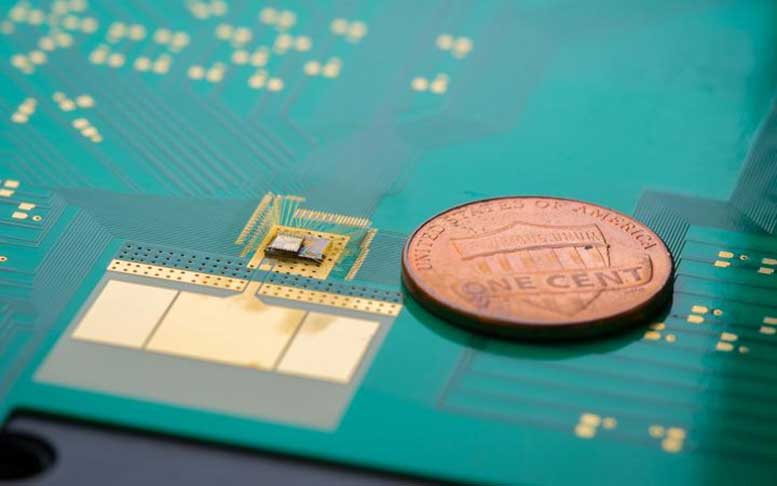
A new power-saving chip developed by engineers at the University of California San Diego could significantly reduce or eliminate the need to replace batteries in the Internet of Things (IoT) devices and wearables. The so-called wake-up receiver wakes up a device only when it needs to communicate and perform its function. It allows the device to stay dormant the rest of the time and reduce power use.
The technology is useful for applications that do not always need to be transmitting data, like IoT devices that let consumers instantly order household items they are about to run out of, or wearable health monitors that take readings a handful of times a day.
“The problem now is that these devices do not know exactly when to synchronize with the network, so they periodically wake up to do this even when there’s nothing to communicate. This ends up costing a lot of power,” said Patrick Mercier, a professor of electrical and computer engineering at UC San Diego. “By adding a wake-up receiver, we could improve the battery life of small IoT devices from months to years.”
The team, led by Mercier and UC San Diego electrical and computer engineering professors Drew Hall and Gabriel Rebeiz, published their work titled, “A 22.3 nW, 4.55 cm2 Temperature-Robust Wake-up Receiver Achieving a Sensitivity of -69.5 dBm at 9 GHz,” in the IEEE Journal of Solid-State Circuits.
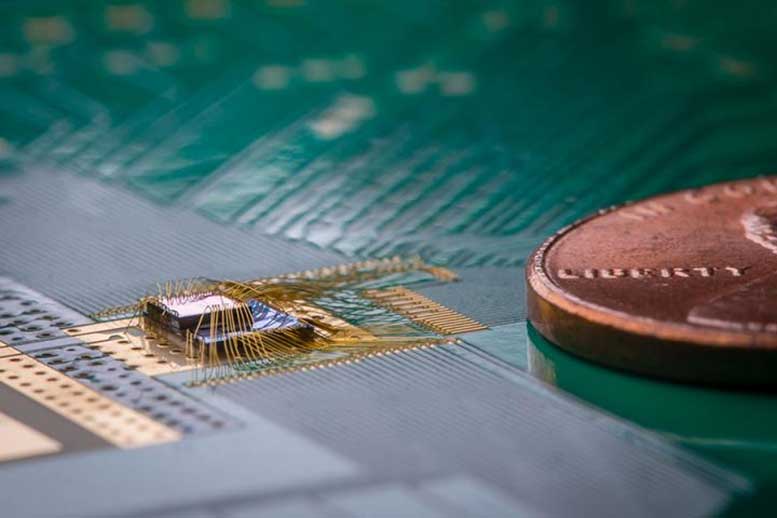
The wake-up receiver is an ultra-low power chip that continuously looks out for a specific radio signal, called a wake-up signature, that tells it when to wake up the main device. It needs only a very small amount of power to stay on and do this—22.3 nanowatts in this case, about half a millionth the power it takes to run an LED night light.
A key part of this receiver’s design is that it targets higher frequency radio signals than other wake-up receivers. The signals are in the frequency of 9 gigahertz, which is in the realm of satellite communication, air traffic control, and vehicle speed detection. Targeting a higher frequency allowed researchers to shrink everything, including the antenna, transformer, and other off-chip components down into a much smaller package—at least 20 times smaller than prior nanowatt-level work.
This wake-up receiver can also do something else that other nanowatt-powered receivers cannot: perform well over a wide temperature range. For this receiver, performance is consistent from -10 C up to 40 C (14 F to 104 F). Typically, performance in low power wake-up receivers drops if the temperature changes by even just a few degrees. “For indoor use, this is not a big deal. But for outdoor use, it needs to work over a wide temperature window. We specifically addressed that in this work,” Mercier said.
The UC San Diego team developed new circuit designs and system-level techniques to equip their receiver with all these features while boosting sensitivity. These were made possible thanks to cutting-edge ultra-low power electronics developed by the Mercier and Hall labs, and advanced antenna and radio technologies developed by the Rebeiz lab.
According to the researchers, this receiver’s combination of nanowatt-level power consumption, small package size (4.55 square centimeters in area), sensitivity (-69.5 dBm), and temperature performance is the best that has been published to date.
“These numbers are pretty impressive in the field of wireless communications—power consumption that low, while still retaining temperature-robustness, all in a small, highly sensitive system—this will enable all sorts of new IoT applications,” Mercier said.
There is a small tradeoff in latency. There is a 540-millisecond delay between when the receiver detects the wake-up signature and when it wakes up the device. But for the intended applications, researchers note that this amount of delay is not a problem.
“You don’t need high-throughput, high-bandwidth communication when sending commands to your smart home or wearables devices, for example, so the trade-off of waiting for a mere half a second to get a 100,000x improvement in power is worth it,” Mercier said.
###
Reference: “A 22.3 nW, 4.55 cm2 Temperature-Robust Wake-up Receiver Achieving a Sensitivity of -69.5 dBm at 9 GHz” by Haowei Jian, Po-Han Peter Wang, Li Gao, Corentin Pochet, Gabriel M. Rebeiz, Drew A. Hall and Patrick P. Mercier, IEEE Journal of Solid-State Circuits.
DOI: 10.1109/JSSC.2019.2948812
This work was supported by Defense Advanced Research Projects Agency (DARPA, contract HR0011-15-C-0134) and equipment purchased through a DURIP award from the Office of Naval Research (award N00014-18-1-2350).
Never miss a breakthrough: Join the SciTechDaily newsletter.
Follow us on Google and Google News.