
Close Menu
    Facebook X (Twitter) Instagram
    SciTechDaily
    • Biology
    • Chemistry
    • Earth
    • Health
    • Physics
    • Science
    • Space
    • Technology
    Facebook X (Twitter) Pinterest YouTube RSS
    SciTechDaily
    Home»Space»Dark Cosmic Filaments: The Magnetic Field in Milky Way “Bones”
    Space

    Dark Cosmic Filaments: The Magnetic Field in Milky Way “Bones”

    By Harvard-Smithsonian Center for AstrophysicsFebruary 6, 2022No Comments3 Mins Read
    Facebook Twitter Pinterest Telegram LinkedIn WhatsApp Email Reddit
    Share
    Facebook Twitter LinkedIn Pinterest Telegram Email Reddit
    Nessie Dark Filament
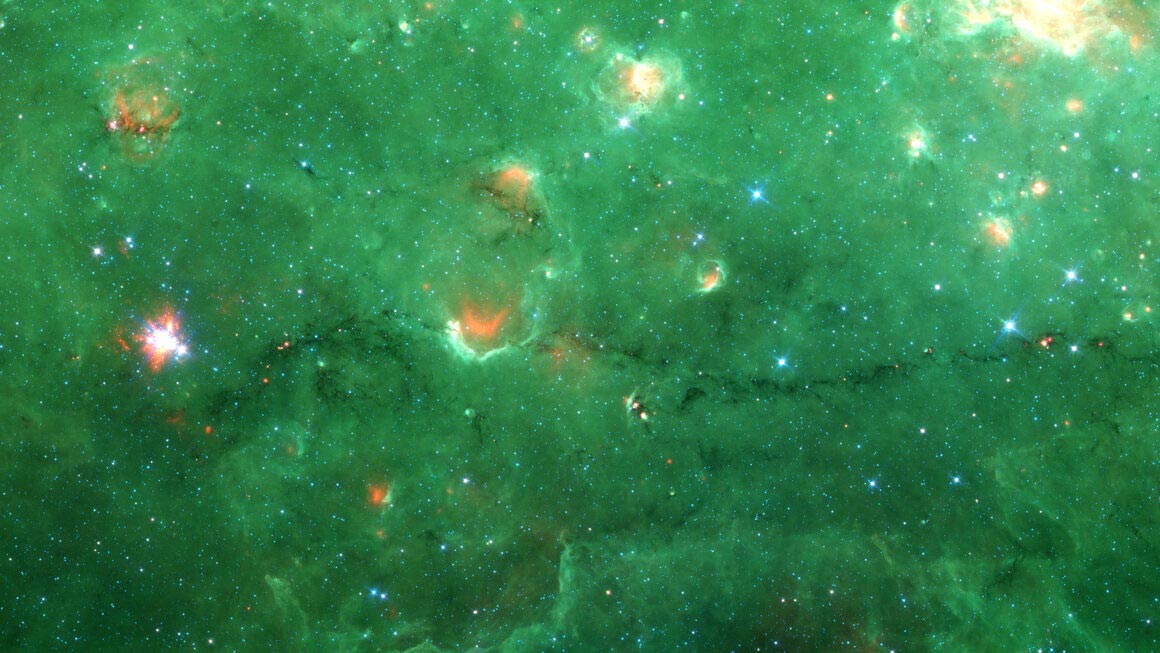
    The dark filament “Nessie,” as seen in the infrared with the IRAC camera on Spitzer. Nessie, a cloud of cold gas and dust, is a “bone” tracing the Milky Way’s spiral arm structure. Astronomers have used SOFIA, NASA’s Stratospheric Observatory for Infrared Astronomy, to measure the magnetic field along the bone G47.06+0.26 via its infrared polarization. Credit: NASA/JPL/SSC

    Researchers are mapping magnetic fields in Milky Way filaments using SOFIA to understand their role in star formation, revealing varying influences on the gravitational collapse of gas and dust.

    Star formation in the Milky Way primarily occurs in long, dense filaments of gas and dust that stretch along the spiral arms. Dubbed “bones” because they delineate the galaxy’s densest skeletal spiral structures, these filaments are characterized by being at least fifty times longer than they are wide and having coherent internal motions along their lengths. While most of the key physical properties of these bones are known, what we know of their magnetic field properties is generally unconstrained. These fields can play a critical role either in supporting the gas and dust against gravitational collapse into new stars, or alternatively, in assisting the flow of mass along the bone into cores making new stars.

    Magnetic fields are notoriously difficult to measure in space. The most common method relies on the emission from non-spherical dust grains that align their short axes with the direction of the field, resulting in infrared radiation that is preferentially polarized perpendicular to the field. Measuring this faint polarization signal, and inferring the field strength and direction, has only recently become easier to do with the HAWC+ instrument on SOFIA, NASA’s Stratospheric Observatory for Infrared Astronomy, and its 2.5-m telescope. SOFIA flies as high as 45,000 feet, above most of the atmospheric water vapor that absorbs far infrared infrared signals from space.

    CfA astronomers Ian Stephens, Phil Myers, Catherine Zucker, and Howard Smith led a team that used HAWC+ polarization to map the detailed magnetic field along the bone G47.06+0.26. This filament is about 190 light-years long, 5 light-years across, and has a mass of 28,000 solar-masses with a typical dust temperature of 18 kelvin. The IRAC camera on Spitzer had previously mapped the bone to identify the regions of young star formation along its length. The astronomers determined where along the bone the magnetic field is capable of supporting the gas against collapse into stars, and those regions where it is too weak. They also mapped low-density regions where the field is more complex in shape. G47.06+0.26 is just the first object studied in a larger program to map the magnetic fields in ten of the eighteen known Milky Way bones. Once an analysis of this larger statistical sample has been completed, the scientists expect to be able to quantify more precisely how the strength and orientation of fields influence the evolution of the bones and their pockets of star formation.

    Reference: “The Magnetic Field in the Milky Way Filamentary Bone G47” by Ian W. Stephens, Philip C. Myers, Catherine Zucker, James M. Jackson, B-G Andersson, Rowan Smith, Archana Soam, Cara Battersby, Patricio Sanhueza, Taylor Hogge, Howard A. Smith, Giles Novak, Sarah Sadavoy, Thushara Pillai, Zhi-Yun Li, Leslie W. Looney, Koji Sugitani, Simon Coude, Andres Guzman, Alyssa Goodman, Takayoshi Kusune, Fabio P. Santos, Leah Zuckerman and Frankie Encalada, 15 February 2022, The Astrophysical Journal Letters.
    DOI: 10.3847/2041-8213/ac4d8f
    arXiv:2201.11933

    Never miss a breakthrough: Join the SciTechDaily newsletter.
    Follow us on Google and Google News.

    Astronomy Astrophysics Harvard-Smithsonian Center for Astrophysics Milky Way
    Share. Facebook Twitter Pinterest LinkedIn Email Reddit

    Related Articles

    Powerful Magnetic Fields Spin Around Our Galaxy’s Supermassive Black Hole

    Groundbreaking 3D Map of Cosmic Superbubble’s Magnetic Field Unveiled

    Harvard Astronomers Have Revealed the True Shape of the Milky Way’s Halo of Stars

    Unprecedented New Panorama of the Center of Our Milky Way – Reveals Magnetized Threads Weaving Spectacular Galactic Tapestry

    New All-Sky Map of Milky Way’s Outer Reaches Released – Could Offer a New Test of Dark Matter Theories

    Astrophysicists Show Milky Way Had a Blowout Bash 6 Million Years Ago

    Astronomers Take A Closer Look at the Milky Way’s Central Molecular Zone

    Astronomers Use G1 and G2 to Probe the Accretion Flow Feeding Sgr A*

    Astronomers Reveal the “Skeletal Structure” of the Milky Way

    Leave A Reply Cancel Reply

    • Facebook
    • Twitter
    • Pinterest
    • YouTube

    Don't Miss a Discovery

    Subscribe for the Latest in Science & Tech!

    Trending News

    Scientists Uncover Potential Brain Risks of Popular Fish Oil Supplements

    Scientists Discover a Surprising Way To Make Bread Healthier and More Nutritious

    After 60 Years, Scientists Uncover Unexpected Brain Effects of Popular Diabetes Drug Metformin

    New Research Uncovers Hidden Side Effects of Popular Weight-Loss Drugs

    Scientists Rethink Extreme Warming After Surprising Ocean Discovery

    Landmark Study Links Never Marrying to Significantly Higher Cancer Risk

    Researchers Discover Unknown Beetle Species Just Steps From Their Lab

    Largest-Ever Study Finds Medicinal Cannabis Ineffective for Anxiety, Depression, PTSD

    Follow SciTechDaily
    • Facebook
    • Twitter
    • YouTube
    • Pinterest
    • Newsletter
    • RSS
    SciTech News
    • Biology News
    • Chemistry News
    • Earth News
    • Health News
    • Physics News
    • Science News
    • Space News
    • Technology News
    Recent Posts
    • Students Build Dark Matter Detector and Set New Experimental Limits
    • Scientists Discover Caffeine Can Repair Key Memory Circuits After Sleep Loss
    • Strange 65-Foot Dinosaur Discovered in Argentina
    • Researchers Uncover Source of Strange Deformation in Earth’s Largest Continental Rift
    • Scientists Solve Mystery of Where the Colorado River Vanished Millions of Years Ago
    Copyright © 1998 - 2026 SciTechDaily. All Rights Reserved.
    • Science News
    • About
    • Contact
    • Editorial Board
    • Privacy Policy
    • Terms of Use

    Type above and press Enter to search. Press Esc to cancel.