
Close Menu
    Facebook X (Twitter) Instagram
    SciTechDaily
    • Biology
    • Chemistry
    • Earth
    • Health
    • Physics
    • Science
    • Space
    • Technology
    Facebook X (Twitter) Pinterest YouTube RSS
    SciTechDaily
    Home»Biology»Deaf Moths Evolved Noise-Cancelling Scales to Evade Prey – More Efficient Than Current Sound Engineering Technology
    Biology

    Deaf Moths Evolved Noise-Cancelling Scales to Evade Prey – More Efficient Than Current Sound Engineering Technology

    By University of BristolFebruary 26, 2020No Comments3 Mins Read
    Facebook Twitter Pinterest Telegram LinkedIn WhatsApp Email Reddit
    Share
    Facebook Twitter LinkedIn Pinterest Telegram Email Reddit
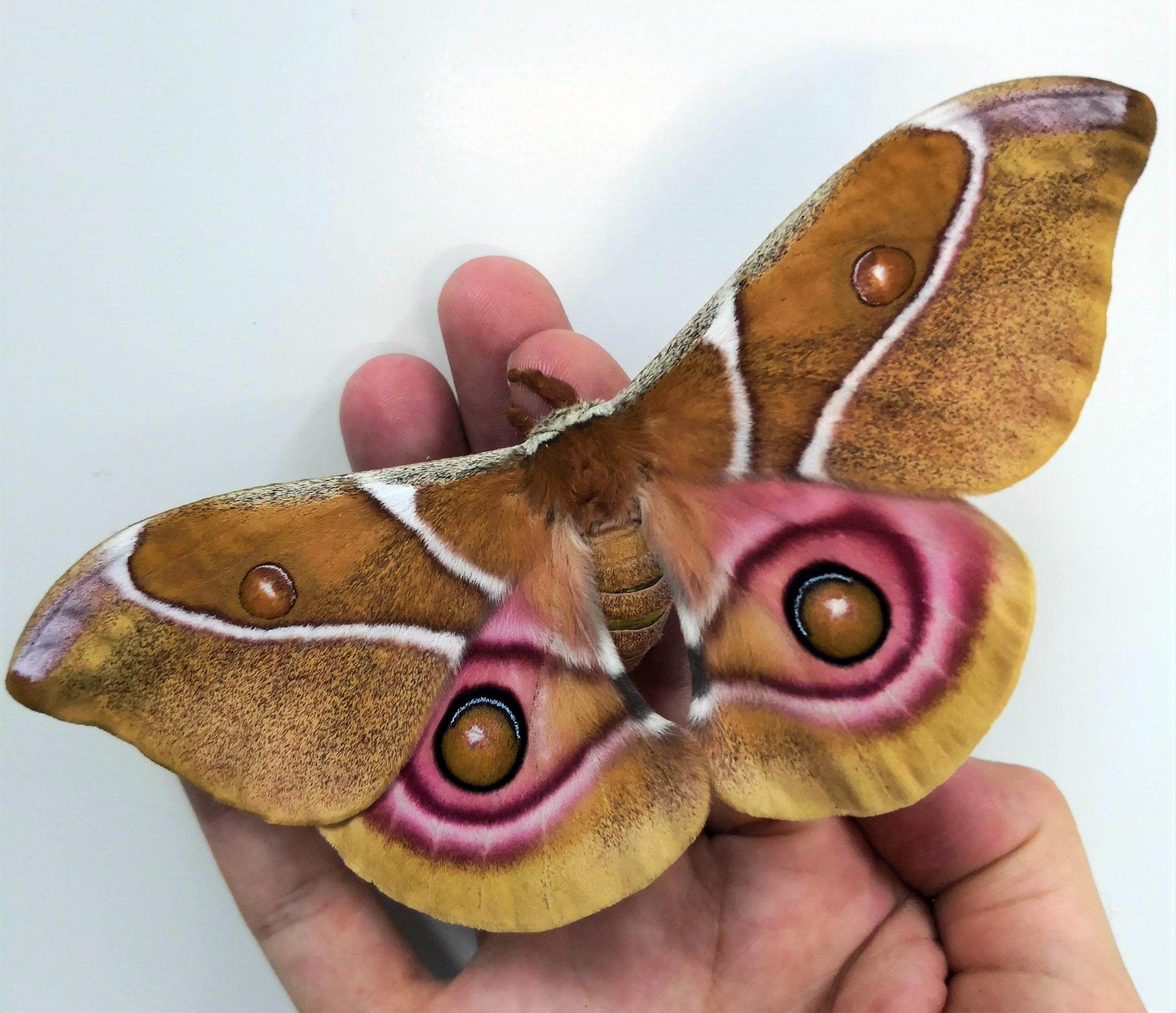
    Antherina suraka Moth
    One of the four species used in the present study (Antherina suraka). The thorax scales on this moth can absorb up to 85% of the sound energy produced by an echolocating bat. Credit: Thomas R. Neil

    Some species of deaf moths can absorb as much as 85 percent of the incoming sound energy from predatory bats — who use echolocation to detect them. The findings, published in Royal Society Interface on February 25, 2020, reveal the moths, who are unable to hear the ultrasonic calls of bats, have evolved this clever defensive strategy to help it survive.

    Bats hunt at night using echolocation. The technique, which is also known as biological sonar, first evolved around 65 million years ago and enables bats to search for and find prey putting huge predation pressure on nocturnal insects. One defense that many nocturnal insects evolved is the ability to hear the ultrasonic calls of bats, which allows them to actively evade approaching bats.

    Fluffy Moth Species
    A particularly fluffy moth species (Periphoba arcaei) displaying highly elongated thorax scales which act as a type of acoustic camouflage against bats. Credit: Thomas R. Neil

    Many moth species, however, cannot hear. The team of researchers from the University of Bristol wanted to investigate the alternative defenses against bats that some species of deaf moths might have evolved.

    Using scanning electron microscopy, the team from Bristol’s School of Biological Sciences discovered that the thorax scales of the moths Antherina suraka and Callosamia promethea looked structurally similar to fibers that are used as noise insulation, so wanted to explore whether the thorax scales of moths might be acting in some way to absorb the ultrasonic clicks of bats and dampen the echoes returning to the bat, offering the moths a type of acoustic camouflage.

    The team measured that the scales on the body of a moth absorb as much as 85 percent of the incoming sound energy and that the scales can reduce the distance a bat would be able to detect a moth by almost 25 percent, potentially offering the moth a significant increase in its survival chances.
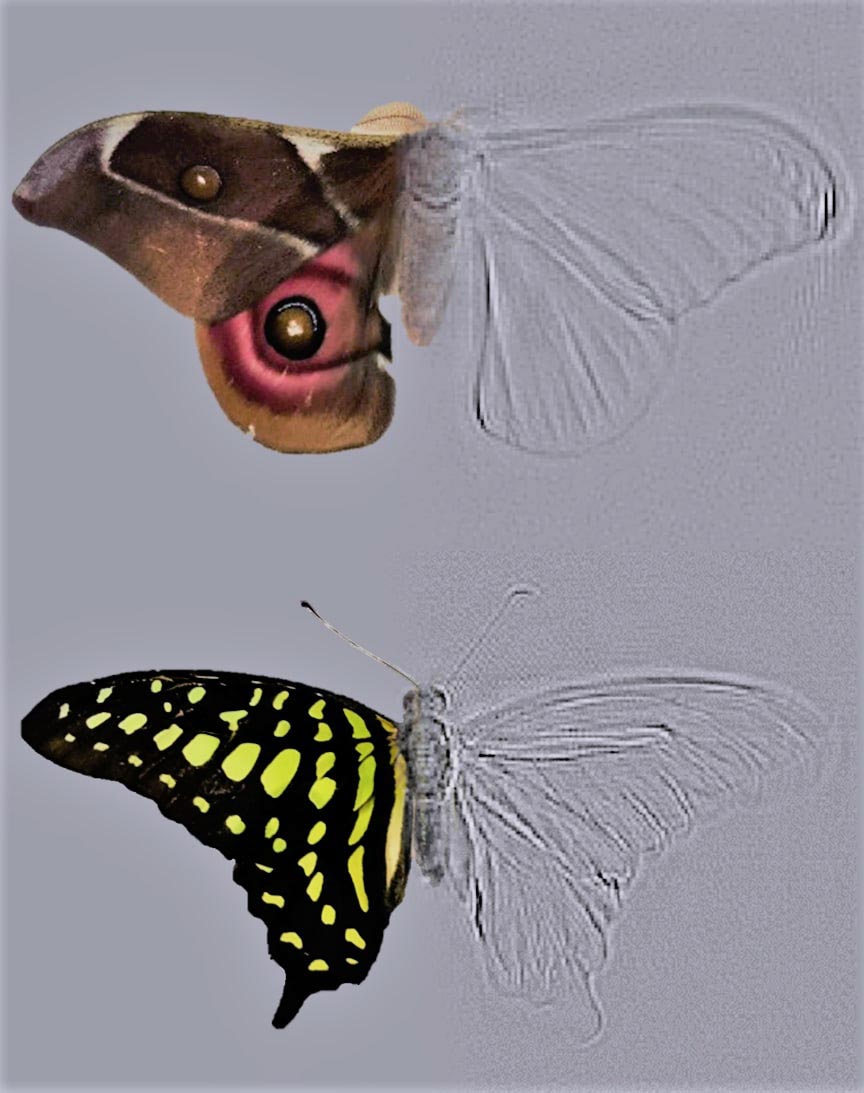
    Composite Moth and Butterfly
    A composite image of a moth and a butterfly showing how we can use acoustic tomography to create a picture using sound. The color images show the target species whilst the grey scale is the resultant tomographic image. This technique allows us to measure exactly how much sound is being reflected from certain body parts of a specimen. Credit: Thomas R. Neil and Marc W. Holderied

    Dr. Thomas Neil, Research Associate from Bristol’s School of Biological Sciences and lead author, said: “We were amazed to see that these extraordinary insects were able to achieve the same levels of sound absorption as commercially available technical sound absorbers, whilst at the same time being much thinner and lighter.

    “We are now looking at ways in which we can use these biological systems to inspire new solutions to sound-insulating technology and analyze the scaling on a moth’s wing to explore whether they too have sound absorbing properties.”

    Reference: “Thoracic scales of moths as a stealth coating against bat biosonar” by Thomas R. Neil, Zhiyuan Shen, Daniel Robert, Bruce W. Drinkwater and Marc W. Holderied, 26 February 2020, Royal Society Interface.
    DOI: 10.1098/rsif.2019.0692

    The study was funded by the Biotechnology and Biological Sciences Research Council (BBSRC) and the Engineering and Physical Sciences Research Council (EPSRC).

    Never miss a breakthrough: Join the SciTechDaily newsletter.
    Follow us on Google and Google News.

    Entomology Evolution University of Bristol
    Share. Facebook Twitter Pinterest LinkedIn Email Reddit

    Related Articles

    Tropical Paper Wasps Babysit for Neighboring Nests

    Mosquitoes Are Drawn to Flowers As Much as People — Now Scientists Finally Know Why

    Ancient Wasp-Mimicking Fly Discovered – Named After PSY’s ‘Gangnam Style’

    Recently Discovered Parasitic Wasp Is Enemy of Serious Alien Pest in North America

    In a Twist of Fate, Ant Expert Discovers Distinct New Species in His Own Backyard

    Meet the ‘Mold Pigs,’ a Newly Discovered Invertebrate From 30 Million Years Ago

    The Last Mass Extinction Event Occurred 66 Million Years Ago – Here’s How Ocean Ecosystems Recovered

    The Unexpected Role Ant-Plant Partnerships May Play in Ant Evolution

    Frightening 500-Million-Year-Old Predator Unveils the Rise of Scorpions and Spiders

    Leave A Reply Cancel Reply

    • Facebook
    • Twitter
    • Pinterest
    • YouTube

    Don't Miss a Discovery

    Subscribe for the Latest in Science & Tech!

    Trending News

    Artificial Sweeteners May Harm Future Generations, Study Suggests

    Splashdown! NASA Artemis II Returns From Record-Breaking Moon Mission

    What If Consciousness Exists Beyond Your Brain

    Scientists Finally Crack the 100-Million-Year Evolutionary Mystery of Squid and Cuttlefish

    Beyond “Safe Levels”: Study Challenges What We Know About Pesticides and Cancer

    Researchers Have Found a Dietary Compound That Increases Longevity

    Scientists Baffled by Bizarre “Living Fossil” From 275 Million Years Ago

    Your IQ at 23 Could Predict Your Wealth at 27, Study Finds

    Follow SciTechDaily
    • Facebook
    • Twitter
    • YouTube
    • Pinterest
    • Newsletter
    • RSS
    SciTech News
    • Biology News
    • Chemistry News
    • Earth News
    • Health News
    • Physics News
    • Science News
    • Space News
    • Technology News
    Recent Posts
    • What if Dark Matter Has Two Forms? Bold New Hypothesis Could Explain a Cosmic Mystery
    • Researchers Expose Hidden Chemistry of “Ore-Forming” Elements in Biology
    • Geologists Reveal the Americas Collided Earlier Than We Thought
    • 20x Difference: Study Reveals True Source of Airborne Microplastics
    • Scientists Uncover Hidden Force Powering Yellowstone’s Supervolcano
    Copyright © 1998 - 2026 SciTechDaily. All Rights Reserved.
    • Science News
    • About
    • Contact
    • Editorial Board
    • Privacy Policy
    • Terms of Use

    Type above and press Enter to search. Press Esc to cancel.