
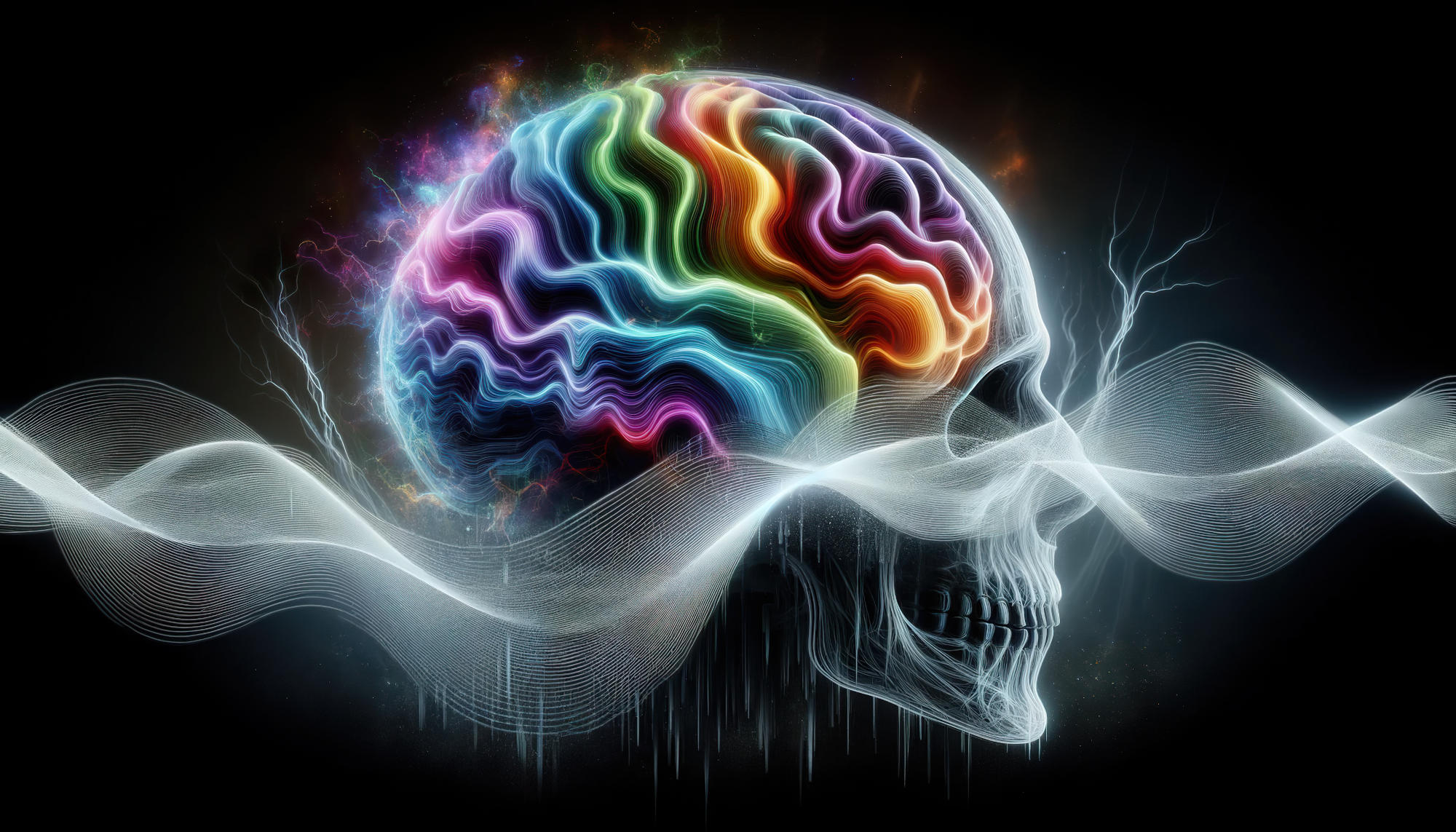
Defining death from a neurological perspective is challenging. It’s not an exact moment of transition from life to death, but rather a process spanning several minutes, which in certain instances can be reversed. Researchers from the “Dynamics of Epileptic Networks and Neuronal Excitability” team at the Paris Brain Institute have demonstrated in a prior study that after a long period of oxygen deprivation—called anoxia—brain activity undergoes a cascade of successive changes that can now be described precisely.
When the brain stops receiving oxygen, its stores of ATP, the cells’ fuel, are rapidly depleted. This causes a disruption in the electrical balance of neurons and a massive release of glutamate, an essential excitatory neurotransmitter in the nervous system. “Neural circuits seem to shut down at first… Then we see a surge in brain activity—specifically an increase in gamma and beta waves,” Séverine Mahon, a researcher in neuroscience, explains. “These waves are usually associated with a conscious experience. In this context, they may be involved in near-death experiences reported by people who have survived cardiorespiratory arrest.”
After that, the activity of the neurons gradually diminishes until a state of perfect electrical silence— corresponding to a flat electroencephalogram—is reached. However, this silence is quickly interrupted by the depolarization of neurons, which takes the form of a high-amplitude wave known as the “wave of death”, which alters the function and structure of the brain. “This critical event, called anoxic depolarization, induces neuronal death throughout the cortex. Like a swan song, it is the true marker of transition towards the cessation of all brain activity,”Antoine Carton-Leclercq, PhD student and first author of the study, adds.
Until now, researchers did not know where the wave of death is initiated in the cortex or whether it propagates homogeneously across all cortical layers. “We already knew that it is possible to reverse the effects of anoxic depolarization if we manage to resuscitate the subject within a specific time window,” the researcher adds. “We still had to understand in which areas of the brain the death wave is likely to do the most damage to preserve brain function as much as possible.”
Following the path of the wave of death
To answer these questions, the researchers used, in rats, measurements of local field potentials and recordings of the electrical activity of individual neurons in different layers of the primary somatosensory cortex—an area that plays a crucial role in body representation and processing of sensory information. They then compared the electrical activity of these different layers before and during anoxic depolarization.
“We noticed that neuronal activity was relatively homogeneous at the onset of brain anoxia. Then, the wave of death appeared in the pyramidal neurons located in layer 5 of the neocortex and propagated in two directions: upwards, i.e. the surface of the brain, and downwards, i.e. the white matter,” Séverine Mahon explains. “We have observed this same dynamic under different experimental conditions and believe it could exist in humans.”
These findings also suggest that the deeper layers of the cortex are the most vulnerable to oxygen deprivation—probably because the pyramidal neurons in layer 5 have exceptionally high energy needs. However, when the researchers reoxygenated the rats’ brains, the cells replenished their ATP reserves, leading to the repolarization of neurons and the restoration of synaptic activity.
“This new study advances our understanding of the neural mechanisms underlying changes in brain activity as death approaches. It is now established that, from a physiological point of view, death is a process that takes its time… and that it is currently impossible to dissociate it rigorously from life. We also know that a flat EEG does not necessarily mean the definitive cessation of brain functions,” Prof. Stéphane Charpier, head of the research team, concludes. “We now need to establish the exact conditions under which these functions can be restored and develop neuroprotective drugs to support resuscitation in the event of heart and lung failure.”
Reference: “Laminar organization of neocortical activities during systemic anoxia” by Antoine Carton-Leclercq, Sofia Carrion-Falgarona, Paul Baudin, Pierre Lemaire, Sarah Lecas, Thomas Topilko, Stéphane Charpier and Séverine Mahon, 3 November 2023, Neurobiology of Disease.
DOI: 10.1016/j.nbd.2023.106345
Never miss a breakthrough: Join the SciTechDaily newsletter.
Follow us on Google and Google News.
4 Comments
Hocka dooks
I feel so much …
Rats 🐀 to human .
Okay I see .
Not looking forward to the end result. Death
Maybe I will play cards n win the hand 🤘 with ole death☠💀👽😂🤣😅🧠thanks 🐀 🐁 🐭 🐀 🐁
Not sure whether this cheers me or adds to the terror!
Just more evidence that what doctors call “brain dead”, isn’t necessarily “actually dead”…