

A long-established drug with a diverse medical history is drawing new attention for its potential role in treating an ultra-rare and life-threatening genetic disorder.
Early findings suggest that a medicine first developed decades ago could take on an unexpected new role in treating Bachmann-Bupp syndrome (BABS), a devastating and ultra-rare condition with no established therapy. Although the drug has long been prescribed for entirely different diseases, researchers now believe it may offer meaningful benefits to patients affected by this little-known disorder.
That possibility is being explored through a new collaboration between Corewell Health, Michigan State University, and Every Cure, a nonprofit biotech organization focused on unlocking new uses for existing medications.
“Beyond helping us build preclinical studies and retrospective analyses, the team at Every Cure has already begun helping us navigate regulatory pathways and compliance on so many levels in the hopes that we can treat more of our BABS patients,” said Caleb Bupp, M.D., pediatric geneticist for Corewell Health Helen DeVos Children’s Hospital in Grand Rapids, Michigan. “They are opening doors that we never would have been able to crack open. It’s a hopeful and exciting time for all of us and more importantly, our patients.”
The drug at the center of this effort is difluoromethylornithine, also known as DFMO or eflornithine. It was originally developed to treat West African sleeping sickness, a chronic parasitic disease transmitted by the tsetse fly. Over time, it also found use in reducing female facial hair growth and helping prevent the return of neuroblastoma.
Repurposing a Well-Studied Drug
More recently, Corewell Health clinicians and scientists at Michigan State University College of Human Medicine found evidence that DFMO may also help address Bachmann-Bupp syndrome, a severe neurodevelopmental disorder. Some patients have already received the drug through an FDA-approved, single-patient investigational protocol.
BABS results from gain-of-function changes in the ornithine decarboxylase, or ODC1 gene, which can lead to profound developmental delays, low muscle tone, and hair loss. DFMO is a well-characterized inhibitor of the ODC protein and may reduce the heightened enzyme activity driven by the altered gene. In a limited number of treated patients, many symptoms have improved.
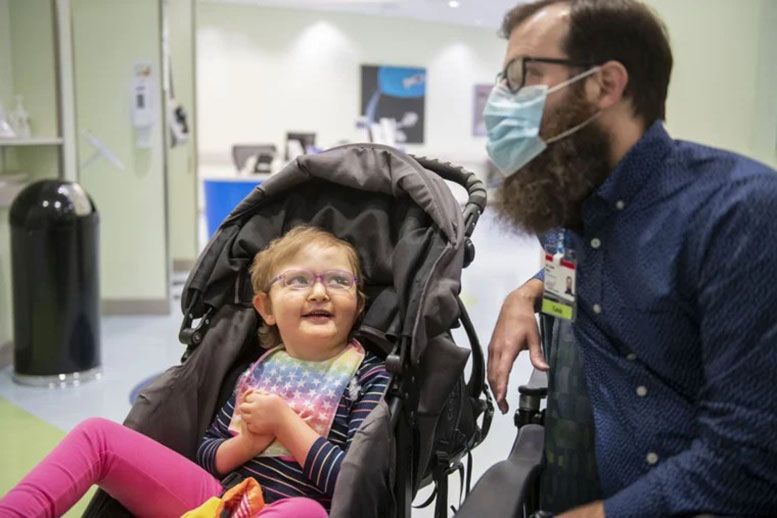
“I’ve studied DFMO and its effect on the ODC1 gene for three decades, including its clinical use in pediatric neuroblastoma,” said MSU pediatrics professor André Bachmann, Ph.D., who, along with Dr. Bupp collaborated to be the first to identify BABS in a patient. “It was a chance encounter with Dr. Bupp that we connected and were able to use DFMO on a patient – and now five others – with promising early results.
Since the research team’s discovery, regulatory hurdles, limited awareness, and the complexity of launching a clinical trial have slowed treatment progress for this newly described condition, which to date has been reported in only about 20 cases worldwide.
Challenges to Clinical Advancement
The Food and Drug Administration (FDA) has urged Drs. Bupp and Bachmann to move forward with a clinical trial. However, the team continues to face challenges in raising awareness of DFMO’s potential, developing a robust study design and establishing appropriate clinical endpoints.
“For the past year, we’ve been at a standstill as far as moving our DFMO therapy forward,” Dr. Bupp said.
That is where Every Cure can help. The nonprofit will help reduce many of these barriers and support systems that help BABS patients receive appropriate evaluation and care as potential DFMO therapies are developed.
“Our role is to help bridge this gap by strengthening the evidence behind BABS and DFMO through preclinical studies, increasing awareness among physicians and rare disease organizations, and ensuring that no child goes undiagnosed or untreated,” said David Fajgenbaum, M.D., co-founder and Every Cure president.
Work has already begun between the three organizations to help build on the years of foundational research that Drs. Bachmann, Bupp, Corewell Health colleague Surender Rajasekaran, M.D., and numerous others have compiled related to DFMO and BABS. The team hopes to have a preclinical study up and running sometime next year.
Never miss a breakthrough: Join the SciTechDaily newsletter.
Follow us on Google and Google News.
1 Comment
DISEASE cause it parasite treatment Super Strength Oil of Oregano drops “Must” go under the tongue brand North American Herb and Spice