
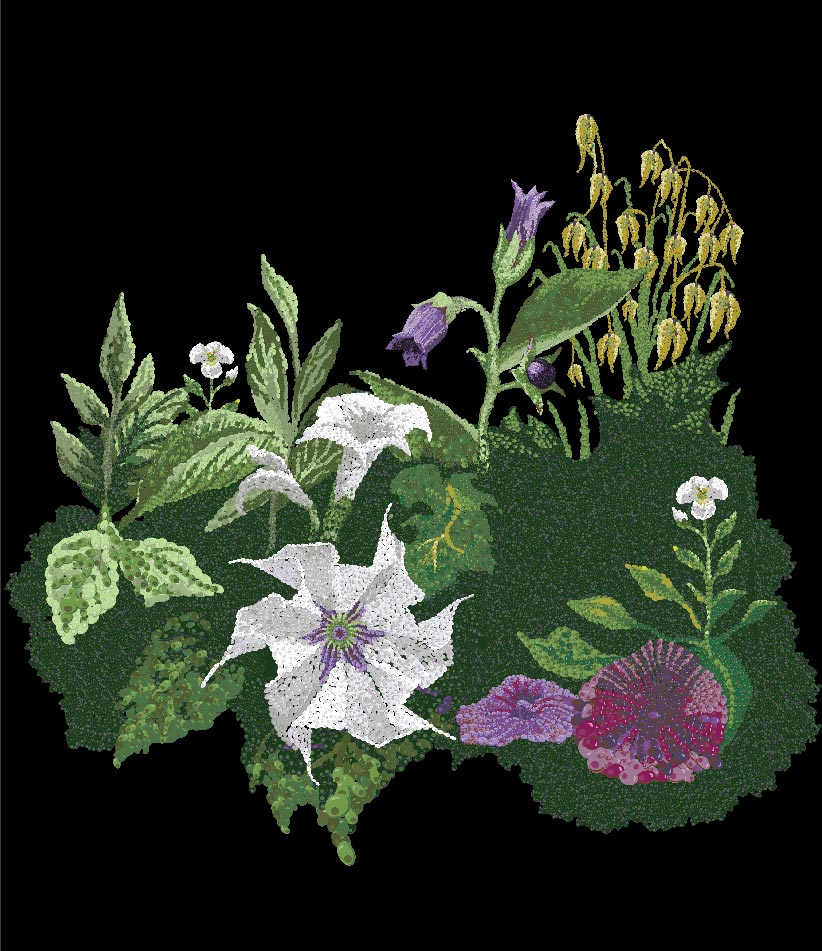
By genetically reprogramming the cellular machinery of yeast they created microscopic factories that convert sugars and amino acids into plant-based drugs.
Since antiquity, cultures on nearly every continent have discovered that certain plant leaves, when chewed or brewed or rubbed on the body, could relieve diverse ailments, inspire hallucinations or, in higher dosages, even cause death. Today, pharmaceutical companies import these once-rare plants from specialized farms and extract their active chemical compounds to make drugs like scopolamine for relieving motion sickness and postoperative nausea, and atropine, to curb the drooling associated with Parkinson’s disease or help maintain cardiac function when intubating COVID-19 patients and placing them on ventilators.
Now, Stanford engineers are recreating these ancient remedies in a thoroughly modern way by genetically reprogramming the cellular machinery of a special strain of yeast, effectively transforming them into microscopic factories that convert sugars and amino acids into these folkloric drugs, in much the same way that brewers’ yeast can naturally convert sugars into alcohol.
“The drug shortages we’re seeing around the COVID-19 crisis drive home why we need new and more reliable ways to source these plant-based medicines, which take months to years to grow and come from a few countries, where climate change, natural disasters, and geopolitical issues can disrupt supplies,” said Christina Smolke, a professor of bioengineering and senior author of a paper published on September 2, 2020, in Nature.

Prashanth Srinivasan, a graduate student in Smolke’s lab and first author of the paper, carried out the factory-floor reprogramming of yeast. With an engineer’s mindset, he looked at each of the yeast organelles, or basic metabolic units, as workstations on an assembly line. He imagined the nucleus as the factory control center, regulating the step-by-step chemical process needed to assemble medicinal compounds. Mitochondria, the energy-producing organelles, demanded special attention. Cells use electrons to hook or unhook molecules on the assembly line, and Srinivasan needed a lot of them to make the products he wanted – a family of complex chemical compounds called tropane alkaloids. Humans have used these compounds for millennia for everything from relieving toothaches and bellyaches to conducting religious rituals and poisoning rivals.
A long history of use
The wide-ranging medicinal utility of tropane alkaloids are an accident of co-evolution. A chemical that two plant families – coca, producers of cocaine, and nightshades, which include henbane and tobacco as well as tomatoes and peppers – evolved to defend against insects and animals just so happen to fit perfectly into a critical cell receptor in the mammalian nervous system. These acetylcholine or ACh receptors help convert nerve impulses into actions by muscles, glands and other human tissues. When a tropane alkaloid enters the bloodstream, it binds to these ACh receptors and either stimulates or inhibits the adjoining muscle, gland or tissue, resulting in diverse and widespread effects.
Traditional societies didn’t understand the biochemistry of these compounds but they did notice their medicinal virtues. Native Andeans chewed or brewed teas from coca leaves to suppress hunger, treat gastrointestinal ailments, and for recreation. From Europe to North Africa to Western Asia, various peoples favored tropane alkaloids derived from deadly nightshade, or Atropa belladonna, so named for its use by women as a cosmetic agent for dilation of the pupils; modern ophthalmologists still use it to elicit the same effect during eye exams. In Southeast Asia, tropane alkaloids from Datura plants were taken orally for sinus infections, and Australia’s Aboriginal people based rituals on the hallucinogenic effects of the shrub Duboisia, which is the primary source of tropane alkaloid for drugs today.
Metabolic engineering
Smolke and her team spent three years making a total of 34 genetic modifications to the yeast’s DNA to control every step in the unseen chemical assembly process of tropane alkaloids. Their approach – called metabolic engineering – is a more precise form of biotechnology in which genetic reprogramming uses or modifies naturally-occurring cellular processes to manufacture products to meet human needs. For instance, when brewers’ yeast produces alcohol, the cells naturally expel the chemical so we can collect and drink it. The Stanford team carefully engineered the organelles and membranes of their engineered yeast to make sure that their intricate tropane alkaloid molecules emerged intact from the chemical assembly line so that they would be useful for medicines.
Smolke, who has previously bioengineered yeast to produce a different family of plant-based analgesic drugs, has co-founded a biotech startup that will license the technology from Stanford to take the experimental quantities of medicines produced by these cell factories into full-scale production, which she expects to take about two years.
“Plants are the world’s best chemists,” said Smolke. “We want to recapitulate their unique and useful chemistries in domesticated microbes to build complex molecules inspired by the natural world but tailored to better meet human needs.”
Reference: “Biosynthesis of medicinal tropane alkaloids in yeast” by Prashanth Srinivasan and Christina D. Smolke, 2 September 2020, Nature.
DOI: 10.1038/s41586-020-2650-9
This work was supported by the National Institutes of Health and a doctoral postgraduate scholarship from the Natural Sciences and Engineering Research Council of Canada.
Never miss a breakthrough: Join the SciTechDaily newsletter.
Follow us on Google and Google News.
2 Comments
Who engineered the first human cell?Because it was far more complex, than a yeast cell?
All I want to know is: how can I invest in this?!