
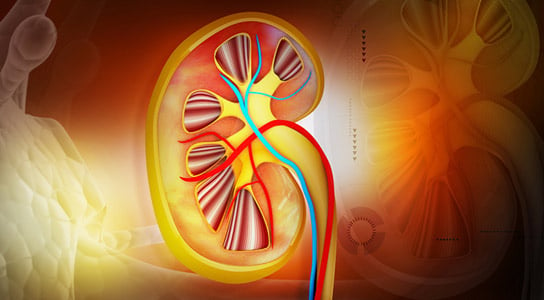
New research from Yale University shows that kidneys from deceased donors that have acute injuries can be successfully used for transplants, instead of being discarded. The study finds that such kidneys may be more viable than previously thought, and should be considered to meet the growing demand for organ transplants.
The study was published March 11 in the American Journal of Transplantation.
Donated kidneys with acute injury are often discarded for fear of poor outcomes such as delayed function and even premature kidney transplant failure. Given the growing need for transplant organs, the Yale-led team embarked on the largest multicenter observational study of its kind to date, including more than 1,600 deceased donors. They examined associations between acute kidney injury (AKI) in donors, rates of kidney discard, and recipient kidney function in the short term as well as six months after transplantation.
As anticipated, the researchers found an association between AKI and organ discard. They also found that injured kidneys were associated with “delayed graft function (DGF),” or the need for continued dialysis support in the first week after transplantation. But unexpectedly, the study did not find a link between deceased-donor kidney injury and poor kidney transplant function six months later.
“What we saw was, with worsening AKI in the donor, the six-month outcome was actually better for recipients who experienced DGF,” said Dr. Isaac E. Hall, an investigator in the Program of Applied Translational Research at Yale School of Medicine and first author of the study. Paradoxically, the six-month transplant function was worst for those with DGF who had received a donated kidney with no apparent injury.
Though that result seemed counterintuitive, Hall suggested that organs acutely injured in the donor might develop “ischemic preconditioning,” a mechanism that could protect the organs from the effects of subsequent injury. Another possible explanation is that the successfully transplanted kidneys with AKI were of otherwise higher quality than the rejected kidneys with AKI, though the study did adjust for many important variables like donor age and comorbidity.
“There appears to be room to attempt more transplants using these AKI kidneys rather than throwing them away,” said Dr. Chirag R. Parikh, director of the Program of Applied Translational Research and senior author of the study.
“The waiting list has grown to over 100,000 patients as thousands more people are wait-listed each year than actually receive a transplant. In addition, the median time it takes for an adult to receive a transplant in the United States increased from 2.7 to 4.2 years between 1998 and 2008, and more than 5,000 people die each year while waiting for a kidney,” said Parikh.
“Even if it only means a few dozen more kidney transplants each year, those are patients who would come off of the waiting list for transplants sooner and have much better survival than continuing on dialysis in hopes of seemingly higher-quality kidney offers, which may never come in time,” he said.
Other authors include Bernd Shröppel, Mona D. Doshi, Joseph Ficek, Francis L. Weng, Rick D. Hasz, Heather Thiessen-Philbrook, and Peter P. Reese.
This work was supported in part by the American Heart Association and the National Institutes of Health grant RO1DK-93770, grant K24DK090203.
Reference: “Associations of Deceased Donor Kidney Injury With Kidney Discard and Function After Transplantation” by I. E. Hall, B. Schröppel, M. D. Doshi, J. Ficek, F. L. Weng, R. D. Hasz, H. Thiessen-Philbrook, P. P. Reese and C. R. Parikh, 11 March 2015, American Journal of Transplantation.
DOI: 10.1111/ajt.13144
Never miss a breakthrough: Join the SciTechDaily newsletter.
Follow us on Google and Google News.