
Close Menu
    Facebook X (Twitter) Instagram
    SciTechDaily
    • Biology
    • Chemistry
    • Earth
    • Health
    • Physics
    • Science
    • Space
    • Technology
    Facebook X (Twitter) Pinterest YouTube RSS
    SciTechDaily
    Home»Biology»Defying Fundamental Laws of Biology – Scientists Discover Real-Life Chimeras
    Biology

    Defying Fundamental Laws of Biology – Scientists Discover Real-Life Chimeras

    By Johannes Gutenberg University MainzJune 10, 20231 Comment4 Mins Read
    Facebook Twitter Pinterest Telegram LinkedIn WhatsApp Email Reddit
    Share
    Facebook Twitter LinkedIn Pinterest Telegram Email Reddit
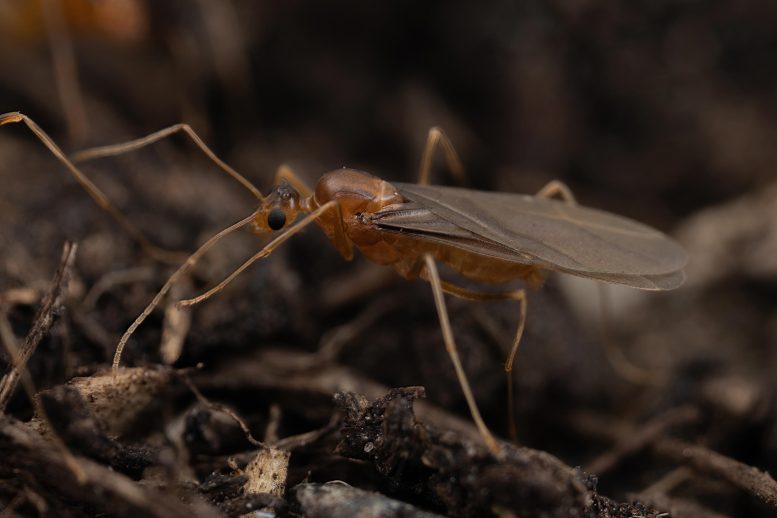
    Male Yellow Crazy Ant in Wild
    International researchers studying the yellow crazy ant, or Anoplolepis gracilipes, found that male ants of this species are chimeras, containing two genomes from different parent cells within their bodies. This unique reproductive process, originating from a single fertilized egg that undergoes separate maternal and paternal nuclear division, is unprecedented and challenges the fundamental biological inheritance law stating that all cells of an individual should contain the same genome. Credit: Hugo Darras

    Male yellow crazy ants exhibit a unique characteristic of possessing two distinct genomes, each contained within separate cell clusters.

    The yellow crazy ant, known scientifically as Anoplolepis gracilipes, is notorious for being one of the most devastating invasive species globally. Despite this, an international team of researchers is not interested in its destructive capabilities. Their study, instead, is centered on its unique reproduction process, as the male counterparts of this ant species have long puzzled the scientific community.

    “The results of previous genetic analyses of the yellow crazy ant have shown that the males of this species have two copies of each chromosome. This was highly unexpected, as males usually develop from unfertilized eggs in ants, bees, and wasps – and thus should only have one maternal copy of each chromosome,” explained Dr. Hugo Darras, Assistant Professor at Johannes Gutenberg University Mainz (JGU) and lead author of the corresponding article recently published in Science.

    “With this in view, we decided to investigate this puzzling phenomenon with subsequent experiments.”
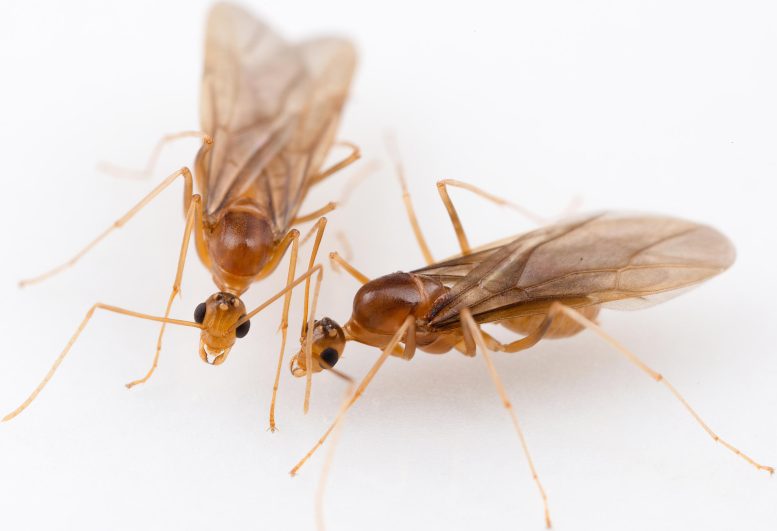
    Two Male Yellow Crazy Ants
    Two male yellow crazy ants (Anoplolepis gracilipes). Credit: Hugo Darras

    Two Genomes in Different Cell Clusters

    The results were quite extraordinary. It had been assumed to date that the males of the yellow crazy ant carried the same two sets of chromosomes in all cells of their body. However, the team was able to demonstrate that this premise was anything but correct.

    “We discovered that the male ants have maternal and paternal genomes in different cells of their body and are thus chimeras. To put it another way, all males have two genomes, but each cell of their bodies contains only one or the other of the two genomes,” summarized Darras.

    Normally, in a multicellular life form – be this a human, a dog, or a bat – all cells contain identical genetic material.
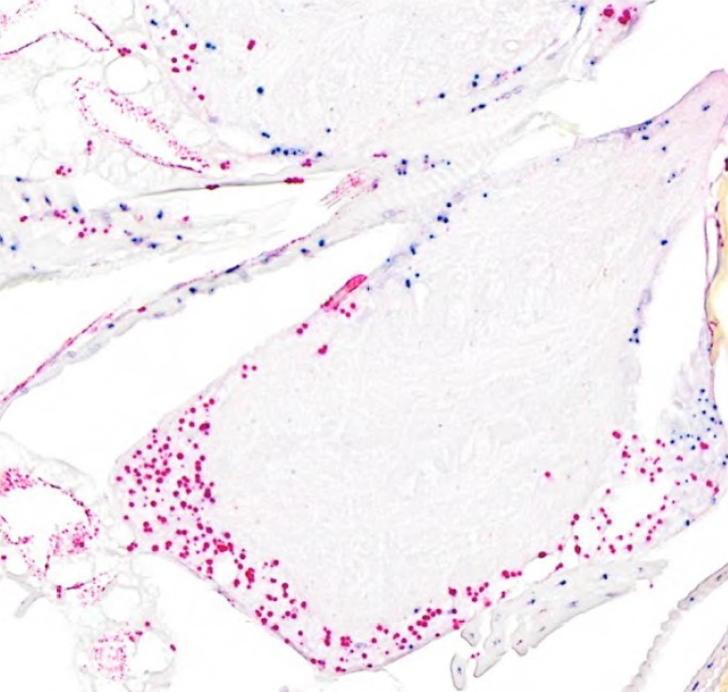
    Longitudinal Section of the Brain of a Chimeric Male Yellow Crazy Ant
    A longitudinal section of the brain of a chimeric male yellow crazy ant with maternal (pink) and paternal (blue) genomes in situ hybridization: The male tissue consists of large cell clusters carrying only maternal or paternal genomes. Credit: Hugo Darras

    The research team concludes that male yellow crazy ants are chimeras: they develop from fertilized eggs in which the two parental gametes do not actually fuse. Instead, the maternal and paternal nuclei divide separately within the same egg, meaning that the resultant adult males have both parental DNA sequences but in different body cells.

    When the gametes do fuse, either a queen or a worker develops from the egg, depending on the genetic information carried by the sperm. It is yet unknown what mechanisms determine whether fusion of the parental gametes takes place or not.

    Chimerism and the Yellow Crazy Ant: A Mode of Reproduction Previously Unknown to Science

    Chimeras are individuals whose cells contain different genetic materials. They naturally occur in certain species, such as corals and angler fish, in which separate individuals can merge to become one. Chimerism can also be found in humans and other placenta mammals. During gestation, mother and fetus can exchange a small number of cells so the offspring usually has a few cells that contain the same genetic material as the mother. Such small-scale exchanges also occur between twins in the womb.
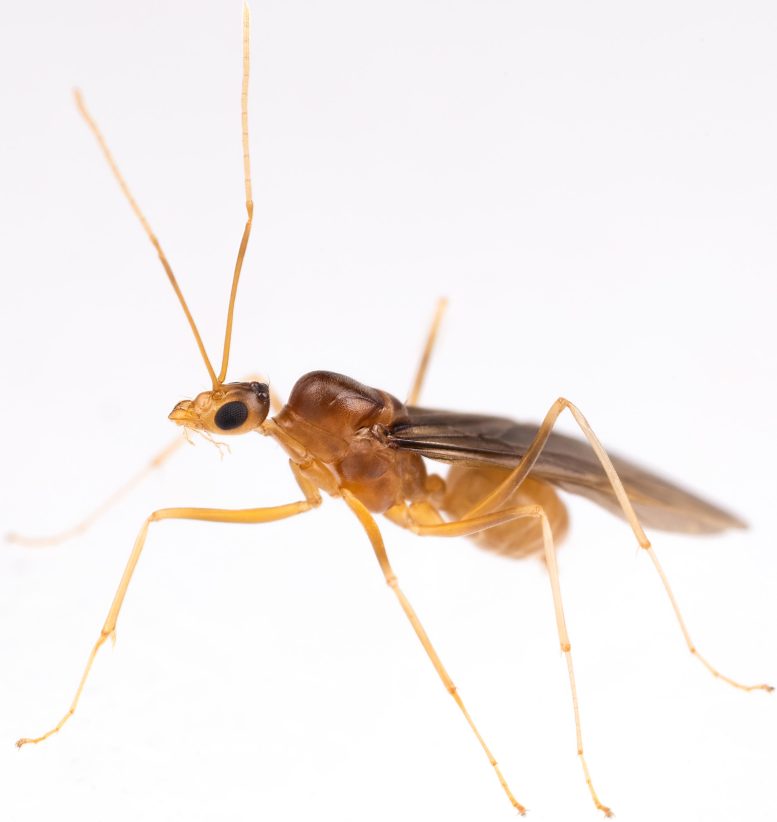
    Male Yellow Crazy Ant
    A male yellow crazy ant (Anoplolepis gracilipes). Credit: Hugo Darras

    “In contrast to these known cases, chimerism in the yellow crazy ant does not result from the fusion of two separate individuals or an exchange of cells between them. Instead, this process has its origin within a single fertilized egg. This is unique,” concluded Darras.

    Hence, the development of the male yellow crazy ant appears to contravene one of the fundamental laws of biological inheritance in which all cells of an individual should contain the same genome.

    Reference: “Obligate chimerism in male yellow crazy ants” by H. Darras, C. Berney, S. Hasin, J. Drescher, H. Feldhaar and L. Keller, 6 April 2023, Science.
    DOI: 10.1126/science.adf0419

    Never miss a breakthrough: Join the SciTechDaily newsletter.
    Follow us on Google and Google News.

    Ants Genetics Insect Johannes Gutenberg University Mainz Popular
    Share. Facebook Twitter Pinterest LinkedIn Email Reddit

    Related Articles

    Meet the Ants That Can Perform Surgery to Save Lives

    Unveiling the Dawn of Complex Life: How a Simple Creature Set the Stage for Human Evolution

    Genetic Thieves: New Research Reveals How Parasites Hijack Host Behavior With Stolen DNA

    Scientists Discover Genetic Secret of Virgin Birth

    Scientists Sound the Alarm on Emerging Tick-Borne Disease Babesiosis

    How Ants Took Over the World

    Ant Responses to Social Isolation Surprisingly Resemble Those of Humans

    Aphid-Like Insects Stole DNA From Plants – Gene Shields Them From Leaf Toxins

    Record-Breaking Evolutionary Innovation: Powerful, Deadly, Ultrafast Bite of a Trap-Jaw Ant

    1 Comment

    1. Tony Palmer. on June 10, 2023 9:46 pm

      A very interesting article on ‘Hell ant fossils.’ I’m interested in all scientific articles on insects past and present.

      Reply
    Leave A Reply Cancel Reply

    • Facebook
    • Twitter
    • Pinterest
    • YouTube

    Don't Miss a Discovery

    Subscribe for the Latest in Science & Tech!

    Trending News

    Breakthrough Bowel Cancer Trial Leaves Patients Cancer-Free for Nearly 3 Years

    Natural Compound Shows Powerful Potential Against Rheumatoid Arthritis

    100,000-Year-Old Neanderthal Fossils in Poland Reveal Unexpected Genetic Connections

    Simple “Gut Reset” May Prevent Weight Gain After Ozempic or Wegovy

    2.8 Days to Disaster: Scientists Warn Low Earth Orbit Could Suddenly Collapse

    Common Food Compound Shows Surprising Power Against Superbugs

    5 Simple Ways To Remember More and Forget Less

    The Atomic Gap That Could Cost the Semiconductor Industry Billions

    Follow SciTechDaily
    • Facebook
    • Twitter
    • YouTube
    • Pinterest
    • Newsletter
    • RSS
    SciTech News
    • Biology News
    • Chemistry News
    • Earth News
    • Health News
    • Physics News
    • Science News
    • Space News
    • Technology News
    Recent Posts
    • Total Solar Eclipse Made Cities Go Eerily Quiet Beneath the Surface
    • This Common Plant Could Be an Unexpected New Source of Protein
    • Birds in Cities Fear Women More Than Men and Scientists Don’t Know Why
    • Scientists Warn That This Common Pet Fish Can Wreck Entire Ecosystems
    • Scientists Just Made Carbon Capture Much Cheaper and Easier
    Copyright © 1998 - 2026 SciTechDaily. All Rights Reserved.
    • Science News
    • About
    • Contact
    • Editorial Board
    • Privacy Policy
    • Terms of Use

    Type above and press Enter to search. Press Esc to cancel.