
Close Menu
    Facebook X (Twitter) Instagram
    SciTechDaily
    • Biology
    • Chemistry
    • Earth
    • Health
    • Physics
    • Science
    • Space
    • Technology
    Facebook X (Twitter) Pinterest YouTube RSS
    SciTechDaily
    Home»Earth»Riding the Atmospheric Rivers: Satellite Evidence of Record Water Gains in California
    Earth

    Riding the Atmospheric Rivers: Satellite Evidence of Record Water Gains in California

    By Jet Propulsion LaboratoryJune 10, 20231 Comment4 Mins Read
    Facebook Twitter Pinterest Telegram LinkedIn WhatsApp Email Reddit
    Share
    Facebook Twitter LinkedIn Pinterest Telegram Email Reddit
    California Water Gains After Record Winter
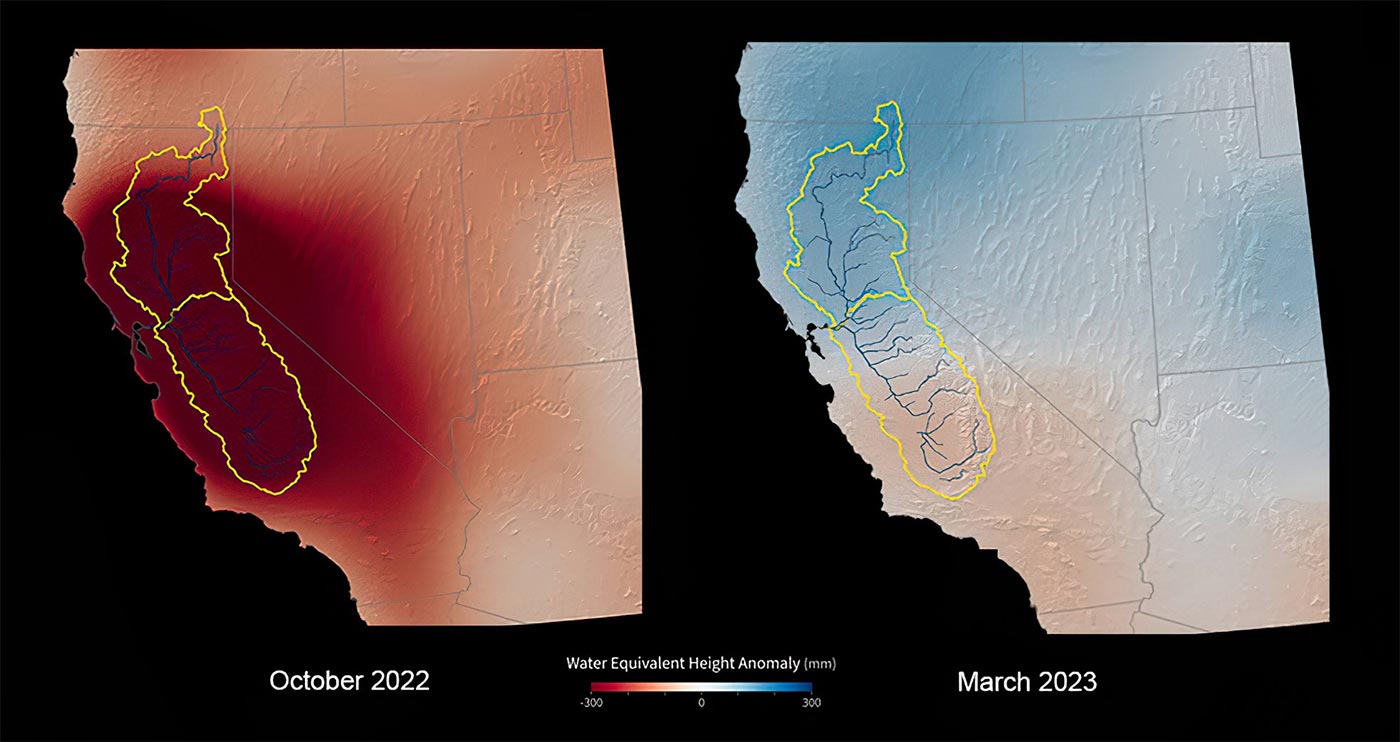
    Thanks to a wet winter, California saw tremendous gains in the amount of water in the San Joaquin, Sacramento, and Tulare river basins (outlined in yellow) from October 2022 to March 2023, GRACE-FO data shows. The measurement includes water in lakes, rivers, reservoirs, snowpack, and groundwater aquifers. Credit: NASA’s Scientific Visualization Studio

    Early data shows the greatest net gain of water over the winter in nearly 22 years, but the state’s groundwater levels still suffer from the effects of years of drought.

    After years of intense drought and diminishing groundwater, California just saw its greatest year-over-year water gains in two decades, according to data from the GRACE-FO (Gravity Recovery and Climate Experiment Follow-On) satellite mission, a partnership between NASA and the German Research Centre for Geosciences (GFZ). This past winter’s bonanza of atmospheric rivers alleviated some of the water deficit that the state incurred during periods of drought over the last 10 years, which included the three driest years on record in California.


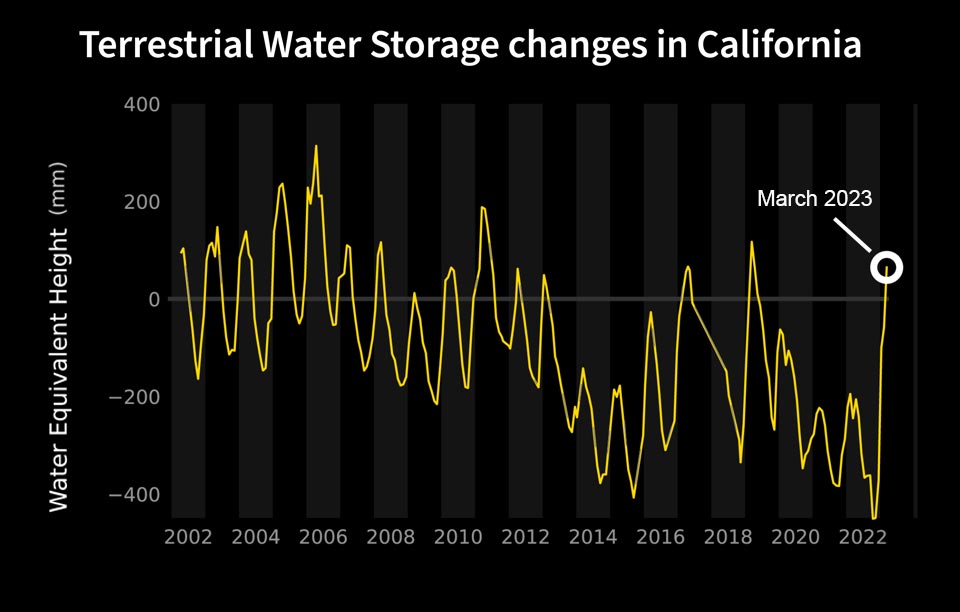
    This animation shows changes in the total amount of water within the California region outlined in yellow – including the Sacramento, San Joaquin, and Tulare river basins – from 2002 to 2023. The zero line on the graph represents the average amount of water in the region from 2004 to 2010. Credit: NASA’s Scientific Visualization Studio

    Think of the state’s Central Valley region (outlined in yellow, above) as a giant swimming pool: GRACE-FO measurements include all the water contained in the lakes, rivers, soil, snowpack, and underground aquifers within that region. Between October 2022 and March 2023, storms provided enough water to raise the amount of water within the “swimming pool” by about 20 inches (about 500 millimeters). That’s about twice as much as the average winter water gain since satellite-based water storage measurements began in 2002 with the first GRACE mission.

    While surface water basins are filling, underground stores of fresh water (aquifers) that are tapped for irrigation and other needs could take years to fully recharge. “One good winter of rain and snow won’t make up for years of extreme drought and extensive groundwater use,” said Felix Landerer, GRACE-FO project scientist at NASA’s Jet Propulsion Laboratory in Southern California. The GRACE-FO team will continue to track how California’s water storage evolves through the summer after the snowpack melts and water levels in the state’s lakes, rivers, and reservoirs start to recede during drier weather.
    Water Storage Changes in California Chart
    The line graph shows seasonal changes in the total amount of water contained in California’s lakes, rivers, reservoirs, snowpack, and groundwater from 2002 to 2023. (The data gap from late 2017 to early 2018 coincides with the decommissioning of the GRACE mission and the launch of its successor, GRACE-FO.) Credit: NASA’s Scientific Visualization Studio

    The observations were made possible through the unique sensing approach taken by both GRACE missions. As water moves around – in the form of ocean currents, falling rain, shifting groundwater, ice, and so on – it alters the planet’s mass near the surface, which changes Earth’s gravitational pull ever so slightly. GRACE-FO measures these subtle changes, enabling researchers to estimate changes in the total volume of water in an area.

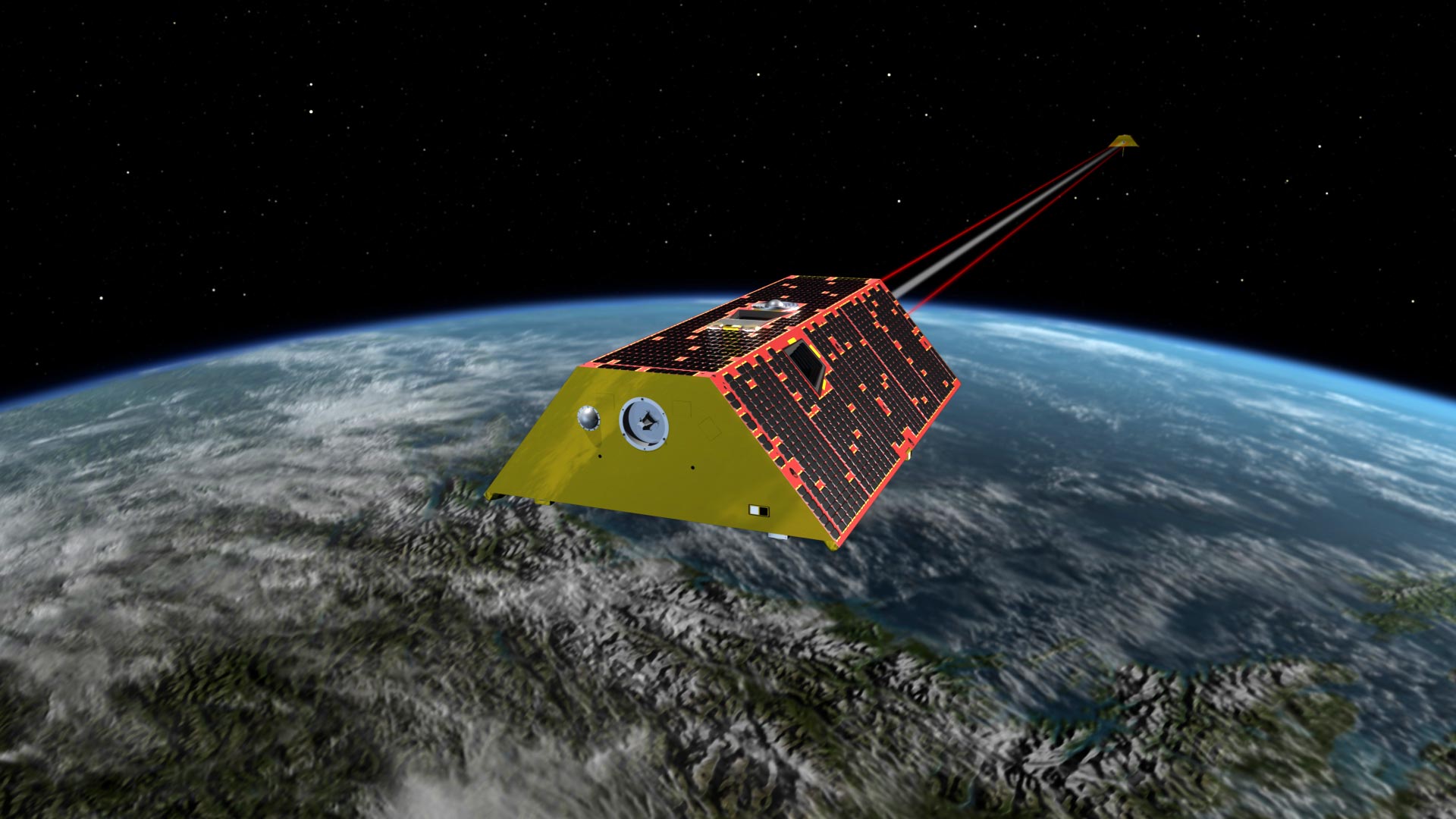
    Like its predecessor, the GRACE-FO mission consists of two identical satellites that fly one behind the other. As the lead satellite flies over an area with greater mass – such as an area with more water than another region – the slight change in gravity tugs it forward, increasing the distance between the two satellites. Microwave and laser instruments aboard the spacecraft precisely measure the minute distance changes between the two, revealing details about the overall mass of water that caused those changes.
    GRACE-FO in Orbit
    Illustration of GRACE-FO in orbit. Credit: NASA/JPL-Caltech

    More About the Mission

    GRACE (2002-2017) was a joint partnership between NASA and the German Aerospace Center, Deutsches Zentrum für Luft- und Raumfahrt (DLR). JPL managed the GRACE mission and manages the GRACE-FO mission for NASA’s Earth Science Division in the Science Mission Directorate in Washington. GRACE-FO is a collaboration between NASA and GFZ. Caltech in Pasadena, California, manages JPL for NASA.

    Never miss a breakthrough: Join the SciTechDaily newsletter.
    Follow us on Google and Google News.

    Drought GRACE-FO JPL NASA Water
    Share. Facebook Twitter Pinterest LinkedIn Email Reddit

    Related Articles

    NASA’s OPERA: Revolutionizing Earth Observation Through Satellite Synergy

    Lake Powell – The Second Largest Reservoir in the United States – Reaches New Low

    Lake Mead – The Largest Reservoir in the United States – Drops to a Record Low

    California Reservoirs Reflect Deepening Drought – Worst They Have Been Since the 1970s

    17 Years of Gravity Observations Show How Earth’s Water Cycle Is Ramping Up As Climate Warms

    Dwindling Water Sources in Mexico: Nearly 85 Percent of the Country Is Experiencing Drought

    New NASA Research Projects Probe COVID-19 Impacts on Environment, Food & Water Supply

    California Valley Land Continues to Sink

    GRACE Data Spreads Awareness of Groundwater Levels

    1 Comment

    1. Clyde Spencer on June 10, 2023 10:57 am

      “Think of the state’s Central Valley region (outlined in yellow, above) as a giant swimming pool:”

      Why? Is the concept of a ‘hydrologic basin’ expecting too much from readers of this website?

      Reply
    Leave A Reply Cancel Reply

    • Facebook
    • Twitter
    • Pinterest
    • YouTube

    Don't Miss a Discovery

    Subscribe for the Latest in Science & Tech!

    Trending News

    Artificial Sweeteners May Harm Future Generations, Study Suggests

    Splashdown! NASA Artemis II Returns From Record-Breaking Moon Mission

    What If Consciousness Exists Beyond Your Brain

    Scientists Finally Crack the 100-Million-Year Evolutionary Mystery of Squid and Cuttlefish

    Beyond “Safe Levels”: Study Challenges What We Know About Pesticides and Cancer

    Researchers Have Found a Dietary Compound That Increases Longevity

    Scientists Baffled by Bizarre “Living Fossil” From 275 Million Years Ago

    Your IQ at 23 Could Predict Your Wealth at 27, Study Finds

    Follow SciTechDaily
    • Facebook
    • Twitter
    • YouTube
    • Pinterest
    • Newsletter
    • RSS
    SciTech News
    • Biology News
    • Chemistry News
    • Earth News
    • Health News
    • Physics News
    • Science News
    • Space News
    • Technology News
    Recent Posts
    • What if Dark Matter Has Two Forms? Bold New Hypothesis Could Explain a Cosmic Mystery
    • Researchers Expose Hidden Chemistry of “Ore-Forming” Elements in Biology
    • Geologists Reveal the Americas Collided Earlier Than We Thought
    • 20x Difference: Study Reveals True Source of Airborne Microplastics
    • Scientists Uncover Hidden Force Powering Yellowstone’s Supervolcano
    Copyright © 1998 - 2026 SciTechDaily. All Rights Reserved.
    • Science News
    • About
    • Contact
    • Editorial Board
    • Privacy Policy
    • Terms of Use

    Type above and press Enter to search. Press Esc to cancel.