
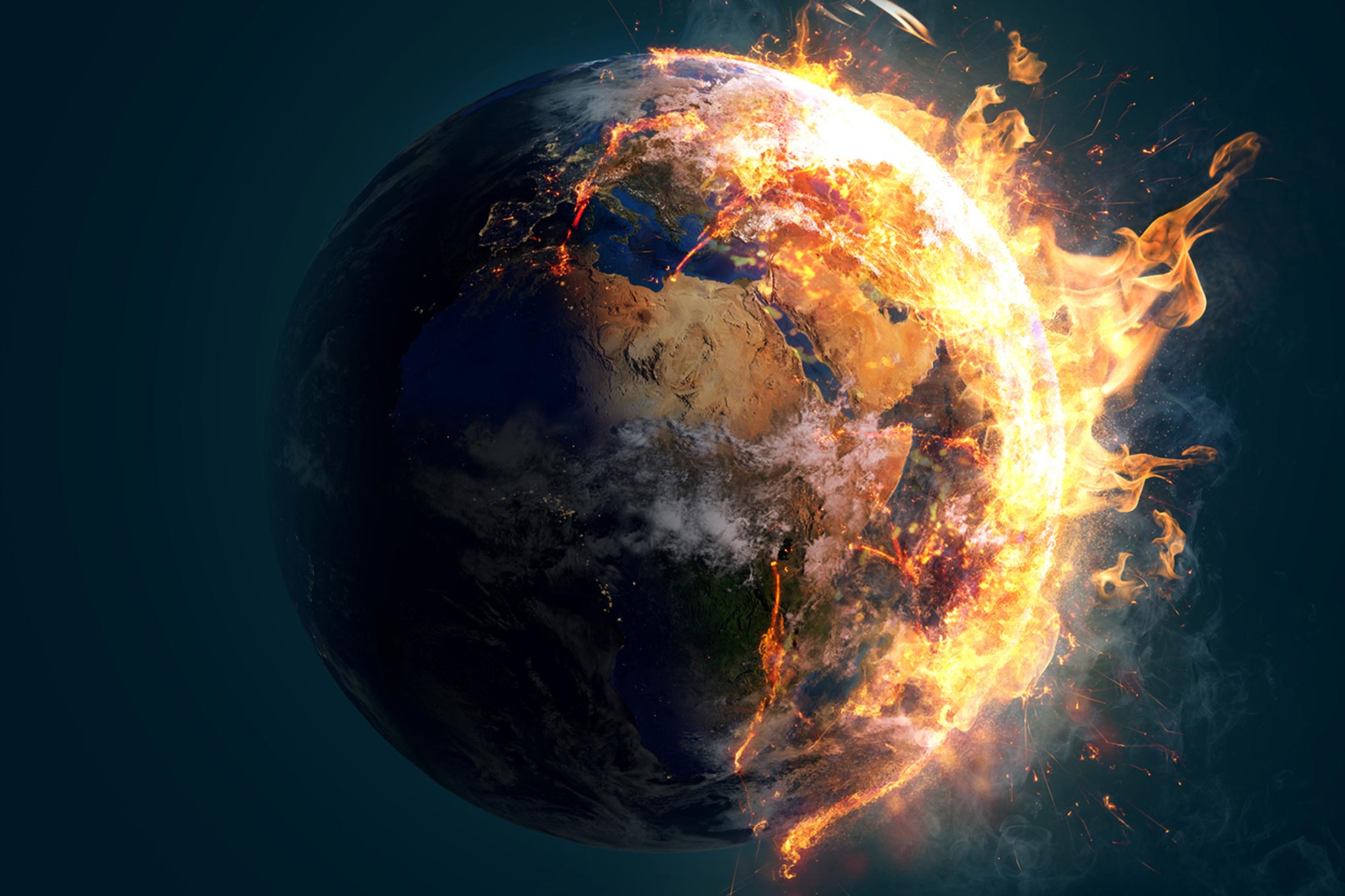
New long-term climate modeling reveals that extreme heatwaves will keep worsening for centuries if global net zero is delayed.
The research shows that even after emissions stop rising, many regions will not return to pre-industrial heat levels for at least 1,000 years.
Heatwaves Intensify as Net Zero Timelines Drift Later
New climate research warns that extremely hot and long-lasting heatwaves will become increasingly common if progress toward net zero carbon emissions continues to slow. The findings show that the severity of these events grows the longer the world waits to reach net zero.
Published in Environmental Research: Climate, the study draws on advanced climate modelling carried out by the ARC Centre of Excellence for 21st Century Weather and CSIRO. Using powerful supercomputers, the research team examined how heatwaves could evolve during the 1,000 years following the point when global emissions finally reach net zero.
Simulations Reveal the Impact of Delaying Net Zero
To explore how timing affects future conditions, the scientists tested a series of net zero years between 2030 and 2060. They then compared how heatwaves change with each additional five-year delay.
According to University of Melbourne researcher Dr. Andrew King, who co-authored the study, every scenario showed the same pattern. As net zero is pushed further into the future, extreme heatwave events that were once rare begin to occur far more often.
“This is particularly problematic for countries nearer the equator, which are generally more vulnerable, and where a heatwave event that breaks current historical records can be expected at least once every year or more often if net zero is delayed until 2050 or later,” Dr. King said.
Severe Heatwaves Continue Long After Emissions Peak
The results show that heatwaves become hotter, last longer, and strike more frequently the later global emissions are brought to zero. The researchers also found that long-term warming in the Southern Ocean could continue to worsen heatwaves even after net zero has been achieved.
Across all 1,000-year simulations, the team observed no meaningful decline in extreme heat events. Instead, heatwaves remained above preindustrial levels for at least a millennium. In certain regions, when net zero occurs in 2050 or later, heatwaves grew even more intense as the centuries progressed.
Net Zero Will Not Bring Immediate Relief
Lead author Professor Sarah Perkins-Kirkpatrick of the Australian National University said the results challenge the assumption that climate conditions will begin to improve for future generations once net zero is reached.
“While our results are alarming, they provide a vital glimpse of the future, allowing effective and permanent adaptation measures to be planned and implemented,” Professor Perkins-Kirkpatrick said.
“It is still vitally important we make rapid progress to permanent net zero, and reaching global net zero by 2040 at the latest will be important to minimise the heatwaves severity.”
Urgent Need for Adaptation and Rapid Emissions Cuts
Dr. King said the findings highlight the need for both immediate emissions reductions and large-scale planning to protect communities from escalating extreme heat.
“Investment in public infrastructure, housing, and health services to keep people cool and healthy during extreme heat will very likely look quite different in terms of scale, cost and the resources required under earlier versus later net zero stabilisation. This adaptation process is going to be the work of centuries, not decades,” Dr. King said.
Reference: “Heatwaves in a net zero World” by Sarah Perkins-Kirkpatrick, Lucinda Palmer, Andrew King and Tilo Ziehn, 17 November 2025, Environmental Research: Climate.
DOI: 10.1088/2752-5295/ae0ea4
Never miss a breakthrough: Join the SciTechDaily newsletter.
Follow us on Google and Google News.
6 Comments
“Using powerful supercomputers,” — Garbage in, garbage out. It is the computer program being run that determines whether the results are applicable.
Once again, the only thing that the word “could” means is, a low-probability event that is judged not impossible. But the authors don’t give the probability and margin of error!
They are using the SSP5-8.5 CO2 emissions scenario, which most researchers are now aware is improbable because there aren’t sufficient resources to continue ‘business as usual’ long-term.
“Heatwaves, defined as prolonged periods of excessive heat, have increased in their frequency, intensity, and duration virtually everywhere in the world since at least the 1950s (Perkins-Kirkpatrick and Lewis 2020).” Just because there is one study that reaches that conclusion, it does not mean that the results can be replicated or that someone else would come to the same conclusion. See https://wattsupwiththat.com/2019/09/06/the-gestalt-of-heat-waves/
“This is particularly problematic for countries nearer the equator, which are generally more vulnerable, and where a heatwave event that breaks current historical records can be expected at least once every year or more often if net zero is delayed until 2050 or later,”
An unanswered question is whether the tropics will reach the claimed temperatures, or whether emergent weather phenomena will suppress the warming. There are reasons be believe that is exactly why the polar regions are warming faster today than the tropics. Geologic history also suggests that while it was warm enough in the past (Cretaceous) for cold-blooded dinosaurs and reptiles to survive at the North Pole, the equatorial regions didn’t become uninhabitable for the same reason as today.
“Investment in public infrastructure, housing, and health services to keep people cool and healthy during extreme heat will very likely look quite different in terms of scale, cost and the resources required under earlier versus later net zero stabilisation.”
The major obstacle will be cost as the cost of so-called ‘renewable’ energy sources have driven energy costs up. However, when the problem of economical thermonuclear fusion is solved, the needed investment will become affordable. It will only take years, not decades, and certainly not centuries, to build the new infrastructure should the worst-case scenario of the authors’ vision actually take place, which itself, in my judgement, is unlikely, considering how much human societies have changed in the last two hundred years, and the rate of change is accelerating. Even the members of ‘uncontacted’ Amazonian tribes are photographed wearing T-shirts made in China!
You’re presuming these Springer Publishing climate articles are earnest. They are not.
By most of these computer models of theirs, we were already supposed to be long dead.
So, I figure we’re gonna do just fine, no matter what crap they throw at us.
What a load!!🤣😂🤣
“We gotta hit net zero or the world is going to overheat and melt under our feet!” is a meaningless argument. We either do it or we don’t. “We don’t” is the odds on favorite. I’ll believe there is a crisis here when people start working on dealing with the crisis that cannot be stopped with any realistic measures. So far all I see is an attempt to make people dance to some megalomaniacs’ tunes. Scroom.
{^_^}
Let’s keep it simple:
1) CO2 is a greenhouse gas.
2)Atmospheric CO2 has increased from the pitiful 270ppm or thereabouts to the pitififul 450ppm in a pitifully short geological time of 283 years since 1742 , being when ironmaster Joe Derby used coking coal to smelt iron at Ironbridge to build the iron bridge at Ironbridge, that being the start of the Industrial Revolution.
3) There is a nice graph somewhere that purports to show that the greenhouse effect of CO2 diminishes as CO2 increase in concentration and it would appear to be some log relationship. However what I have seen of said graph is that that effect doesn’t kick in helpfully until global climate has warmed up by about 2 degrees Centigrade, which is going to change how we humans get on with each other as we all want cars , lotsa luverly energy to watch crappy TV shows, big fancy houses with aircons and to be able to drop bombs on each other (and bombs require a massive arms industry)-
I don’t care whether the globe heats up by 2 degree C in the next 5 years, or tomorrow, or in 1000 years time, as I won’t be here for much longer, but am a trifle annoyed as I have descendants who of are a bit more than average intelligence and they have been well brought up. But whatever, things will get warmer, but by how much and when is a matter for conjecture, and that will have a world-wide social humanitarian impact.