
Close Menu
    Facebook X (Twitter) Instagram
    SciTechDaily
    • Biology
    • Chemistry
    • Earth
    • Health
    • Physics
    • Science
    • Space
    • Technology
    Facebook X (Twitter) Pinterest YouTube RSS
    SciTechDaily
    Home»Space»The Destructive Results of a Mighty Supernova Explosion
    Space

    The Destructive Results of a Mighty Supernova Explosion

    By NASAAugust 21, 2014No Comments2 Mins Read
    Facebook Twitter Pinterest Telegram LinkedIn WhatsApp Email Reddit
    Share
    Facebook Twitter LinkedIn Pinterest Telegram Email Reddit
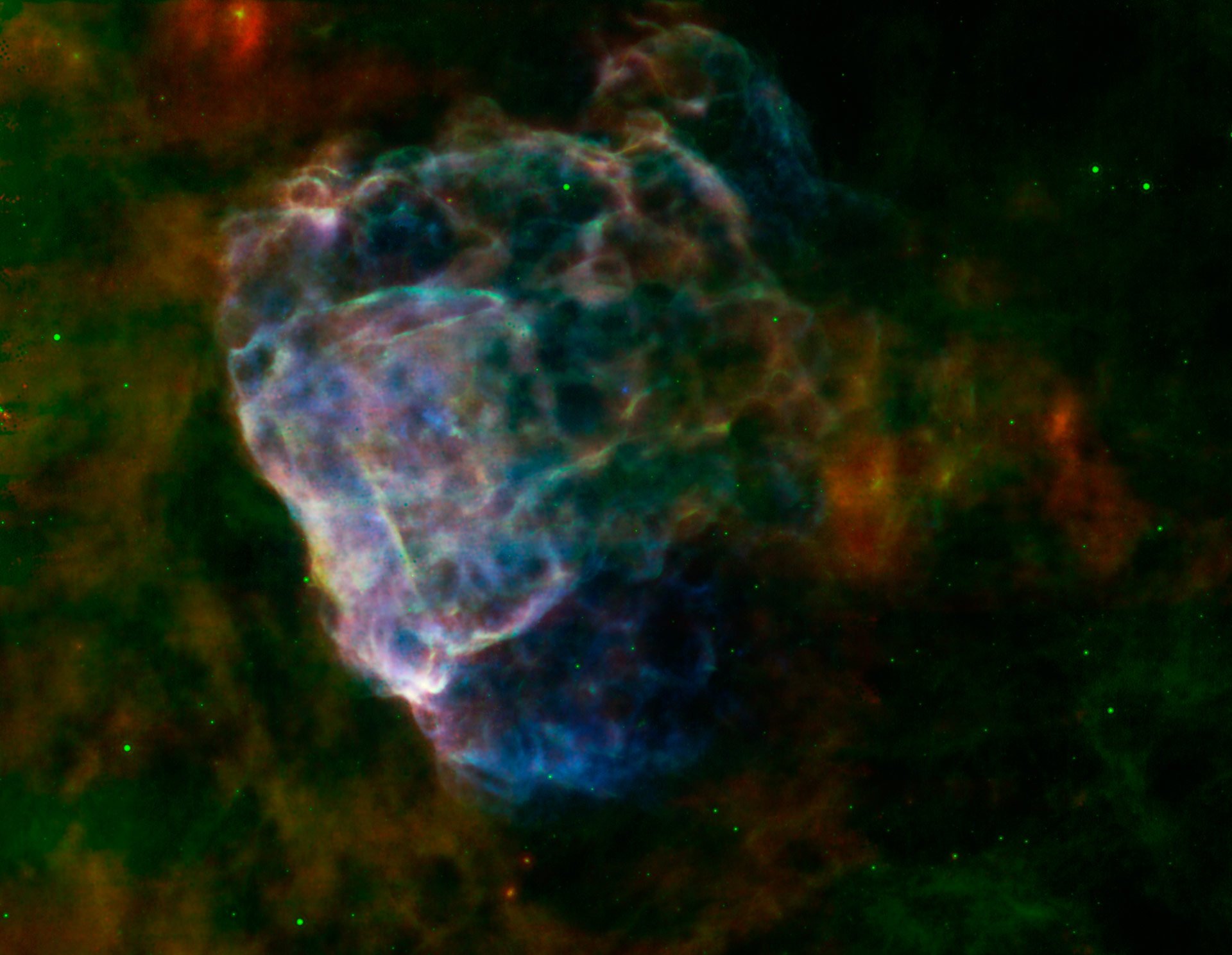
    Chandra Views Puppis A
    The bubbly cloud is a shock wave caused by a supernova witnessed 3,700 years ago from Earth. Known as Puppis A, it’s located 7,000 light-years away, with the shock wave spanning 10 light-years. Credit: NASA/ESA/JPL-Caltech/GSFC/IAFE

    This composite image shows the remnant of a supernova that would have been witnessed on Earth 3,700 years ago.

    This image from the Chandra X-Ray Observatory, NASA’s Spitzer Space Telescope, and the European Space Agency’s XMM-Newton reveals the destructive results of a mighty supernova explosion in a delicate blend of infrared and X-ray light.

    The bubbly cloud is an irregular shock wave, generated by a supernova that would have been witnessed on Earth 3,700 years ago. The remnant itself, called Puppis A, is around 7,000 light-years away, and the shock wave is about 10 light-years across.

    The pastel hues in this image reveal that the infrared and X-ray structures trace each other closely. Warm dust particles are responsible for most of the infrared light wavelengths, assigned red and green colors in this view. Material heated by the supernova’s shock wave emits X-rays, which are colored blue. Regions where the infrared and X-ray emissions blend together take on brighter, more pastel tones.

    The shock wave appears to light up as it slams into surrounding clouds of dust and gas that fill the interstellar space in this region.

    From the infrared glow, astronomers have found a total quantity of dust in the region equal to about a quarter of the mass of our sun. Data collected from Spitzer’s infrared spectrograph reveal how the shock wave is breaking apart the fragile dust grains that fill the surrounding space.

    Supernova explosions forge the heavy elements that can provide the raw material from which future generations of stars and planets will form. Studying how supernova remnants expand into the galaxy and interact with other materials provides critical clues into our own origins.

    Infrared data from Spitzer’s multiband imaging photometer (MIPS) at wavelengths of 24 and 70 microns are rendered in green and red. X-ray data from XMM-Newton spanning an energy range of 0.3 to 8 kiloelectron volts are shown in blue.

    Never miss a breakthrough: Join the SciTechDaily newsletter.
    Follow us on Google and Google News.

    Astronomy Chandra X-ray Observatory Spitzer Space Telescope Supernova XMM-Newton
    Share. Facebook Twitter Pinterest LinkedIn Email Reddit

    Related Articles

    A Cosmic Powder Keg: When a Stable Star Explodes

    3D Viewer Offers a New Look at Cassiopeia A

    NASA Data Suggests Black Holes Abundant Among the Earliest Stars

    New Image of SN 1006 Provides New Details About the Remains of an Exploded Star

    Diagnosing the X-Ray Variability in Active Galaxy NGC 4507

    Astronomers Detect X-rays From the Remains of Supernova SN 1957D

    In McNeil’s Nebula, Protostar V1647 Ori Flaunts its X-ray Spots

    Supernova Shock Wave Breaks Through a Cocoon of Gas

    Spacecraft to Explore Supermassive Black Holes at Center of Galaxies

    Leave A Reply Cancel Reply

    • Facebook
    • Twitter
    • Pinterest
    • YouTube

    Don't Miss a Discovery

    Subscribe for the Latest in Science & Tech!

    Trending News

    Massive Study Warns Marijuana Use in Teens Is Linked to Serious Mental Illness

    Scientists Discover a Completely Unexpected Way T Cells Kill Cancer

    Scientists Just Found the Solar System’s Original “Planet Factory”

    Study Warns Widely Used Food Preservatives Linked to High Blood Pressure and Heart Disease

    New Treatment Could Reverse Osteoarthritis Within Weeks

    Physicists Have Measured “Negative Time” in Bizarre Quantum Experiment

    The Deadly Tapeworm Spreading Across America Has Reached the Pacific Northwest

    Could Low Vitamin D Be Making Your Pain Worse?

    Follow SciTechDaily
    • Facebook
    • Twitter
    • YouTube
    • Pinterest
    • Newsletter
    • RSS
    SciTech News
    • Biology News
    • Chemistry News
    • Earth News
    • Health News
    • Physics News
    • Science News
    • Space News
    • Technology News
    Recent Posts
    • Scientists Discover Mysterious Creature Living in the Great Salt Lake – and It Exists Nowhere Else on Earth
    • It’s Alive? Surprising Discovery Changes What We Know About Fog
    • Simple Family Routines May Be the Secret to a Smoother Start at School
    • Brain Study Overturns Long-Held Beliefs About How Humans Learn Speech
    • Ancient Goose Fossil Challenges Long-Held Theories About New Zealand Birds
    Copyright © 1998 - 2026 SciTechDaily. All Rights Reserved.
    • Science News
    • About
    • Contact
    • Editorial Board
    • Privacy Policy
    • Terms of Use

    Type above and press Enter to search. Press Esc to cancel.